Probe blames arson for Cape fires
|Published
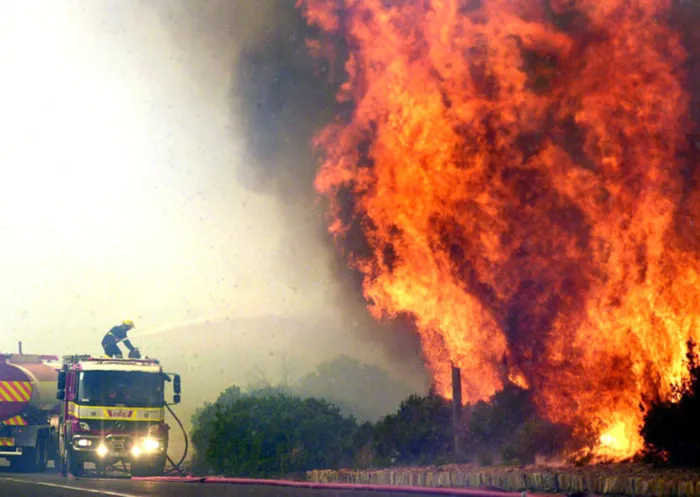
Fee bearing image Cape Town 150302 Fire fighters battle flames burning on Chapman s Peak. A runaway fire burns for three days from Muizenberg to Hout Bay. Reporter: Melanie Gosling. Photographer: Armand Hough Fee bearing image Cape Town 150302 Fire fighters battle flames burning on Chapman s Peak. A runaway fire burns for three days from Muizenberg to Hout Bay. Reporter: Melanie Gosling. Photographer: Armand Hough
Cape Town - Arson was the cause of two of the three massive fires that ravaged the South Peninsula for five days in March, estimated to have cost the City of Cape Town R50 million in emergency services and other costs.
The findings of an independent investigation by forensic expert Dr David Klatzow have revealed that the fires in Clovelly and Scarborough were started deliberately, said J P Smith, mayoral committee member for safety and security, at Thursday’s portfolio committee. “Based on witness statements and physical evidence – including containers filled with fuel – someone started these fires on purpose.”
However, the main fire that started in Muizenberg and spread to Ou Kaapseweg, Chapman’s Peak and Tokai – while caused by “human hand” – was not started maliciously, Klatzow found.
This outcome supports the finding of wildfire investigator Rob Erasmus, appointed by South African National Parks (SanParks), who said the Muizenberg blaze was caused by an accident, negligent act.
Erasmus did not investigate the Clovelly and Scarborough incidents, but Smith said Klatzow had spoken to several witness who saw people starting fires in these areas. “There was clearly an intentional arson element,” said Smith.
One resident reportedly saw a group of people carrying torches and setting fires, Klatzow said. When fires went out, this group then reignited them.
At this stage it was difficult to say whether the motive was political, fuelled by some “local issue” or just started by someone with some psychological issue, Smith added.
Klatzow’s report will be handed to the SAPS for further investigation. “We need to lay charges of arson,” said Smith.
Smith said the area around the caves above St James was used by homeless people, frequented by hikers and also a popular spot for religious groups. One of these activities or users seems to have caused the fire, he said.
According to Klatzow’s findings, which were released in a statement by the city on Thursday afternoon, the main fire started on the crest of Pecks Valley.
“I observed a shelter of sorts with signs of human habitation. There was a partially burned blanket, together with clear signs of fire-making and smoking material and two lighters. There is little doubt that the main fire which burned across to Hout Bay had its origin in or near this rock shelter and that its cause was human agency.”
Although Klatzow’s findings could not prove any malicious intent for this blaze, Smith said the city would meet with SanParks about the uncontrolled use of this area which was a potential hotspot for future fires.
Smith said the city would also raise concerns about resources and capacity to fight the increasing number of fires.
“The costs of the fires are only starting (to become apparent),” he said.
With a base cost of about R1m a day, the city is also looking at the additional costs of overtime, extra resources, replacement of signage and remedial measures on roads.
The cost is estimated to be between R30m and R50m for the 10-day period.
Meanwhile, Smith said the city’s fire fighting capacity would get a boost with an additional R16m on the budget for the next two financial years to buy seven new fire engines. There was also provision for additional staff on the operational budget.
In the report, city fire chief Ian Schnetler said the fire and rescue service “has been and still is understaffed in accordance with legislated national codes and practices”.
anel.lewis@inl.co.za
Cape Argus