

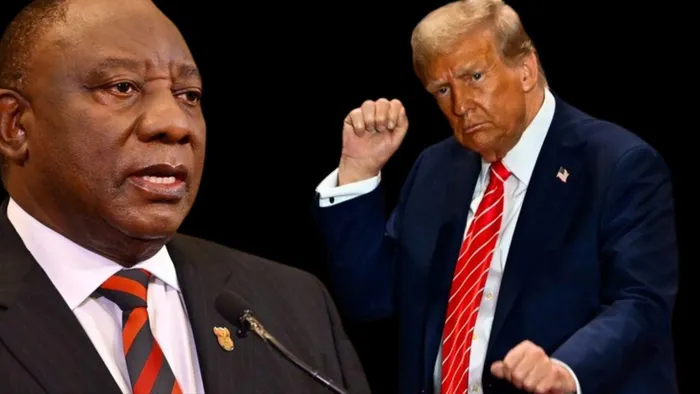
There are several complexities in the bilateral relations between Washington and Pretoria, the writer says.
Image: SihleMlambo/IOL
Bilateral relations between Washington and Pretoria have recently been marred with political drama. The Trump administration is also at odds with Pretoria’s prominent position in the International Court of Justice’s case against Israel, which stands accused of genocide in Gaza. The latest stunt from Washington has been the adoption of an order to take in Afrikaners under refugee status by the US, based on their supposed systemic racial persecution in the country.
The South African government reiterated its commitment to finding diplomatic solutions to any misunderstandings or disputes. I am confident that the Trump administration is well aware of the actual status and stance of Afrikaner people in this country, which is largely privileged.
Ramaphosa's meeting with Trump
This visit has less or nothing to do with the manufactured "white genocide" narrative. The Ministry in its statement reiterated South Africa's position as a constitutional democracy committed to respecting human rights, including human dignity and equality. Allegations of discrimination and persecution of white farmers have been proven to be baseless and unfounded. The narrative of "white genocide" has been incessantly rebuffed as a failed attempt of the centre-right to drum up support against many progressive policies and bills currently being debated in parliament to address inequality borne out of the legacy of Apartheid. These Bills include NHI, BELA Bill, and the Land Expropriation Bill.
Furthermore, Minister of Agriculture, John Steenhuisen, a DA leader of Afrikaner descent, has also echoed the same views that white genocide in SA exists as a figment of imagination in SA. While this is true, such attempts serve as evidence of how failure to address inequality in society can tarnish a country's reputation on a global stage. The extent to which privilege has continued to be a sole preserve of the white minority, even 30 years after the end of Apartheid, allows such machinations among sections of society who still see themselves as super-citizens over other sections of society within one country. As such, whether the Trump administration can be convinced there is no genocide is neither here nor there. However, the message that there is no Afrikaner genocide must be clarified; whether the message is received is something else.
Accompanied by Johan Rupert
Secondly, the issue of Ramaphosa's visit to the US and him being accompanied by Johan Rupert, SA's richest man, adds an interesting angle. This follows after the Trump administration expelled the SA ambassador to the US and continued threats of increased tariffs imposed on SA products. What does SA export to the US? Nothing but our precious minerals as raw materials. The question then becomes: Who owns the mines that mine & export these minerals? Johan Rupert.
Rupert’s visit signals very little to do with a meagre 49 self-described refugees who have "fled" to the US over "fears" of genocide. The reality is Johan Rupert has been and remains central in shaping the country’s politics at home and abroad. For example, it was Rupert who sponsored the ascension of Cyril Ramaphosa into the ANC's Presidency.
Will this meeting bear fruit?
Whether the meeting will bear fruit or not, I cannot say for certain. But this dialogue between the two parties is important. The SA government has and must continue to hold constructive dialogue and engagement with Washington for a number of reasons: the bilateral relationship has been under strain, as such this calls for a careful balancing act on the side of Pretoria. There is a need to deal with the matter carefully, particularly following the sanctions from the US in a number of areas including trade, health, defence, etc. Calling out the US loudly has cost the country particularly threats not to renew AGOA, the cessation of US development aid, and the dismantling of USAid operations in South Africa.
The reality is that there are numerous issues that have caused strain, including the Israel-Palestine conflict, BRICS expansion, and perceived alignment with Russia. And these differences may well be among the reasons behind Washington’s lash out against Pretoria. Bending over backwards also poses significant risks to the country’s sovereignty. The reality is that granting refugee status to a privileged minority from a democratic country in the absence of violence or even conflict undermines the legitimacy of the country’s democracy. The US needs to be reminded that South Africa is a sovereign constitutional democracy.
What we can draw as lessons from this debacle and, of course, from other countries who have also been sanctioned or threatened with sanctions is that our sovereignty (including food sovereignty) is our own responsibility. And no amount of diplomacy will appease imperialists.
Pretoria has a responsibility to engage and respond to the false claims and finally reaffirm the legitimacy of our constitutional order and the truth of our ongoing, if imperfect, transformation. It is increasingly important that the rest of the world is aware that the US government has got the wrong end of the stick.
It should not be forgotten that past US policies favoured the defunct apartheid regime, and today the Trump administration, with its latest order, undermines South Africa’s ongoing efforts to redress systemic inequality and the people that suffer due to systematic inequality in the country.
| Phungula is a researcher and lecturer at the University of KwaZulu-Natal's International and Public Affairs Department