

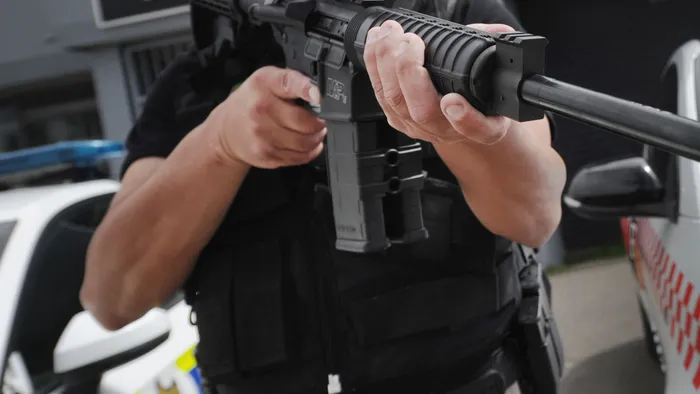
Amid a surge in executive kidnappings, South African CEOs are increasingly turning to private security firms for protection, adapting to sophisticated threats posed by organised crime syndicates.
Image: Armand Hough / Independent Newspapers
South African executives are increasingly turning to private security companies for tactical escorts and high-level protection as kidnappings and blue-light crimes surge, particularly in Gauteng.
Phangela Group, a private security provider, said that demand for tactical escort services in unmarked vehicles has reached record levels as business leaders adapt to more sophisticated threats.
“Executive threats are no longer opportunistic but coordinated,” said Chris Thornhill, CEO of Phangela Group.
“We’re seeing organised crime syndicates targeting business owners, directors, and high-net-worth individuals with increasing sophistication including impersonating police, using fake uniforms, and forcing mobile banking transfers under duress.”
Figures cited in recent reports show that kidnappings have more than doubled in five years, from 1 919 to 4 748 cases over a comparable three-month period. Gauteng recorded 2 499 of those incidents, followed by KwaZulu-Natal with 901 and the Western Cape with 275. Most are believed to be driven by ransom demands.
Chad Thomas, CEO of IRS Forensic Investigations, said there is growing demand for executive-level protection. “Monied individuals that can afford close protection and bulletproof vehicles are making more use of security companies that provide these tactical services,” he said.
“We are also noting that multi-national companies have engaged close protection for members of their C-Suite (the highest-level executive positions) in South Africa.”
Thomas added that the security landscape is complex, with some underworld actors also using private security firms for criminal purposes.
“Worryingly though, are the bad actors in the underworld who are also making use of security companies, ostensibly for close protection, but in reality to carry out extortion, settle disputes, and in extreme cases, to take out rivals.”
Both Thornhill and Thomas pointed to the growing use of police impersonation and cloned vehicles in such crimes. “There are cases dating back several years where criminals have impersonated police and traffic officials,” said Thomas.
“The most well-known was the so-called ‘Blue Light’ gang that targeted travellers arriving at OR Tambo International Airport.”
Thornhill said Phangela has responded by investing in intelligence-led operations, predictive analytics, and AI-powered case management tools to anticipate and intercept threats. The company also partners with SAPS through initiatives such as real-time intelligence sharing and rapid-response deployments.
Thomas echoed the importance of collaboration and praised multi-agency initiatives such as the Eyes and Ears (E2) programme led by Business Against Crime South Africa and local networks like the Civilian Crime Intelligence Network, which bring together police, security firms, and traffic authorities. “Private investigations in South Africa are also legislated as a private security service and have become a valuable tool in the investigation of crime,” Thomas added.
Thornhill said company leaders to integrate proactive security into their broader risk and business continuity strategies. “We’re not here to replace SAPS, but to support and empower them,” he said. “Every business needs to move from reactive protection to proactive planning.”