

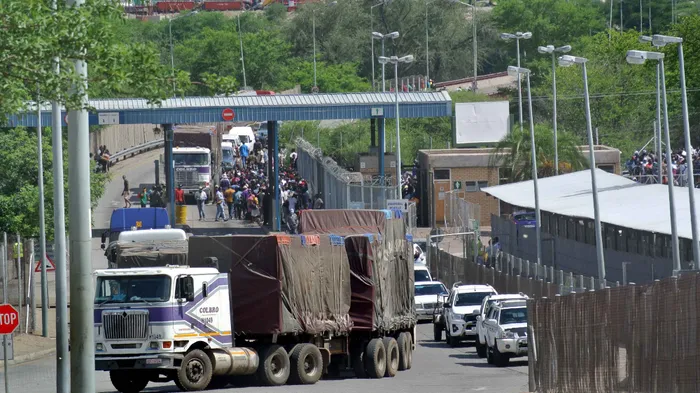
The Border Management Authority (BMA) has defended its continued requirement for original paper-based veterinary health certificates for poultry imports.
Image: Timothy Bernard / Independent Newspapers
The Border Management Authority (BMA) has defended its continued requirement for original paper-based veterinary health certificates for poultry imports.
This comes after calls from Merlog Foods to adopt secure online verification systems to prevent delays at South African ports.
Merlog Foods, an importer of chicken and chilled meats, had urged the BMA to modernise its verification processes by fully embracing the use of electronic veterinary certificates issued by Brazil.
These digital documents are already available through an internationally recognised online portal and are accessible to both the BMA and the Department of Agriculture, Land Reform and Rural Development (DALRRD).
“After months of disruption to poultry imports, we urge the Border Management Authority to align port inspection procedures with modern, technologically based practices,” said Georg Southey, manager at Merlog Foods.
“Formalising the use of electronic verification systems would streamline trade while maintaining food safety and compliance.”
But in response, Dr ME Machedi, Commandant for Agriculture Specialised Functions at the BMA, said the agency is legally required to enforce the import conditions set out in permits issued by the Department of Agriculture.
“According to section 6 of the Animal Diseases Act, 1984 (Act No. 35 of 1984), no person shall import into or convey in transit through the Republic any animal, parasite or contaminated or infectious thing except under the authority of a permit and in compliance with any condition imposed in such permit,” said Machedi.
He added that clause 9 of the Veterinary Import Permit explicitly requires the presentation of original paper certificates at the port of entry.
“This is to ensure authenticity and prevention of fraud. This guarantees that all goods meet South African biosecurity and import requirements. It also enables effective risk assessment and legal compliance at the point of inspection,” he said.
Machedi emphasised that while the BMA enforces the current regulations, it is also working to modernise its inspection systems.
“BMA is using the eCert system for some of the commodities, whilst onboarding others. There is a plan to fully automate inspection systems,” he said.
“With the current system, the risks are mitigated, and we are still able to conduct inspections in a safe and effective environment that facilitates timely entry and exit of agricultural products in and out of South Africa.”
Merlog Foods warned that the existing delays adding up to 7 to 10 days per shipment, are preventing the timely release of key imports such as mechanically deboned meat (MDM), a critical raw material used in processed protein products like polony and viennas.
These products are widely consumed by low-income households and are used in school feeding schemes.
Southey said delays in MDM imports result in an estimated 100 million meals lost per week. The company also called on DALRRD to urgently finalise a regionalisation protocol with Brazil that would allow imports from unaffected areas during future bird flu outbreaks.
“It is important that a regionalisation protocol with Brazil is concluded without delay,” Southey said.
South Africa lifted its ban on Brazilian poultry in July after a single case of bird flu was reported in one state. The first shipments are expected to arrive in the week of 18 August.