

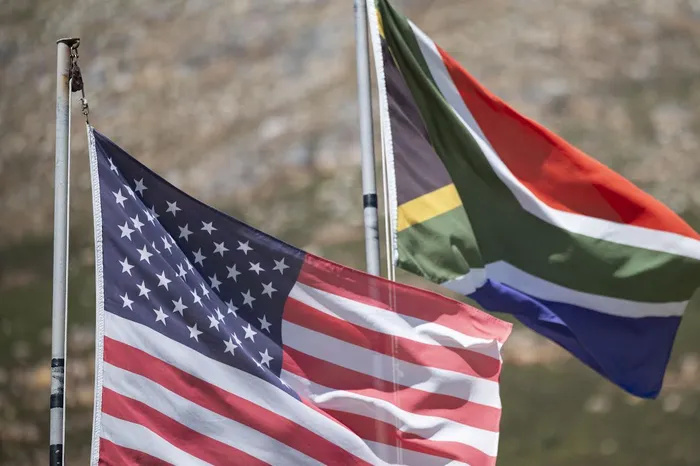
The US State Department's recent report on South Africa misrepresents the country's commitment to human rights and undermines its constitutional democracy, says the writer.
Image: Armand Hough / Independent Newspapers
I am a human rights lawyer born in an era when the worst amongst a racist ruling minority ruined the humanity of the majority in South Africa.
The recent US State Department Human Rights Report on SA presents a deeply flawed and inaccurate account of the state of human rights in our country.
The majority of thinking and patriotic people of South Africa firmly reject its findings as an a-contextual and politically motivated document that fails to recognise the reality of our robust constitutional democracy.
I managed to access the report. Its selective use of information and reliance on unverified anecdotes is not only a disservice to the truth but also undermines the very principles of independent human rights reporting.
The US report fails to acknowledge the foundation of our democracy: the South African Constitution. This is a document universally recognised for its progressive and comprehensive protection of human rights.
Our commitment to these rights is not merely a matter of policy but a constitutional mandate. When human rights violations are alleged—whether by state actors or private citizens—South Africa has transparent and independent mechanisms to address them.
These include the following: an independent judiciary, where our courts operate without political interference. When allegations of police misconduct or other abuses are made, the judiciary is the final arbiter, and those found guilty are held accountable.
The report often cites incidents that are actively under investigation or adjudication by our courts, presenting them as settled facts of abuse rather than as cases within a functioning legal system.
The report conveniently sidesteps the role of our Chapter 9 institutions, which are created to safeguard democracy and human rights. Bodies like the South African Human Rights Commission (SAHRC) and the Independent Police Investigative Directorate (IPID) are constitutionally mandated to investigate human rights abuses and police brutality.
Their public reports and findings are freely available, and they play a critical role in holding the government and its agencies accountable.
The US report’s most egregious claims often rely on a distorted narrative. Allegations of "extrajudicial killings" and police misconduct are cited, with the report claiming "credible reports" of arbitrary killings by the government.
This broad and unsubstantiated claim ignores the fact that any death caused by police action is immediately referred to the IPID for independent investigation. The IPID's reports, while sometimes highlighting a rise in police misconduct, also detail the specific cases under investigation and the actions taken against officers. To label these incidents as "extrajudicial killings" without acknowledging the ongoing, transparent legal process is a willful misrepresentation of facts.
The report frames the Expropriation Act as a move to seize land from Afrikaner minorities without compensation. This is a gross simplification and politicisation of a complex issue.
The purpose of the Act is to address the deeply entrenched, racially imbalanced land ownership patterns that are a direct legacy of apartheid. It is a critical step towards social justice and land reform.
In fact, international bodies like the United Nations Human Rights Office in Geneva have praised the Act as a necessary and “critical step” in rectifying historical injustices, providing a stark contrast to the US State Department's highly political interpretation.
The report points to farm attacks as a sign of targeted violence against a racial minority. While farm attacks are a serious crime and a concern for all of South Africa, data from police and independent research show that these crimes affect all racial groups in rural areas.
To single out one racial group for political purposes is to ignore the broader issue of rural crime and violence that South Africa is actively working to combat.
The US State Department's report is not an objective assessment but rather a political tool that seeks to undermine South Africa's democratic progress.
It ignores our constitutional framework, our independent judiciary, and the transparent work of our Chapter 9 institutions.
South Africa is a nation committed to addressing its historical injustices and its contemporary challenges through democratic and legal means. We are a work in progress, and we face serious issues, but we do so with a commitment to transparency and accountability.
SABER AHMED JAZBHAY
Human Rights attorney
Newlands West