

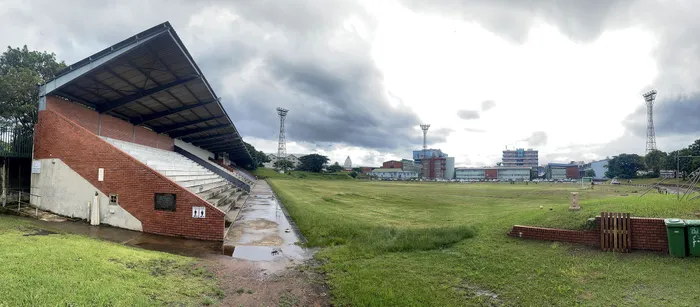
Curries Fountain Stadium in Overport celebrated its centenary in 2024. An application has been made to have it declared a provincial heritage site.
Image: Shelley Kjonstad Independent Newspapers
The Curries Fountain Heritage Preservation Foundation are waiting to hear whether the Curries Fountain stadium in Durban will be declared a provincial heritage site.
The matter is before the KwaZulu-Natal Amafa and Research Institute which is the provincial heritage resources authority.
The foundation marked Heritage Day on Wednesday by holding an event which was attended by those who had been involved in sports, particularly football at the stadium.
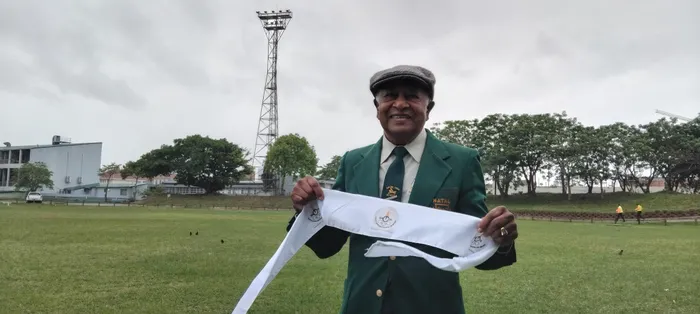
Maya Singh, the president of the Curries Fountain Heritage Preservation Foundation, at a heritage day gathering on Wednesday.
Image: Zainul Dawood
The foundation's president Maya Singh said they wanted to preserve the stadium. He said he became concerned after seeing a news article about a parking lot being created at Curries Fountain.
Singh said that the foundation has already projected the future utility of the Curries Fountain Heritage site with the development of a museum, development of sports, among others, as priorities.
Anand Jayrajh said that all sports could be used as a vital and powerful tool to encourage youth to involve themselves in social, public, and charitable work.
“This will shape them into becoming useful and upright citizens of the world. Our future depends on them. Curries Fountain must not be out of the public consciousness,” he said.
Curries Fountain Stadium is associated with the Struggle against apartheid, particularly in the 1960s and 1970s, which influenced the interaction of people within a socio-political and cultural environment in Durban and South Africa.
The stadium was used for most non-racial sporting codes and was undoubtedly the centre of community activity, where freedom fighters gave speeches to mobilise the public and the world against apartheid.
A partnership exists between the eThekwini Municipality, which owns the land, the Durban University of Technology, the former Durban Sports Ground Association, and representatives from Civil Society structures.
A representative from the KwaZulu-Natal Amafa, who did not want to be named, said a Grade 2 provincial heritage site application had been made. The application will be discussed at a council meeting in November. Once a final decision is made, it will then have to be gazetted by February 2026.
Dr Bhugwan Singh said Curries Fountain weaponised the Struggle against apartheid, and although areas were segregated according to racial classification, the sports ground saw multiracial sports being played.
“This sports ground where we met weaponised our quest for dignity. It is a living monument. Others had made representations in the 1970s to have it declared a heritage site. We cannot afford to take our foot off the pedal with our latest submission,” he said.
Vincent Pillay, 80, a former striker for Verulam Suburb, spoke of his memories of playing at the stadium, in particular the day he scored three goals in 20 minutes at the Orient end of the grounds.
Pillay displayed two Knock Out (KO) Cup gold medals and a silver medal he won when he represented Natal Professionals against Western Province Professionals in the Inter-provincial KO Cup Final staged at Curries Fountain.
“This place is nostalgic with many unforgettable memories. I recall being paid R8 for a win, R6 for a draw, and R4 for a loss. We played for the love of the game,” he said.
Cassim Docrat spoke of the cricket matches and the fact that memories will live forever, while Lux Gordhan enlightened the crowd about the athletics fraternity and his memories of setting up the track and field. Both spoke of the challenges the sporting codes faced during apartheid.