

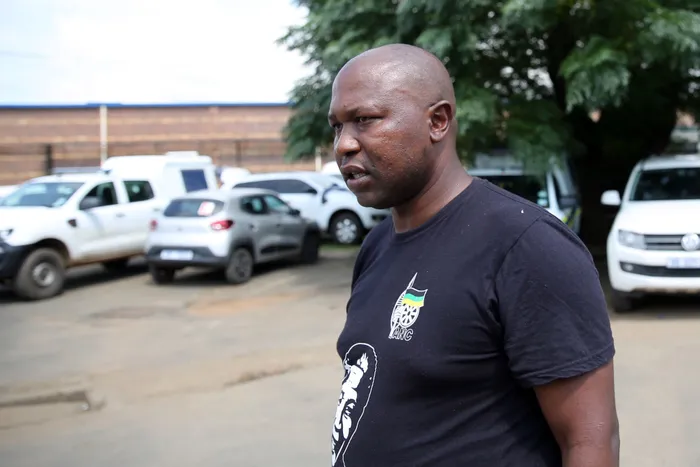
Mary De Haas has rejected claims that prominent whistleblower Thabiso Zulu refused state protection when his life was being threatened.
Image: Independent Newspapers Archives
Crime and policing expert Mary De Haas has rubbished claims that prominent whistleblower Thabiso Zulu refused state protection when he was being threatened. The claims surfaced recently when former police minister Bheki Cele testified before the Ad Hoc Committee.
De Haas lashed out at Cele, stating that he has no credibility on the issue and should not be taken seriously. Zulu was a close friend of slain ANC councillor in Umzimkhulu, Sindiso Magaqa, who was killed for exposing corruption in the municipality.
Zulu has been on a campaign to ensure that those implicated in Magaqa’s murder are held to account. As a result, his own life has been threatened, and he has faced attempted assassination. High-profile individuals have been arrested in connection with Magaqa’s murder, including ANC heavyweight and former mayor, Mluleki Ndobe, and a municipal manager, Zweliphansi Sikhosana, but they were later released.
The municipal manager was re-arrested for the murder, and Ndobe is now deceased. A hitman was recently sentenced after admitting to the killing, and others implicated in the case are facing trial. The police came under scrutiny after numerous reports emerged indicating that they had failed to provide Zulu with protection.
The matter went as far as the Public Protector’s office. Cele was questioned by the Ad Hoc Committee on why Zulu had never been offered protection as a whistleblower.
It was reported that Cele stated the reason Zulu was not provided protection was that he had refused to go into witness protection, that he wanted bodyguards he could take with him wherever he chose to go, and that he was also facing some criminal charges.
Cele said activists like De Haas were not considering the other factors in their campaign to fight for Zulu to receive protection. De Haas responded to Cele’s claims, stating that they were unfounded. She has known Zulu for years and said that he had even worked for her doing research; she was also at the forefront of trying to get him protection.
De Haas stated, “The claim that he refused witness protection is rubbish. When he was offered witness protection, he told me that while he did not want to go there, he also did not want to ignore them. So he went there, only to find that he was being surveilled, and he left. On the fact that he wants a bodyguard he can go anywhere with, that is also untrue. What he asked for was that he be able to choose the people to protect him because he did not trust the police, considering how much the country spends on protecting the police. Protecting him would have been nothing,” she stated.
She added that any claims of impropriety are simply not true, noting that the person who accused Zulu had settled the matter financially without Zulu admitting to any wrongdoing or to the allegations. De Haas said Cele’s dismissive attitude towards the matter was uncalled for, as Zulu’s life was under serious threat at the time.
“Things had gotten very bad when he testified at the Moerane Commission. I have told him that perhaps he should not go there, but he felt it was important for him to testify, and after he testified, there were serious threats to his life.”
Zulu commented on Cele’s testimony, saying, “My only comment on this is that I have no comment. We will leave what he said as it is. The media has been following this news for some time, and they know what the truth is. I do not want to rehash and open up old wounds.”
Cele was taken to task by the former public protector Busisiwe Mkhwebane over the matter.
In her 47-page report, Public Protector Mkhwebane found that the “failure” by Cele and the South African Police Service (SAPS) in providing security for Zulu and Les Stuta “exposed them to the risk of being assassinated” and also exposed the police to potential legal action from the men’s families should they be “assassinated.”
In her remedial actions, Mkhwebane stated that, amongst other things, Cele needed to provide Zulu and Stuta “with the requisite security at state expense.”
The report was however taken on review and declared invalid by the Gauteng North High Court. It also cleared Cele of wrongdoing.