

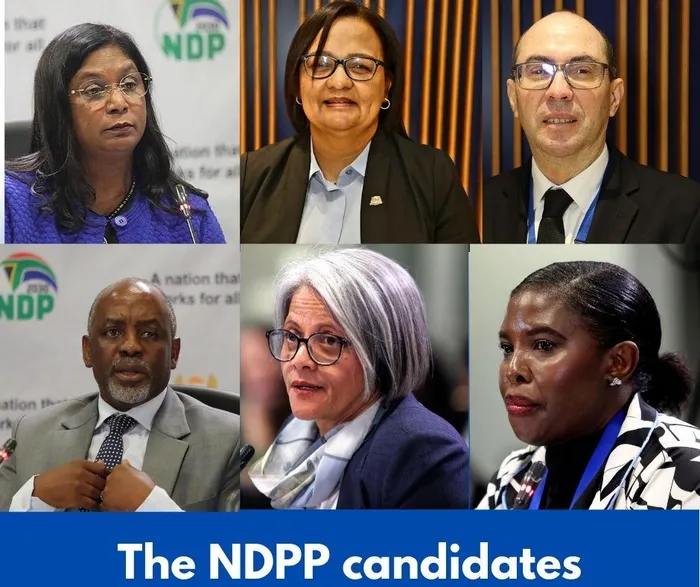
The six candidates interviewed for the position of National Director of Public Prosecutions this week are: top, from left, Andrea Johnson, Nicolette Bell and Adrian Mopp. Bottom from left: Menzi Simelane, Hermione Cronje and Xolisile Khanyile.
Image: Timothy Bernard and Oupa Mokoena / Independent Newspapers
Each of the six candidates shortlisted for the position of National Director of Public Prosecutions (NDPP) were questioned this week about how they would lead the National Prosecuting Authority and tackle the myriad challenges facing the prosecuting body.
The Advisory Panel for the selection of the NDPP is being chaired by the Minister of Justice and Constitutional Development, Mmamoloko Kubayi.
The following candidates were interviewed in two-hours slots on December 10 and 11:
• Adv Nicolette Bell
• Adv Adrian Mopp
• Adv Andrea Johnson
• Adv Xolisile Khanyile
• Adv Hermione Cronje
• Adv Menzi Simelane
First up in the hot seat was Advocate Bell, the Director of Public Prosecutions (DPP) in the Western Cape .
According to her CV, she started out as a public prosecutor and rose to their ranks to State Advocate, Senior State Advocate and deputy director of Public Prosecutions before she was promoted to DPP.
She was questioned about the poor performance of the Western Cape NPA in securing, especially, gender-based violence and murder convictions.
Bell said her team in the Western Cape has reflected on the province’s poor prosecution rate, and they have put several measures in place to address these problems. According to her, things are looking up.
Speaking about the Joshlin Smith case, Bell said the matter had huge reputational consequences for her office.
She explained that not everyone in her office agreed to prosecute the accused. She had to make a decision, which was the right one in the end, she said.
Transparency and accountability to Parliament regarding the work of the NPA are also high on her list. “I am ready to serve the entire NPA. I have the experience,” she told the panel.
Advocate Mopp, who is the Deputy Director of Public Prosecutions in the Western Cape, stated that if he took over, the starting point must be ensuring the independence of the office.
He pointed out that some say the NPA had been captured, but stressed that decisions taken must be underpinned by two things - the law and the facts.
“I lay awake at night worrying about the future of our country. I am concerned about the threats we face. I want to make a change,” Mopp said.
Investigating Directorate Against Corruption (IDAC) head Johnson had some difficult moments in her interview as she had to explain how it came to be that suspended Ekurhuleni legal executive Kemi Behari was cited as a reference on her CV.
The City of Ekurhuleni placed Behari on precautionary suspension with full remuneration for allegedly failing to take disciplinary action against now suspended Ekurhuleni police head, Brigadier Julius Mkhwanazi.
Johnson explained that she had sent her CV a while ago to the panel and Behari has been cited for some time as a reference. After his suspension, she chose not to remove his name because she knew that there would be questions about it.
Johnson said she told Behari that she was not judging him, but that she cannot have him on her CV.
She told the panel that she has known Behari for most of her adult life and he is a good friend.
The panel also noted that 209 public comments were submitted about Johnson and most of them were critical.
Advocate Cronje, former Investigating Directorate (ID) head, now called IDAC, and part of the team that had established the Asset Forfeiture Unit, said she left the National Prosecuting Authority (NPA) for professional reasons.
“I certainly saw dysfunction that I thought needed to be addressed,” she told the panel, headed by Justice Minister Mmamoloko Kubayi, on Thursday.
Cronje resigned as head of the NPA’s Investigating Unit in 2022 due to frustrations within the prosecution authority, which included a skills shortage and other obstacles that she said made her life there difficult. Yet, she feels she is ready to return and take up the reins as the head of the organisation.
Cronje described the skills crisis within the NPA as a “catastrophe” requiring urgent attention. While acknowledging the diligence of some hard-working professionals, she asserted that the system itself degrades prosecutors, reducing them to “second-hand professionals”, an outcome she stressed must be rectified.
Advocate Xolisile Khanyile, former director of the Financial Intelligence Centre, who also was interviewed on Thursday, told the panel she has served in different roles in law enforcement agencies for 23 years.
This includes being a senior official in the Asset Forfeiture Unit for five years, as well as a Director of Public Prosecutions for eight years - both in Johannesburg and in the Free State.
Professor Somadoda Fikeni, a panellist and chairperson of the Public Service Commission, questioned Khanyile about how she would tackle the backlog of cases not prosecuted, some dating back from the Zondo Commission.
Khanyile responded that it would be critical for her to prioritise Commission cases to ensure that it moves with speed. “The Madlanga Commission shows that we have not cleaned enough after the Zondo Commission. There is more to do,” she said.
Khanyile said a lot of prosecutors asked her to come back to the profession. “For my country, I will do it,” she told the panel.
The final interviewee on Thursday was Advocate Simelane, a former NDPP whose shortlisting for the position has drawn the ire of the DA which raised concerns.
The DA said Simelane has already been found unfit in the past for this office by the Constitutional Court. “It is impossible to overlook that history,” DA spokesperson on Justice and Constitutional Development advocate Glynnis Breytenbach said this week.
She said Simelane’s past appointment as NDPP had been declared unconstitutional as he “lacked the necessary integrity and competence for the job”.
“To make matters worse, he was found guilty of professional misconduct in 2017 for misleading the Ginwala Inquiry, and he now faces a striking-off application from the Johannesburg Bar Council,” she added.
Simelane, meanwhile, on Thursday told the panel that he has for 18 years now tried to clear his name regarding the Ginwala findings. He said the findings were wrong and he hoped the panel would consider this when it considered his application.
The Ginwala Inquiry earlier made pronouncements regarding issues with his honesty, while the Supreme Court of Appeal called his appointment as NDPP in 2009 irrational. The Constitutional Court subsequently also found that he was unfit for the role.
Simelane told the panel that since he has left government and is practicing as an advocate in private practice, he has not done much criminal work. He mainly does administration and constitutional law. Asked about his management style, he said he does not manage people by talking down to them, as he believes in communal communication. This is so that no one is ever left out. But, he added, he holds people to account by setting time frames in place as to when things must be done and how targets must be met. | Additional Reporting Mercury Reporter