

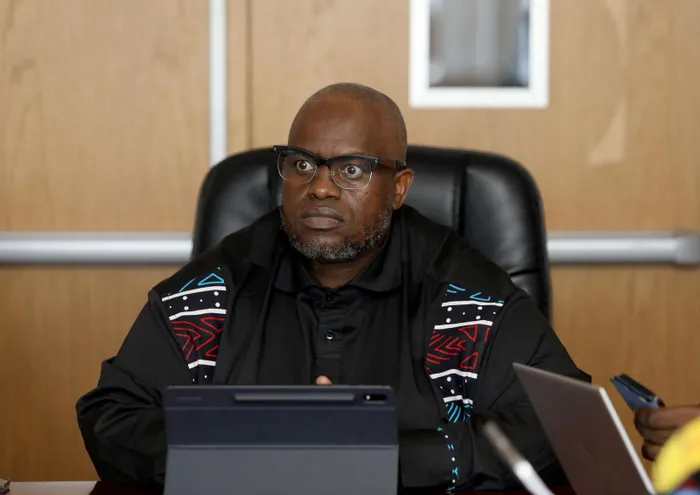
Council for the Built Environment (CBE) Dr Msizi Myeza said the Redcliffe incident must be viewed against a record of repeated structural collapses in Durban over the past few years.
Image: EThekwini Municipality
The collapse of the River Ranch Temple in Redcliffe, Verulam, is the latest in a long series of building failures in the eThekwini metropolitan area over more than a decade, according to the Council for the Built Environment (CBE).
Presenting preliminary technical findings this week, CBE chief executive officer Dr Msizi Myeza said the Redcliffe incident must be viewed against a record of repeated structural collapses within the municipality’s jurisdiction.
“Over the past decade, there have been several structural-related incidents within the jurisdiction of the eThekwini metro,” Myeza said.
The CBE listed the following collapses:
• 2011: “A house at 37 Avoca Road” collapsed during construction after being built “with no approved plans”.
• November 2013: the Tongaat Mall partially collapsed while under construction.
• March 2018: a building collapsed in Jacobs.
• June 2020: a building collapsed in Central Durban.
• January 2025: a structural collapse occurred in Tongaat near King Shaka International Airport.
• March 2025: a building collapsed in Phoenix whilst under construction.
• June 2025: a construction site scaffolding collapse in Springfield.
• December 2025: the temple building in Redcliffe, Verulam, collapsed.
Myeza said the recurrence of collapses across different locations and years pointed to broader failures in development regulation rather than isolated construction defects.
“In our view, this suggests that there is a need for greater focus on systemic and governance issues within the development planning, facilitation, and building control processes,” he said.
The preliminary investigation into the Redcliffe collapse found that the four-storey reinforced concrete structure was erected in contravention of multiple laws governing building approval, construction safety, and land use, with the CBE concluding that the structure was “unauthorised, unlawful, and unsupervised”.
The council has activated its Emergency Incident Response Protocol and will now conduct a formal investigation into technical causes, professional accountability, and regulatory oversight across the development lifecycle.
Criminal responsibility for the Redcliffe deaths and injuries will be determined separately.
“It is a court of law working with law enforcement agencies [that] will determine if negligence caused the deaths of five individuals and injuries to 11 others,” Myeza said.