

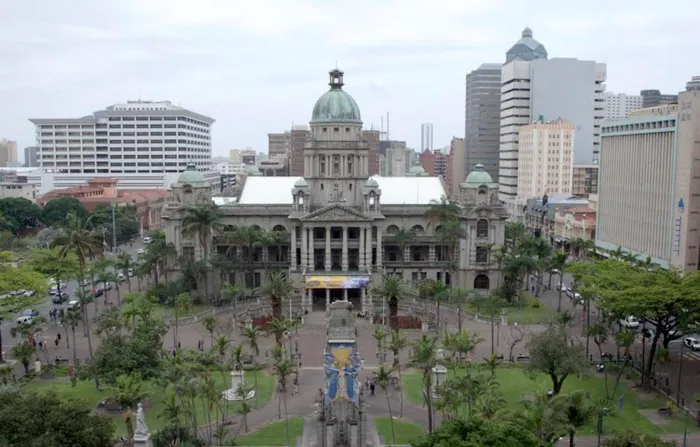
Durban City Hall. The eThekwini Municipality has responded to a court ruling regarding action it must take on sewage spills.
Image: Independent Newspapers Archives
The eThekwini Municipality has responded to the judgment handed down on Thursday in the Pietermaritzburg High Court which compels it to take certain measures to deal with the sewage spillages affecting beaches and other water bodies including rivers in the city.
The judgment came after cases were brought by the DA and ActionSA. While the two court matters were heard at the same time, this judgment deals only with the relief sought by the DA.
The municipality also confirmed on Thursday that four beaches were closed due to pollution being detected.
In a response to the ruling on Thursday night, the City acknowledged the ruling and said it has engaged its legal advisers to study the judgment in detail.
It added that the court refused to make an order directing the City to act under the court's supervision as it had noted that the City had financial constraints and that it had adopted an Action Plan.
The municipality said several interventions called for in the judgment are already being implemented.
These include:
Regarding infrastructure issues, it said it had reprioritised resources to safeguard public health. “Refurbishments are currently in progress at wastewater treatment works affected by storm damage and in addition emergency repairs are undertaken immediately on wastewater pump stations experiencing breakdowns and overflowing.”
It added that there were achievements in relation to wastewater infrastructure compliance and maintenance including:
To address persistent blockages and infrastructure failures, the Municipality has deployed:
Major projects currently underway include sea outfall inspections and critical pipeline repairs, supported by a comprehensive Water Use Licence Application (WULA) process for seven of the ten treatment works, ensuring alignment with the National Water Act.
The municipality also said that over R1.16 billion in capital investment has been committed to strengthen infrastructure.
This funding supports:
“A city-wide Sanitation Masterplan is also being developed to guide future infrastructure planning and ensure sustainable service delivery. Sites previously identified as high-risk, such as KwaMashu and Phoenix, have seen reduced incidents due to enhanced contractor management, improved induction processes, and stricter permit systems that foster a stronger safety culture,” it said.