

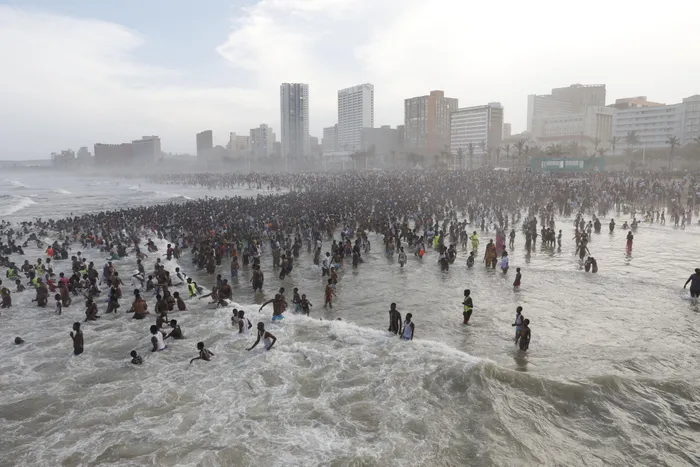
With the festive season in full swing, Lifesaving SA and the Durban Metro Police are calling on holidaymakers to adhere to essential swimming safety rules.
Image: Doctor Ngcobo / Independent Newspapers
A teenager was swept out to sea while swimming at uMdloti beach, north of Durban on Wednesday.
According to a report from Marshall Security, the teen was with two others when all three got into difficulty. While the two young people were brought to safety, the other teen remained missing.
It was reported that the National Sea Rescue Institute, Lifesaving club, Netcare911 and other first responders had conducted a grid search on Wednesday afternoon.
The search operation was expected to resume on Thursday.
The incident comes after the Durban Metro Police and Lifesaving South Africa urged holidaymakers across the country to adhere to rules regarding swimming and supervision when visiting beaches, pools and dams during the festive season to prevent drownings and other incidents.
Lifesaving South Africa noted conditions during the period from the second weekend of December through to the Reconciliation Day public holiday on December 16 “were not the most ideal”, yet beaches, pools and inland waterways were “packed with holidaymakers”.
In Durban, where large crowds gathered along the beachfront, ocean conditions were described as challenging, with “strong onshore winds bringing in some swell”.
However, enforcement measures were required as swimmers continued to enter the water outside the supervised hours.
In a safety notice, the Durban Metro Police Service confirmed that Strike Team members, together with Beach Unit officers, had to remove people from the water after 6pm “to prevent drownings and other incidents”.
“The public is reminded that swimming after 18h00 is strictly prohibited in terms of Municipal Bylaws,” the notice said.
Metro Police warned that lifeguards end their shifts at 6pm and that “thereafter no safety supervision is available, making swimming extremely dangerous”.
Lifesaving South Africa said voluntary clubs across the country reported multiple incidents involving swimmers struggling in difficult conditions.
“Reports from numerous voluntary clubs indicated that there were several help-outs of bathers struggling in the sea conditions,” the organisation said, noting that lifesavers intervened “before they got into serious difficulty”.
The statement highlighted two incidents in Cape Town that illustrated the consequences of rapid response. On December 13, Strand Surf Lifesaving Club members rescued a young boy who was being swept out to sea by a rip current, bringing him to safety “before he went under”.
The following day, Clifton Surf Lifesaving Club lifesavers responded to an elderly woman showing signs of a heart attack near a beach access point. Lifesavers detected “a very faint pulse”, initiated CPR, and later administered an AED shock. Emergency responders later said the quick actions of the five lifesavers “certainly saved the life of the elderly lady”.
Both Lifesaving South Africa and Metro Police urged the public to comply with safety rules.
“ LifesavingSA calls on the holidaymakers to only swim where and when lifesavers are on duty,” the organisation said.
Durban Metro Police urged beachgoers to “comply with instructions from law enforcement officials and to prioritise their safety at all times”.