

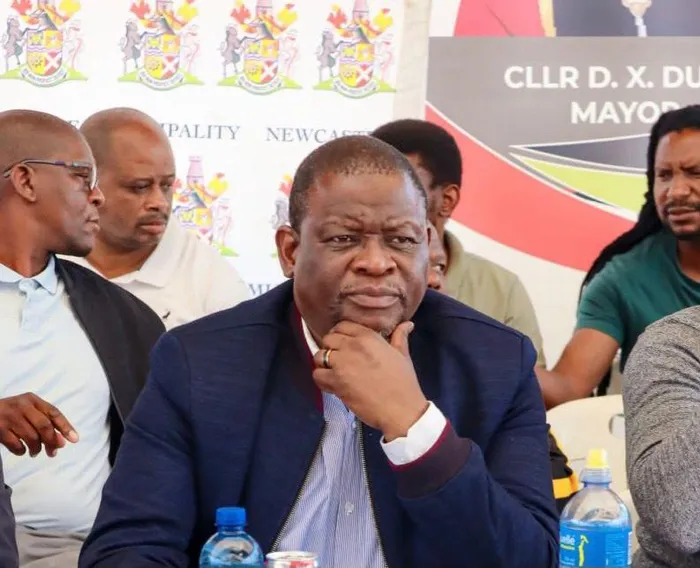
Newcastle Municipality municipal manager Zamani Mcineka said the municipality received the equitable share funds on December 18.
Image: Newcastle Municipality/ Facebook
National Treasury has released Newcastle Municipality’s equitable share allocation following a tense standoff.
The funds, which were due on December 9, were ultimately paid after the municipality sought urgent legal intervention. The KwaZulu-Natal municipality was just one of 75 municipalities that were affected by the withholding of the equitable share funds.
It has been reported that the Treasury withheld the December 2025 local government equitable share tranche due to non-compliance issues, including outstanding budget funding plans, irregularities flagged by the Auditor-General, pension fund submission backlogs, South African Revenue Service compliance problems and unpaid water board debts.
SA Local Government Association and the SA Municipal Workers' Union have both raised concern about the withholding of funds.
Newcastle Municipal Manager Zamani Mcineka confirmed that the municipality received the equitable share on 18 December.
He said the funds were immediately applied in line with the municipality’s funding plan to stabilise operations and avert a looming financial crisis. Of the roughly R188 million received, R88 million was paid to Eskom, R35 million to the bulk water supplier, R21 million to Absa for loan repayments, and further amounts to the Development Bank of Southern Africa. The balance was used to support cash flow and ensure the payment of staff and councillor salaries.
The dispute arose after National Treasury warned it intended to invoke Section 216(2) of the Constitution, which allows for the withholding of funds from an organ of state that persistently breaches financial management requirements.
Mcineka argued that Treasury’s actions were unlawful, procedurally unfair, and disconnected from the realities facing municipalities.
The matter began with a Treasury letter dated 21 October 2025, requesting specific documentation to prevent the withholding of the equitable share.
According to Mcineka, the municipality submitted the requested information. However, before this was fully considered, Treasury issued a second letter on November 9 indicating its intention to invoke Section 216. “Here, I think the goalposts were shifted,” he said, arguing that new and broader criteria were introduced without reference to Newcastle’s specific circumstances.
A central issue was Treasury’s allegation that Newcastle had failed to reduce its unauthorised, irregular, fruitless and wasteful (UIFW) expenditure balance by 75%.
Mcineka highlighted a contradiction in Treasury’s correspondence, stating that a year-on-year analysis showed 'a 99.48% reduction, significantly above the 75% reduction criterion outlined.
He said, “It is a contradiction… In our case, it was almost like 100%.”
Mcineka also expressed concern over what he described as premature threats directed at himself and the municipality’s chief financial officer.
He quoted Treasury as stating that failure to comply would be regarded as a deliberate contravention of the Municipal Finance Management Act (MFMA), with possible charges under Section 171. “I take this very seriously,” he said, adding that the MFMA does not give Treasury the authority to lay charges against municipal officials.
In his written response, Mcineka accused Treasury of using the equitable share “as a weapon and a threat to punish the municipality.” He stressed that the grant exists primarily to support poor and indigent communities.
Despite this, Treasury later informed the Director-General of Cooperative Governance that Newcastle would not receive its allocation, citing indicators such as adverse audit outcomes, unfunded budgets, and non-payment of creditors.
Mcineka rejected these claims. “You can’t say to me I have an adverse audit opinion when I don’t,” he said. “You can’t say I have an unfunded budget when I have a funded budget.”
The situation escalated in early December when the municipality’s attorneys warned Treasury that its actions were unlawful. Shortly thereafter, Treasury confirmed that instructions had been issued to release the funds.