

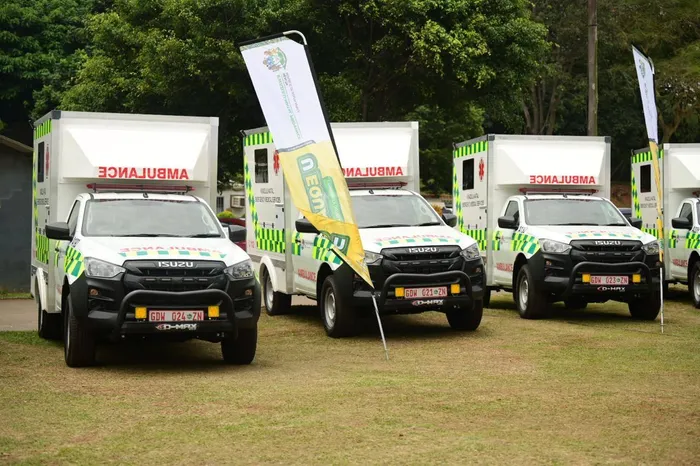
The KZN Department of Health has procured 44 new emergency services vehicles including ambulances.
Image: KZN Department of Health / Facebook
The KwaZulu-Natal Department of Health has unveiled 44 new Emergency Medical Services (EMS) vehicles, describing the procurement as a practical demonstration of its commitment to saving lives and strengthening emergency care ahead of the festive season.
The Department stressed that emergency healthcare does not occur in isolation.
“Healthcare is not just something that occurs in a vacuum; but that it happens in real time, in real communities, often in moments of great urgency to save the lives of those who are in distress,” it said.
The fleet, made up of 30 normal ambulances, eight dual-stretcher vehicles, and six 35-seater planned patient transport vehicles was procured at a cost of R86 million.
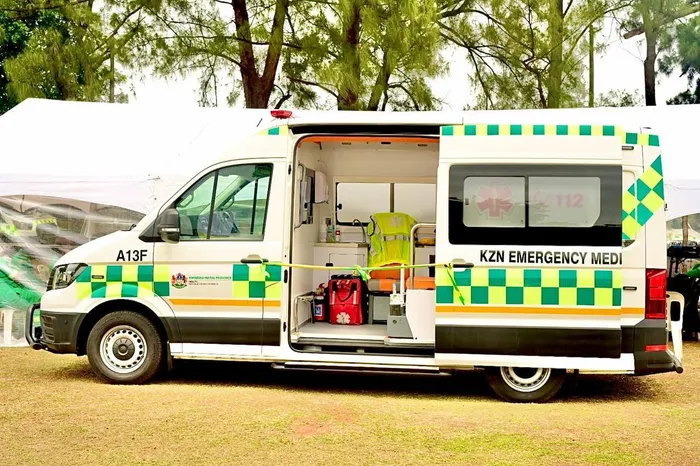
The fleet, made up of 30 normal ambulances, eight dual-stretcher vehicles, and six 35-seater planned patient transport vehicles was procured at a cost of R86 million.
Image: KZN Department of Health / Facebook
The Mercury recently reported that an amount of R14.9 million was reprioritised from Emergency Medical Services to prioritise filled posts and non-negotiable items across all programmes, said the report. At the time, political parties said financial constraints were impacting the maintenance and repair of EMS vehicles.
While some vehicles were not physically present at the launch due to logistical challenges, the Department said it anticipates they will join the fleet “in just a few weeks’ time.”
The unveiling also served to outline the province’s state of readiness for the festive season.
With a historically high influx of visitors and a high accident rate, the department said EMS is working closely with other sector departments to ensure coordination, coverage along major arterial routes, and effective risk management. Ambulances and response vehicles will be deployed “in close liaison with key stakeholders, including SANRAL, SAPS, RTI, and Metro Police.”
Highlighting the role of paramedics, the department said EMS personnel are “often the first point of contact in medical emergencies” and provide care “under severe time pressure, in unpredictable and high-risk environments.” It quoted a common saying in emergency medicine: “An ambulance is hope on four wheels.”
“In medical emergencies, a person’s survival is often determined before they reach a hospital,” the Department said, adding that for many patients “the ambulance is where life-saving care truly begins, not at the hospital.”
The department acknowledged challenges affecting EMS operations, including “an ageing ambulance fleet and vehicle downtime, delays in maintenance and procurement processes, staffing constraints, as well as increased call volumes.” It said the procurement of new ambulances was a “targeted intervention” and “a step towards restoring capacity and reliability.”
It also condemned attacks on emergency workers, stating: “We want to unequivocally condemn any attacks or assaults, intimidation, and threats against EMS personnel; and any interference with emergency medical operations whatsoever.” The Department added: “No EMS worker should ever fear for their life while saving others.”
Responding to the announcement, Democratic Alliance (DA) KwaZulu-Natal spokesperson on Health Imraan Keeka welcomed the new vehicles but cautioned that deeper systemic issues remain unresolved.
“The DA in KwaZulu-Natal is acutely aware that the current budget allocation for emergency medical services is grossly inadequate to meet demand,” Keeka said. “That said, any addition to the fleet must be welcomed.”
He said the new ambulances would help improve coverage and replace unsafe vehicles. “Importantly, many if not all, will replace vehicles that are well past their service life and have become a danger not only to patients, but to EMS staff and other road users,” he said.
However, Keeka warned that “while necessary, this intervention on its own is not sufficient to resolve the systemic challenges and backlogs facing EMS.”
On festive season readiness, Keeka said oversight visits showed progress. “Recent festive-season readiness oversight visits have confirmed that targeted interventions involving the Portfolio Committee, the Department, and National Treasury have yielded palpable results,” he said, noting that “ambulances that were stuck in workshops for months, often for minor issues such as fan belts have been returned to service.”
Staffing remains a major concern. “Each ambulance requires approximately ten staff per shift to operate effectively,” Keeka said, adding that “highly trained EMS personnel continue to leave for the private sector, while budgetary limitations prevent the adequate filling of vacancies.”
On safety, he said: “The safety of EMS personnel is paramount and must be non-negotiable,” describing attacks on paramedics as “completely unacceptable and absolutely deplorable.”