

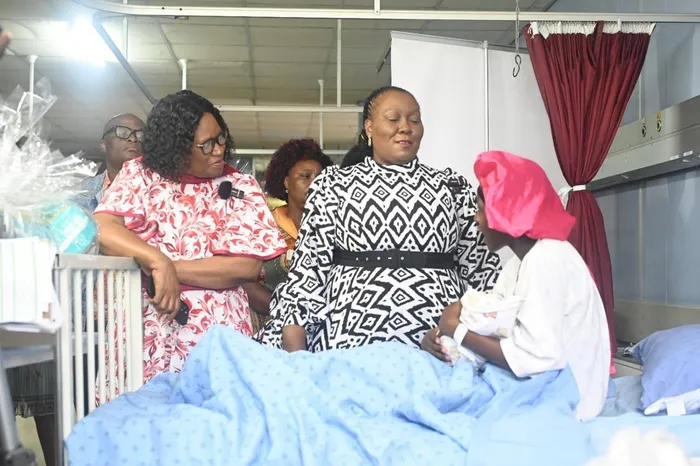
KZN Health MEC Nomagugu Simelane speaks to a mother who gave birth on New Year's Day. There were 144 babies born, by 3pm, on January 1 in KZN public hospitals.
Image: KZN Department of Health / Facebook
As KwaZulu-Natal welcomed dozens of New Year’s Day babies across the province, health authorities used the moment of celebration to sound a stark warning about the persistent and troubling rate of child and teenage pregnancy.
Health MEC Nomagugu Simelane announced that by 3pm on New Year's Day, 179 babies had been born in the province's public hospitals with 91 girls and 88 boys.
Among the earliest arrivals was “the first baby of the year, a baby boy,” born just after midnight at Queen Nandi Regional Hospital to a 31-year-old mother, weighing 1.8kg. Several other hospitals, including RK Khan, Nseleni, and Mahatma Gandhi hospitals, followed within minutes, underscoring the busy start to the year for maternity wards.
However, beneath the celebratory statistics lies a more sobering reality.
Simelane expressed her displeasure over the high number of young mothers. Health officials stressed that “we continue to be concerned over the rate of child and teenage pregnancy,” particularly as updated data shows that “21 of the mothers are teenagers,” a figure that remains under verification.
The concern is not new. On Christmas Day alone, the province recorded 302 births, and “alarmingly, 70 mothers were teenagers, with the youngest being three 15-year-old girls.”
One case involved a 16-year-old girl, who was impregnated by a 32-year-old man.
The New Year’s Day figures echo the same pattern.
According to the Department of Health, “the youngest mothers of our New Year babies are two 16-year-olds”. Officials described this as “absolutely shocking and concerning, because at that age, they are nowhere near ready to be mothers.”
In total, the province has already recorded “9 teenage mothers,” ranging in age from 16 to 19, spread across hospitals in Newcastle, Mseleni, Queen Nandi, Mahatma Gandhi, and Eshowe.
While welcoming the newborns, the Department of Health emphasised that “these statistics are cause for deep concern” pointing to an urgent need for sustained intervention.
Officials say the numbers “highlight the ongoing need for education, guidance, and access to reproductive healthcare for teenagers”.