

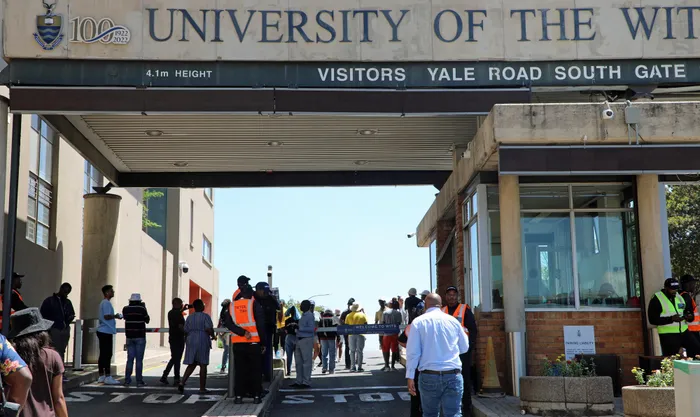
SASCO welcomes NSFAS's progress regarding 2026 funding decisions but warns of challenges that are affecting returning students.
Image: File: Timothy Bernard / Independent Newspapers
The National Student Financial Aid Scheme (NSFAS) has concluded all funding decisions for the 2026 academic year, while the South African Students Congress (SASCO) has welcomed the development but cautioned that significant funding, academic, and payment challenges continue to threaten student stability across higher education institutions.
In a media statement, NSFAS confirmed that it “has processed all 2026 funding applications prior to the start of the 2026 academic year as committed to by the 31st December 2025.”
SASCO said it “notes the work undertaken by the National Student Financial Aid Scheme (NSFAS), in order to ensure the funding of potentially over 1 million students in South African Higher Education.”
NSFAS reported that 609,403 first-time entering students have qualified for financial aid, while 416,688 returning university students have met the academic progression criteria to continue receiving funding in 2026. These figures exclude TVET college students, whose results are due to be released later in January.
At the same time, NSFAS acknowledged that a substantial number of applications remain unresolved. A total of 218,043 first-time applications are currently incomplete due to outstanding documentation, while 49,538 were rejected.
NSFAS stated that applications marked as incomplete relate to cases where “additional documentation is outstanding,” warning that those not completed within 30 days “will not be processed further and will be deemed unsuccessful.”
For continuing students, NSFAS assessed 545,952 university applicants, of whom 129,264 did not meet the academic progression requirements.
Responding to these figures, SASCO described the overall picture as “generally positive,” but noted that the emerging patterns raise serious concerns. The organisation urged students with incomplete applications “to complete these applications, and approach SASCO branches for assistance, if needs be.”
SASCO further noted that “just under 178,802 students, returning and first time, were rejected or have lost funding due to various reasons” including income thresholds and academic criteria. It encouraged affected students to make use of the NSFAS appeals process, stating that its branches, regions, and national structures “will establish platforms to assist students with the appeals procedure.”
Beyond application outcomes, SASCO focused on the academic exclusion of returning students, pointing out that the 129,264 students who failed to meet progression requirements represent “just under one quarter of all returning students.”
The organisation stressed that “no student wants to fail, nor is any student inherently unable to pass,” attributing poor performance largely to “external circumstances, including funding instability, inadequate or insecure accommodation, and insufficient academic and material resource support.”
NSFAS, meanwhile, said it has streamlined the 2026 appeals process to ensure fairness and timely resolution, emphasising that students have a strict 30-day window to submit complete appeal documentation.
On outstanding payments, NSFAS stated that it “has cleared many outstanding claims to higher education institutions and invoices to accommodation providers,” and committed to resolving remaining short payments.
SASCO rejected assurances alone, condemning what it called “the ongoing crisis of mop-up payments,” where students are “unjustly held liable for NSFAS’s failures to pay institutions and landlords in full or on time.” The organisation said repeated commitments to resolve the matter are viewed “with scepticism,” describing the situation as “a persistent, systemic failure.”
Despite this, SASCO said it remains willing to work with NSFAS, supporting the view that funding responsibility must extend beyond disbursement to ensuring learning environments that support academic success.