

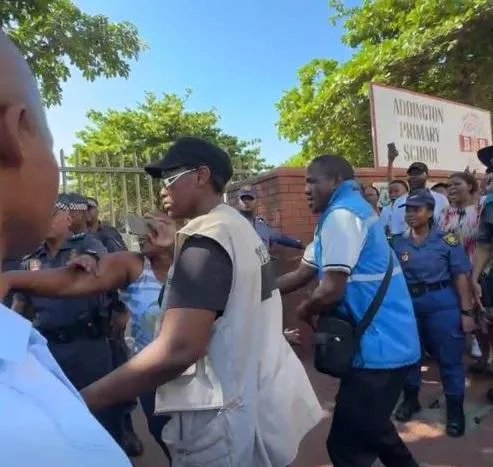
A screengrab from a video shows a scuffle outside the Addington Primary School this week.
Image: Facebook
KwaZulu-Natal’s Education MEC says the government is bound by the Constitution when it comes to school admissions.
Sipho Hlomuka was commenting earlier this week ahead of the opening of schools after he was asked about the comments made by organisation March and March regarding the enrolment of foreign national children at South African schools.
On Wednesday March and March staged a protest at Addington Primary School over the admission of foreign national children. The organisation has argued that school places should be prioritised for South African children. There was a tense standoff between foreign national parents and leader of the March and March movement Jacinta Ngobese-Zuma. It was also reported that the school is overcrowded.
Hlomuka said that the right to basic education applies universally and warned against disruptions to schooling.
“We are guided by the constitution,” the MEC said.
While acknowledging public concern over undocumented learners and illegal immigration, the MEC maintained that education delivery cannot be compromised.
“We are concerned about undocumented learners. We are concerned about illegal foreigners. But our learners, they deserve quality education,” the MEC said, adding that grievances must be addressed through engagement rather than confrontation.
“Anyone who might have a problem with any learner must engage us, must engage the principal, must engage the SGB, because we don't want anyone going to disrupt teaching and learning in all our schools.”
Ngobese-Zuma had said that the March and March movement had gone to Addington Primary after complaints from parents that their children did not get a place in the school.
She claimed that some parents had been forced to enrol their children far from home, which they could not afford.
“The principal immediately dismisses them and says there is no space,” she said. She further claimed that “about 60% of the children here are non-South African, undocumented,” and argued that this was disadvantaging South African learners. The percentage of foreign national children at the school could not be established at the time of publication.
Ngobese insisted that public schools should prioritise South African citizens. “Public schools are for South Africans. Public resources are for South Africans,” she said, calling for legal action against the government’s education and immigration policies.
The protest followed an announcement by the South African Human Rights Commission (SAHRC) that it would commence its annual school readiness monitoring exercise during January and February. The Commission said the monitoring stems from complaints “regarding challenges with access to basic education as enshrined in section 29 of the Constitution of the Republic of South Africa, 1996.”
In its 2025 School Readiness Monitoring Report, the SAHRC found that “South Africa still maintains a highly unequal basic education system, where the right to education is significantly influenced by geographical location, socio-economic status, and decaying infrastructure.” The Commission said it would monitor whether the Department of Basic Education implements recommendations relating to learner placement, infrastructure, safety, staffing shortages, and the inclusion of undocumented learners.
The Commission also reiterated the legal position under the Basic Education Laws Amendment Act 32 of 2024, which requires schools to admit learners even if they do not have identity documents, as the right to basic education applies to everyone in the country, regardless of nationality or immigration status.
Raising concern about threats to disrupt schools, the SAHRC warned that learners should not be subjected to intimidation and confirmed that it had engaged the South African Police Service to ensure visibility and public order policing around school premises.
For more articles from The Mercury, click the link THE MERCURY