
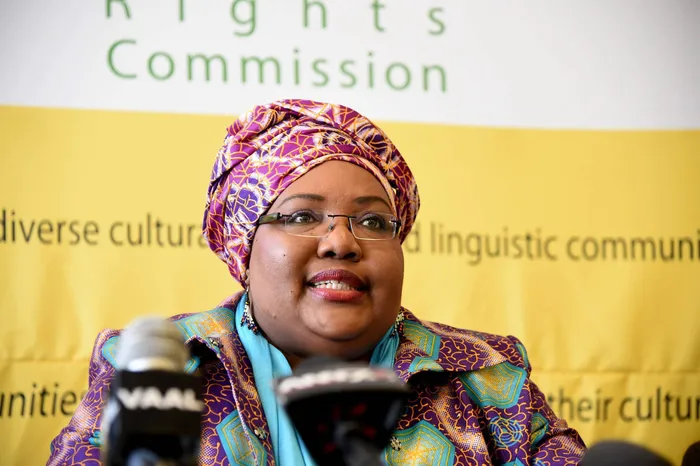
CRL Rights Commission chairperson Thoko Mkhwanazi-Xaluva has defended the Commission's oversight framework for the religious sector.
Image: File
CRL Rights Commission chairperson Thoko Mkhwanazi-Xaluva has broken her silence following a massive protest in Durban, dismissing claims that the Commission is attempting a "backdoor" state takeover of religion.
Thousands of congregants and religious leaders, operating under the banner of the South African Church Defenders, marched through the city streets last week. The protesters demanded the immediate scrapping of the controversial Section 22 Committee and the resignation of Mkhwanazi-Xaluva, labelling the Commission’s oversight framework as a "regulatory burden" and an affront to the constitutional right to freedom of worship.
Speaking in a radio interview, a defiant Mkhwanazi-Xaluva compared the religious sector to other professional bodies, arguing that accountability is a constitutional necessity rather than an overreach.
"Every profession, career, or trade, according to Section 22 of the Constitution, may be regulated," Mkhwanazi-Xaluva said, citing the Legal Practice Council and the South African Nursing Council as precedents. "Traditional health practitioners have a council established through an Act to stop unethical conduct. Why should the religious sector be different?"
The chairperson stood firm on the Commission's mandate to tackle "rogue" practices, referencing notorious incidents where congregants were instructed to eat grass or drink petrol. She argued that while such acts might not always constitute a criminal offence in a court of law, they represent a profound failure of ethics that only a peer-review mechanism can address.
"It is not a crime to say to people 'eat grass' because you aren’t pointing a gun at anyone... but who can tell a leader that what they are doing is unethical? Only your peers," she said.
Addressing concerns regarding the Section 22 Committee’s December 2025 framework which includes requirements for annual financial reporting, constitutions, and the vetting of foreign national pastors, Mkhwanazi-Xaluva insisted these are not "new" hurdles.
"The NPO Act already requires a constitution, annual financial statements, and an AGM for a church to be registered. These are already in legislation. We are merely saying everyone must comply to protect victims and survivors," she clarified.
She also pushed back against fears that the Commission would ban churches that meet under trees or in open spaces, noting that major denominations like the ZCC and Nazareth Baptist Church (Shembe) are active participants in the Section 22 process.
The Section 22 Committee has been mired in controversy since January, following the high-profile resignation of its former chairperson, Professor Xulu, who alleged the process was "murky" and driven solely by Mkhwanazi-Xaluva. However, the CRL head hit back at these claims, alleging that Xulu resigned following a vote of no confidence by committee members after he tried to force his own white paper down their throats.
Mkhwanazi-Xaluva also addressed the personal animosity directed toward her, specifically regarding viral comments where she reportedly suggested that those who "hear the voice of God" belong in psychiatric wards.
She dismissed the outrage as the result of "cropped videos" taken out of context during the Omotoso trial. "Evidence had just been led that Omotoso would say, 'God said you must sleep with me.' [The comment] was in that context," she explained.
Despite the mounting pressure and calls for her head, Mkhwanazi-Xaluva maintained that the Commission would continue its work "without fear or favour," confirming that similar consultative committees are currently being established with Hindu and African Traditional Religion groups.
For more stories from The Mercury, click the link THE MERCURY