

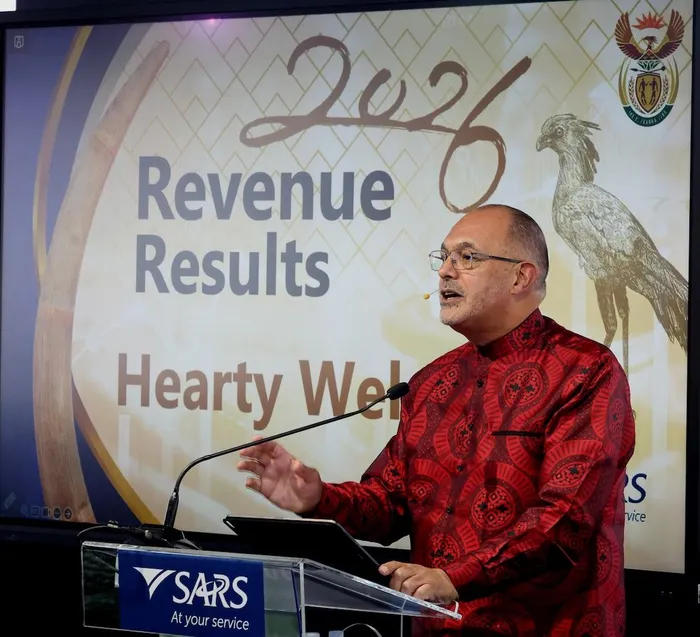
The South African Revenue Service (SARS) Commissioner, Edward Kieswetter, announces the preliminary revenue collection figures for the 2025/26 financial year in Pretoria on Wednesday.
Image: Supplied/GCIS
The South African Revenue Service (Sars) has achieved a historic milestone, collecting more than R2 trillion in net revenue for the first time since the dawn of democracy, underscoring a significant recovery in the country’s tax administration capacity.
Announcing the preliminary results for the 2025/26 financial year yesterday, Sars confirmed it had collected R2.01 trillion, marking an 8.4% increase from the previous year and exceeding earlier projections by R24.7 billion.
The outcome reflects steady growth in collections over the past seven years, supported by improved compliance, administrative reforms and targeted enforcement efforts.
Sars Commissioner Edward Kieswetter described the achievement as the result of sustained institutional rebuilding and the dedication of thousands of employees.
“Collecting over R2trln is not an accident, but the outcome of the more than 14,500 employees who diligently perform millions of activities meticulously to achieve this record collection,” Kieswetter said.
“Every rand not only helps build a capable state that honours the social contract but also enables the state to deliver for all South Africans and strengthen fiscal integrity of South Africa.”
The milestone comes despite a challenging economic backdrop marked by sluggish growth, persistent power constraints, global supply chain disruptions and geopolitical tensions.
Since 1997, Sars has collected R25.4trln in net tax revenue, with nearly half of that — R11.5trln — raised in just the past seven years.
Key tax categories delivered strong performances. Pay-As-You-Earn (PAYE) collections rose by 8.5%, benefiting from modest wage growth and fiscal drag, while corporate income tax (CIT) increased by 9.9%, driven by broad-based gains across large companies and small and medium enterprises.
Domestic value-added tax (VAT) collections also grew by 7.6%, supported by improved consumer sentiment, lower borrowing costs earlier in the year and targeted compliance interventions.
Kieswetter said compliance initiatives alone secured R316.4bn in revenue, including R164.6bn in direct collections and R151.8bn in prevented leakage. This highlights the growing role of enforcement and data-driven oversight in strengthening revenue performance.
However, not all areas performed evenly. Import VAT fell short of expectations, reflecting subdued trade conditions, although import duties exceeded forecasts, partly due to stronger passenger vehicle imports, a sign of recovering consumer demand.
Despite the record-breaking results, Kieswetter warned that the illicit economy remains a major threat to the country’s fiscal health. The illicit economy has grown significantly over the past two decades, faster than the formal economy, expanding from around 5% of GDP to between 12% and 15%.
Activities such as smuggling; customs and excise fraud; under‑declaration; counterfeit trade; fuel and tobacco syndicates; and organised tax crime divert resources away from essential public services and place compliant taxpayers and legitimate businesses at a disadvantage.
The agency estimates that more than R100bn is lost annually due to activities such as smuggling, counterfeit trade, customs fraud and organised tax crime.
“People who buy illicit goods often believe they are getting a bargain,” Kieswetter said. “In reality, they are funding the destruction of legitimate businesses and jobs, shrinking the country’s tax base, and weakening the very institutions meant to serve them.”
He added that Sars is intensifying efforts, in collaboration with law enforcement agencies, to dismantle illicit networks and make non-compliance increasingly difficult and costly.
Looking ahead, Kieswetter — who is leaving office at the end of April — said Sars is placing strong emphasis on technological innovation through its “Modernisation 3.0” strategy.
This includes the introduction of a unique digital identity for taxpayers, enhanced use of artificial intelligence and data science, and the expansion of automated tax assessments.
The system aims to simplify compliance and improve service delivery, moving toward a future where, as Sars puts it, “tax just happens.”
Kieswetter reflected on the milestone as he prepares to conclude his tenure, describing it as a culmination of years of reform following a period of institutional decline.
“As I come to the end of the seven years of national service, I recall the President’s call to restore credibility and capability to our institutions,” he said. “Together with the people at Sars, we have given our best to the nation.”
He also credited compliant taxpayers for the achievement, noting that their contributions are essential to funding public services and supporting vulnerable communities.
BUSINESS REPORT