

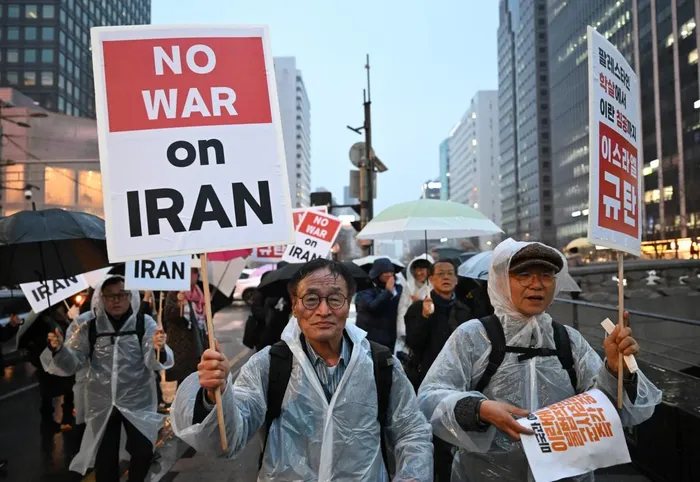
US President Donald Trump issuing a fresh ultimatum to Iran and escalating threats against its civilian infrastructure if it failed to reopen the Strait of Hormuz, but Tehran rejected the latest demand, leaving Hormuz effectively closed.
Image: AFP
A prolonged conflict involving Iran is rapidly pushing the global energy system toward a breaking point, with severe oil shortages, rising prices, and mounting risks of a worldwide economic downturn.
The price of Brent crude oil held around $107 per barrel on Monday amid reports of a potential Middle East ceasefire. This followed US President Donald Trump issuing a fresh ultimatum to Iran and escalating threats against its civilian infrastructure if it failed to reopen the Strait of Hormuz.
However, Tehran rejected the latest demand, warning that Iran will respond "in kind" to any attack on its infrastructure, and leaving Hormuz effectively closed.
The war has already removed approximately 10 million barrels per day (mbpd) of oil from global markets—roughly 10% of pre-conflict demand. While some supply has been partially rerouted through alternative Gulf pipelines, the disruption remains significant, leaving markets scrambling to adjust.
In the early stages, higher prices have absorbed part of the shock. However, oil demand is notoriously unresponsive in the short term. Even after a near 80% surge in crude prices, global consumption has fallen by only about 2.4 mbpd. This limited demand response highlights the lack of immediate alternatives, particularly in sectors heavily dependent on fuel.
To bridge the gap, countries have relied heavily on strategic reserves and commercial stockpiles, which are currently supplying an estimated 6 mbpd. While this has helped prevent widespread shortages, these buffers are finite and becoming increasingly strained.
As a result, a supply gap of around 2 mbpd persists—and is expected to widen sharply.
In a prolonged war scenario, where key infrastructure is damaged and vital shipping routes like the Strait of Hormuz remain closed, Oxford Economics said the shortfall could balloon to as much as 13 mbpd within six months. That would represent an unprecedented deficit of over 12% of global oil consumption.
The implications are severe. Unlike price-driven adjustments, which mainly curb discretionary use, prolonged shortages would force governments and industries into fuel rationing. This is the most economically damaging outcome, as it directly restricts access to energy needed for essential activities.
“The longer the disruption lasts, the more the adjustment shifts into rationing—the most economically destructive outcome, because it constrains essential fuel use and real activity rather than just discretionary demand,” said Bridget Payne, head of energy forecasting at Oxford Economics.
Diesel lies at the heart of the crisis. As the backbone of freight transport, agriculture, construction, and industrial production, diesel demand is particularly difficult to reduce. Shortages in this fuel quickly ripple through supply chains, driving up food prices, disrupting manufacturing, and slowing economic activity.
Evidence of strain is already emerging, particularly in vulnerable economies across Asia and sub-Saharan Africa. Governments have begun implementing emergency measures, including fuel rationing, reduced working weeks, and export restrictions. In some countries, filling stations are running dry, while black markets for fuel are taking hold.
Air travel has also been affected, with airlines cancelling flights due to jet fuel shortages. Meanwhile, regional trade disruptions are intensifying as countries prioritise domestic supply, worsening shortages in neighbouring markets.
If the situation persists, the economic fallout could be profound. According to Oxford Economics modelling, a prolonged disruption would likely trigger a global recession, with world GDP growth slowing to just 1.4% in 2026. Key sectors such as agriculture, manufacturing, and logistics would face significant constraints, amplifying inflationary pressures and weakening global demand.
Regional impacts, however, are uneven. North America remains relatively insulated due to strong domestic production and ample reserves, though consumers still face higher fuel costs. Europe is better positioned than many import-dependent economies but remains vulnerable, particularly if shortages extend to refined products like diesel.
Emerging markets are the most exposed. Heavy reliance on imports, limited storage capacity, and constrained fiscal resources make it difficult for these economies to absorb prolonged shocks. As shortages deepen, the effects are likely to cascade through food systems, transport networks, and industrial output.
In contrast, global natural gas markets appear more resilient. Although disruptions to liquefied natural gas (LNG) exports—particularly from Qatar—are significant, gas demand is more responsive to price changes. Power systems can switch to alternative fuels such as coal, allowing markets to rebalance more effectively.
Ultimately, the trajectory of the crisis will depend on the duration and intensity of the conflict.
BUSINESS REPORT