

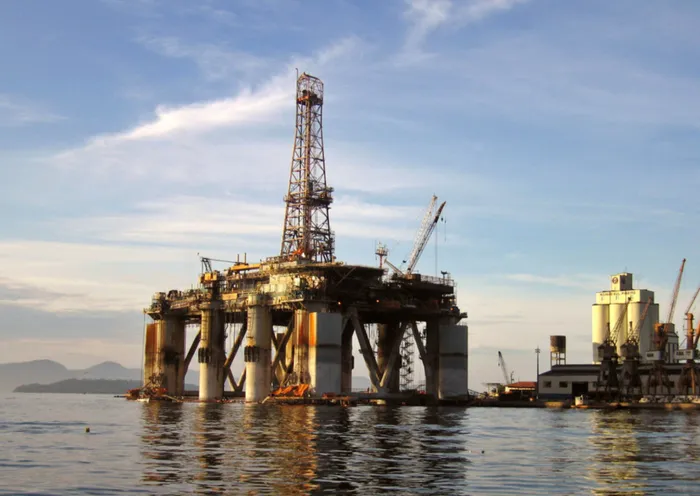
An oil rig is shown in this file photo. At the centre of investor anxiety is the Strait of Hormuz, the narrow maritime chokepoint through which roughly a fifth of globally traded crude oil and significant volumes of liquefied natural gas pass each day
Image: File
Oil prices surged to their highest level in more than a year on Monday morning, with Brent crude jumping 9.5% to $80 per barrel after unprecedented joint strikes by the United States and Israel on Iran triggered a full-scale regional conflict and reignited fears of major supply disruptions in the Middle East.
The sharp move underscores how quickly geopolitical risk in the world’s most systemically important energy corridor can spill into global markets.
At the centre of investor anxiety is the Strait of Hormuz, the narrow maritime chokepoint through which roughly a fifth of globally traded crude oil and significant volumes of liquefied natural gas pass each day.
While Tehran has insisted the strait remains open, shipping companies have begun rerouting vessels amid rising security concerns and reports of tanker attacks, effectively tightening flows.
Energy markets reacted immediately. Beyond oil, gold climbed more than 2% to above $5,400 per ounce, marking an over one-month high as investors sought safe-haven assets. The precious metal has now recorded seven consecutive monthly gains, its longest streak in more than five decades, reflecting both geopolitical stress and shifting global capital flows.
Oil’s spike comes despite efforts by OPEC+ to cushion the blow. Eight member countries — Saudi Arabia, Russia, Iraq, the United Arab Emirates, Kuwait, Kazakhstan, Algeria and Oman — met virtually on Sunday and agreed to increase production by 206,000 barrels per day in April.
The move ends a three-month pause in output adjustments but falls short of the larger increases previously under consideration. The group reiterated its commitment to market stability and flexibility, noting that the phased return of 1.65 million barrels per day in voluntary cuts would remain subject to evolving conditions.
However, analysts cautioned that additional supply on paper offers limited relief if oil cannot move freely through shipping lanes.
“Even the perception of disruption - whether through direct conflict, retaliatory action or tightened sanctions - introduces risk premiums into oil and shipping markets,” said Dr Ernst van Biljon, head lecturer in Supply Chain Management at the IMM Graduate School.
“Freight rates typically follow, as insurers adjust war-risk cover and shipping routes are reassessed. For global supply chains still recalibrating after pandemic-era disruptions and Red Sea shipping instability, this adds another layer of uncertainty.”
The ripple effects extend well beyond the energy sector. Higher oil prices feed directly into transport costs, manufacturing inputs and food systems, which depend heavily on fuel for fertiliser production, mechanised agriculture and distribution. Central banks that had been cautiously considering interest rate cuts may be forced to pause if oil-driven inflation proves persistent.
For South Africa, the implications are particularly acute. As a net importer of crude oil, the country is highly exposed to price shocks. A 10% increase in oil prices can quickly translate into higher fuel costs, putting upward pressure on transport expenses, food inflation and household spending.
North West University Business School economist Prof Raymond Parsons said South Africa must not underestimate the potential negative economic and business implications that could yet unfold for many economies resulting from the US-Israel attack on Iran.
“The latest geopolitical developments have raised key questions about the future stability of the Middle East’s political economy. The biggest immediate impact for countries like South Africa will inevitably be the elevated uncertainty about global oil prices, and hence the prospect of higher fuel costs in the months ahead,” Parsons said.
“The global oil price outlook, therefore, basically remains very uncertain in the highly volatile geopolitical circumstances now existing in the Middle East.”
The rand, already sensitive to global risk sentiment, faces renewed depreciation risks in a flight-to-safety environment, compounding imported inflation. The domestic currency plunged to a one-month low, falling by 1.6% to R16.19 against the US dollar on Monday.
TreasuryONE currency strategist Andre Cilliers said markets are now watching developments “hour by hour.”
The key question, he argued, is whether fighting stabilises and maritime traffic resumes, limiting the spike to a short-lived shock, or whether the conflict deepens and keeps the Strait of Hormuz effectively constrained. The latter scenario risks entrenching a broader global energy and inflation shock.
“Risk aversion is the name of the game as we start March. Gold is back up close to $5,400, with safe-haven buying top of mind as the world reassesses risk amid the war in Iran. The rand and other emerging-market currencies are under pressure as the market assesses how this all plays out,” Cilliers said.
BUSINESS REPORT