

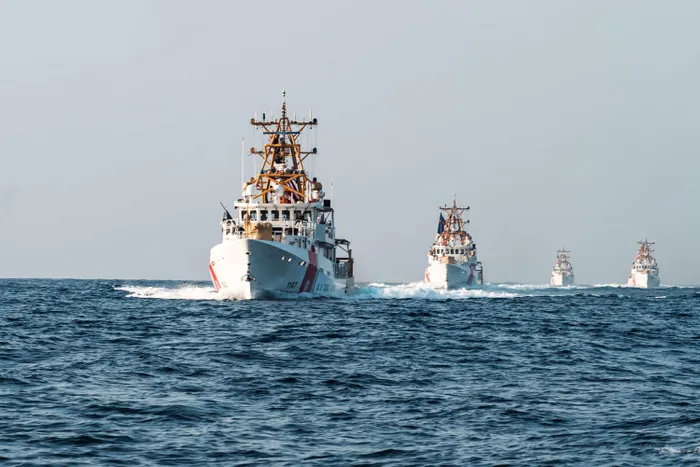
The Strait of Hormuz, which handles between 17 and 20 million barrels of oil daily, has effectively been constrained since the escalation of tensions between the US and Iran, limiting global energy flows.
Image: Noah Martin / Various Sources / AFP
Global markets have been rattled after Donald Trump announced a US-led blockade of the Strait of Hormuz, sending oil prices sharply higher and intensifying fears of inflation, interest rate hikes, and a broader economic slowdown.
The global price of Brent crude oil jumped 7% to $103 per barrel (bbl) following the announcement, reflecting immediate concerns over supply disruptions in one of the world’s most critical energy corridors.
The Strait of Hormuz, which handles between 17 and 20 million barrels of oil daily, has effectively been constrained since the escalation of tensions between the US and Iran, limiting global energy flows.
Trump escalated rhetoric further, warning that Iranian vessels and “fast-attack ships” approaching the blockade would be “immediately eliminated,” signalling a more aggressive military posture after the collapse of weekend negotiations between Washington and Tehran.
The breakdown of talks in Islamabad, Pakistan, has raised the prospect of a prolonged standoff, with significant implications for global trade and energy markets.
Economists warn that sustained disruption to oil flows through the Strait could have far-reaching consequences.
Annabel Bishop of Investec said financial markets have already begun adjusting expectations, particularly in South Africa, where rising fuel costs are feeding into inflation forecasts.
She noted that the forward rate agreement (FRA) curve now signals a full probability of a 25 basis point interest rate hike in May, earlier than previously anticipated. Just a week ago, markets expected a potential hike in July, reflecting how quickly sentiment has shifted in response to geopolitical developments.
Bishop warned that a prolonged conflict in the Middle East poses a clear upside risk to both inflation and interest rates.
“The ICE futures for Brent crude oil show only a slight drop to $84/bbl by November from US$102/bbl currently,” she said.
“In general, there is an upside risk to both our inflation and interest rate forecasts as they do not incorporate large fuel price hikes in May or later this year, built instead on a quick end to the war, lower fuel prices and a stronger rand.”
The fragile two-week truce between the US and Iran now looks likely to collapse as Tehran signaled that no port in the region will be safe if traffic to and from its own is impeded.
Legal and geopolitical analysts said the blockade marks a significant escalation.
Professor Andre Thomashausen from the Unisa described blockades as a longstanding instrument in international law, often used as a countermeasure during armed conflict. He argued that if Iran had restricted access to the waterway, a blockade could be considered a proportional response.
“In the case of the illegal closing and mining of the international waterway of Hormuz by Iran, the countermeasure of a blockade is a proportional and permitted response,” he said.
“The blockade is the lesser and preferable means of pressure, rather than a full resumption of large-scale bombardments.”
From a political and economic perspective, Dr Sakhile Hadebe of the University of KwaZulu-Natal said the announcement underscores the fragility of the current global environment.
He noted that while the immediate focus is on military and strategic considerations, the longer-term economic consequences could be severe.
“A chokepoint through which a substantial proportion of the world’s oil passes. Any form of blockade raises the risk of supply disruptions, whether through direct restriction or retaliatory actions,” he said.
“The possibility of a global recession, while not inevitable, becomes more plausible under sustained escalation. The global economy is already navigating a complex recovery path marked by uneven growth, high debt levels, and lingering post-pandemic vulnerabilities.”
Meanwhile, Prof Raymond Parsons from North West University's Business School, said the conflict is already weighing on global growth, inflation, and supply chains.
He pointed to expectations that the International Monetary Fund will revise its global economic outlook downward at its upcoming Spring Meetings.
“This week the International Monetary Fund will likely confirm its revision of the world economic outlook at its Spring meeting. But the failure of the recent US-Iran negotiations, the fragile ceasefire, and the threatened US blockade of the Hormuz Strait now combine to raise the economic risks for the world economy,” he said.
“The longer the conflict continues, the higher will be the cost of the war to most economies, whatever steps they may be taking to soften its impact.”
BUSINESS REPORT