

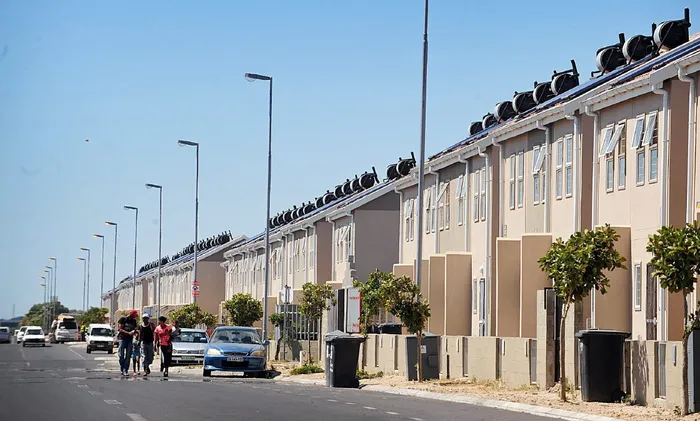
The Western Cape High Court interdicted liquidators from selling or disposing of 41 properties forming part of the Olive Close housing project in Melkbosstrand. (Indicative photo.)
Image: David Ritchie | Independent Media
A High Court judge has stepped in to halt the threatened sale of dozens of state-subsidised homes in Cape Town, warning that allowing liquidators to proceed could trigger evictions, undermine housing rights and derail a flagship government housing programme.
In an urgent judgment delivered on Friday, December 12, the Western Cape High Court interdicted liquidators from selling or disposing of 41 properties forming part of the Olive Close housing project in Melkbosstrand, pending a final ruling on whether the homes can legally be sold at all.
Judge Mangcu-Lockwood said the case raised issues “of national and constitutional significance”, particularly in light of South Africa’s housing crisis and the state’s obligations under the Constitution.
The matter was brought by the City of Cape Town, its city manager Lungelo Mbandazayo and mayoral committee member for human settlements Carl Joshua Pophaim, following moves by liquidators of Catch the Wind Trading to auction the properties.
Catch the Wind was the developer appointed to build 100 low-cost houses under the Melkbos Village Housing Project.
While 59 houses were transferred to beneficiaries more than a decade ago, 41 remain registered in the company’s name after it was finally liquidated in March 2024.
In her judgment, Mangcu-Lockwood said the homes were part of a state-subsidised housing scheme intended for low-income beneficiaries and were not ordinary commercial assets.
“The Olive Close properties are state assets which are meant to benefit housing beneficiaries as part of the State’s obligations to fulfil the rights in section 26 of the Constitution,” the judge said.
The judge warned that selling the properties on the open market could have severe consequences.
“It is therefore highly likely that, if the 41 properties are sold to third parties, those parties will seek to evict the beneficiaries and/or unlawful occupiers of the properties,” the ruling said.
“In those circumstances, the City will probably be required to offer emergency housing to those persons, in terms of its constitutional duty to provide housing.”
Mangcu-Lockwood said such an outcome would be irrational.
“Manifestly, this would not be in the interests of justice as this would have the effect of depriving the beneficiaries of permanent state-subsidised housing to which they are entitled in lieu of emergency accommodation,” the judge said.
The liquidators had argued they were entitled to sell the properties to cover liquidation costs and creditor claims, proposing either private sales or auctions. But the court found there was a strong prima facie case that the Housing Act barred such sales.
The Act “prevents the successors in title or creditors in law, from selling or otherwise alienating such a property unless it has first been offered to the relevant housing department at a price not greater than the subsidy which the person received for the property,” the judge said.
The judge also rejected the idea that the homes could be treated as assets of the insolvent company.
“Even though the 41 houses are yet to be transferred to the names of the beneficiaries, as a matter of law they are not assets of the sompany,” Mangcu-Lockwood said. “Even in the liquidation and distribution account of the company, the properties are not reflected as assets of the company.”
The court also interdicted the Master of the High Court and the Assistant Master from continuing with subpoenas compelling City officials and councillors to appear at creditor meetings, after finding that those steps were not opposed and could be dealt with later in full review proceedings.
The judge noted that liquidators had failed to give assurances that they would halt attempts to sell the properties.
“There can be no clearer instance of an injury reasonably apprehended,” the judge said, “The injury is not only to the city, but to the lawful beneficiaries of the Olive Close project.”
While the ruling does not finally determine whether the properties may ever be sold, Mangcu-Lockwood said the court was obliged to preserve the status quo until the legal questions are fully ventilated.
“There are questions of law relating to whether they are entitled to do so, and those questions warrant resolving before they embark upon the process of a sale or auction,” the judge said.
The judge noted that the liquidator and the Western Cape Provincial Minister of Human Settlements were “interdicted and restrained from taking any action whatsoever to dispose of or sell the forty one immoveable properties registered in the name of the company that for part of the state housing scheme know as Olive Close which forms part of the Melkbos Village Housing Project”.
Costs were reserved for later determination.
IOL BUSINESS