

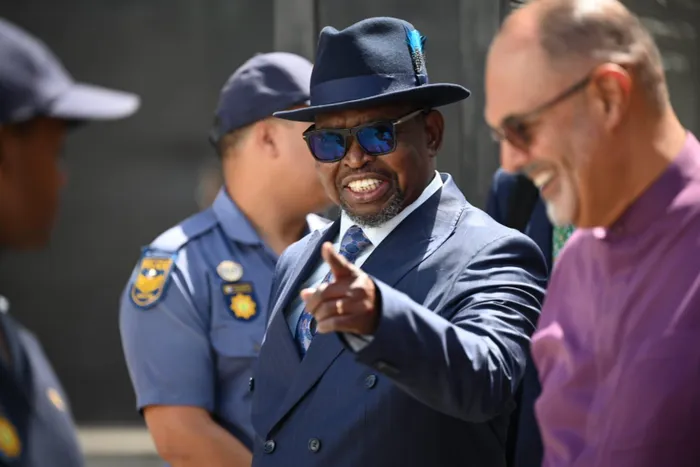
Finance Minister Enoch Godongwana delivered South Africa’s 2026 national budget speech in Parliament in Cape Town
Image: Armand Hough / Independent Newspapers
Finance Minister Enoch Godongwana is expected to table the 2026 National Budget today at 2pm.
Minister Enoch Godongwana delivered the 2026 National Budget.
Read his full speech here.
Over the medium-term, public-sector spending on infrastructure will exceed R1 trillion. Of this:
• R577.4 billion will be spent by state owned companies and other public entities;
• R217.8 billion by provinces;
• R205.7 billion by municipalities.
In 2026/27, 48.9 per cent of nationally raised revenue is allocated to national government, 41.7 per cent to provinces and 9.4 per cent to local government.
The split translates to R951,7 billion for national government, R810.5 billion for provinces andR182,3 billion for municipalities.
Additional allocations to the provincial equitable share include R342 million to progressively equalise Grade R teacher pay, R340 million for the early retirement and voluntary exit programme, and R319 million for the presidential employment initiative.
Basic Education - In terms of consolidated expenditure, spending on education remains the largest component at 23.7 per cent over the medium term. Basic education receives R22.7 billion for carry-through costs announced in May 2025. Early childhood development receives the majority of these funds.R9.9 billion supports employee compensation and other pressures in education. Early childhood development grant receives an additional R12.8 billion over the next three years, expanding service to an additional 300 000 children. This will also maintain the increased per child, per-day subsidy of R24 introduced in 2025/26. The increased allocations align the National School Nutrition Programme with food inflation to continue providing meals to over 9.9 million learners in almost 20 000 schools.
Health - R26 billion is allocated to provinces to bolster our HIV/AIDS programme such as the prevention of mother-to-child transmission and the provision of anti-retro virals.
R21.3 billion is allocated to the health sector over the medium term for the compensationand employment of doctors, and to make up for shortfalls in goods and services expenditure.
To support the deployment of the SANDF and other efforts to intensify law and order, spending on peace and security increases from R268.2 billion in 2025/26 to R291.2 billion in 2028/29. The Border Management Authority has been allocated an additional R990 million over the medium term to build capacity by filling 738 positions.
R2.7 billion is added to defence over the medium term to improve operations, including to maintain the South African Air Force’s fighter capability.
In addition R1 billion has been allocated to the police service, and another R1 billion to the SANDF, through the CARA fund for the fight against organised crime.
Over the medium term, R883.8 million is shifted from the Department of Justice and Constitutional Development to the Office of the Chief Justice. An additional R687 million has been allocated to increase capacity in the judiciary.
The fiscal framework tabled in the 2025 MTBPS included R8.5 billion added to the contingency reserve. The special appropriation bill tabled today allocates these funds. The special appropriation bill also includes, amongst others:• R5.8 billion for PRASA’s rolling stock fleet renewal programme;
• R1 billion for South Africa’s share subscription to the international finance corporation;and
• R700 million for the Department of Communications and Digital Technology.
For 2026/27, social grants are allocated R292.8 billion, enabling the following increases:
● The old age grant, disability grant and care dependency grant rise by R80 in April 2026, to R2 400.
● The war veterans grant also increases by R80 to R2 420.
● The foster care grant goes up to R1 290 in April, a R40 increase and to R1 300 in October, a R10 increase.
● The child support grant and grant-in-aid grant increase by R20 to R580.The social relief of distress continues in its current form over the year ahead.
Government will spend R2.67 trillion. This spending includes a proposed R5 billion in the contingency reserve to cater to disasters declared since the MTBPS. Government spending remains highly redistributive. The social wage accounts for more than60 per cent of non-interest spending over the medium term.
Basic education, health and social protection constitute 70.3 per cent of the social wage in 2026/27, providing support to 13.6 million school children, healthcare services to 84 per cent of the population and social grants to 26.5 million beneficiaries.
R12 billion in savings have been identified over the medium term. Targeted and responsible savings are not a once-off initiative. They will be an ongoing and entrenched part of the budget process going forward to weed out inefficiencies and low-performing programmes. Every programme and every allocation must demonstrate value, efficiency and accountability.
As part of this process, the Public Transport Network Grant has been scaled down, by about R8.4 billion, over the next three years. The grant has not improved access to public transport relative to the investments made. The grant will, however, continue to help cover indirect costs in cities that run bus services.
Following recommendations from the Financial Sector Conduct Authority, National Treasury will introduce reforms to manage these unclaimed benefits through the creation of a central administrator responsible for record keeping and tracing.
Crypto Assets - Crypto assets will now be governed in the cross-border movement of capital framework, which will be complementary to regulations already in place to prevent the use of crypto assets to launder money and commit fraud.
Data infrastructure - Government will be exploring options to help data centres and related infrastructure to expand these investments in South Africa and solidify our role as a regional hub for these technologies.
Trade - National Treasury is easing restrictions on the cross-border flows of capital by enabling domestic asset managers to manage portfolios of foreign assets.
Payments - National Treasury, working with the South African Reserve Bank, has prioritised modernising the national payments system and innovation in digital finance. PayInc will provide an open, shared digital payments infrastructure to support operability across various payment providers, serving as the main platform for high-value and retail transactions.
In terms of fuel levies, the total increase will also be in line with inflation.
• The general fuel levy will go up by 9 cents per litre for petrol and 8 cents per litre for diesel.
• The carbon fuel levy will go up by 5 cents per litre for petrol and 6 cents for diesel.
• The Road Accident Fund levy will increase by 7 cents per litre.
• The tax on a 20-pack of cigarettes rises from R22.81 to R23.58.
• Pipe tobacco rises by 28 cents per 25 grams, and cigarette tobacco by 87 cents per 50grams.
• Cigars rise by R4.56 per 23 grams
• A 340 millilitre can of beer or cider increases by 8 cents.
• A 750 millilitre bottle of wine goes up by 15 cents.
• A 750 millilitre bottle of spirits will increase by R3.20
Minister Godongwana said for 2025/26, the gross tax revenue is revised up by R21.3 billion compared to the estimate in the 2025 Budget.
"Higher-than-expected net VAT, corporate income tax and dividends tax collections, improved the in-year outlook. As a result, government has decided to withdraw the R20 billion in tax increases provisionally included in the May 2025 Budget. The improving fiscal position allows us enough room to withdraw the proposed tax increases, without putting fiscal sustainability or economic activity at risk," Godongwana said.