

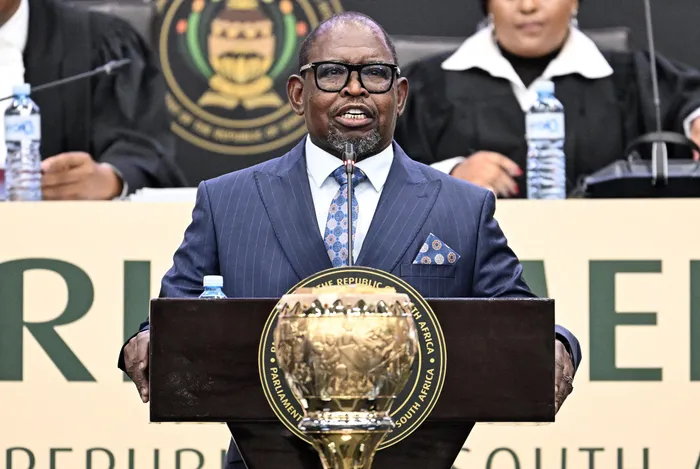
Finance Minister Enoch Godongwana’s Budget 2026 has drawn cautious optimism from tax experts, investors and business leaders.
Image: GCIS
Finance Minister Enoch Godongwana’s Budget 2026 draws cautious optimism from tax experts, investors and business leaders, who say the fiscal stance signals stability, credibility and a shift towards growth-supporting reforms.
While concerns remain around execution, corruption, debt levels and youth unemployment, the overall tone from commentators is notably more positive than in recent years.
Godongwana also pointed to firmer growth projections and what he described as a decisive shift in the country’s fiscal trajectory.
Treasury now expects real economic growth of 1.6% in 2026, an improvement on the 1.4% estimated for 2025.
Nolan Wapenaar, head of Fixed Income at Anchor Capital, said the government was using improved conditions to take steps in the right direction.
“Overall, the impression is one of the government taking pragmatic advantage of the opportunity afforded to South Africa by the commodity boom.”
Wapenaar warned that global growth risks, commodity volatility and state-owned entity pressures remained vulnerabilities. Still, he said markets were likely to respond positively in the near term.
“For now, we expect a slightly stronger financial market as the budget serves to confirm that we are staying on the path of fiscal consolidation,” said Wapenaar.
Liam Dawson, portfolio manager at PortfolioMetrix, said the budget represented a break from past patterns.
"The budget today indicated a stark contrast from times gone by. This simply means that we are rising in the ranks of Emerging Markets.” He said the fiscal framework strengthened credibility.
“This budget goes a long way to winning over investor credibility. The biggest change from the Zuma years is that the numbers now under promise and over-deliver.”
However, “delivery is still important,” said Dawson.
Althea Soobyah, head of Tax at Forvis Mazars, said Budget 2026 marked a clear change in direction after years of pressure.
“In the last five years, Treasury has been under significant fiscal pressure. Overall, Budget 2026 is a lot more positive than we’ve seen in years. It’s measured and, importantly, provides some relief to individual taxpayers.”
Soobyah pointed to inflation-linked adjustments to personal income tax brackets and rebates, alongside higher limits for retirement fund deductions and tax-free investments.
“This is a very credible budget which will encourage confidence and motivate compliance, the latter of which is important to grow tax revenues,” she said.
For small businesses, Soobyah said the increase in the compulsory value-added tax registration threshold from R1 million to R2.3 million was particularly significant.
“The last time the VAT threshold was amended was in 2009. A business turning over R1 million in 2009 looks very different to a R1 million business today,” Soobyah said.
Soobyah added that even modest improvements were being welcomed after a prolonged cycle of difficult budgets.
“We’ve become so accustomed to bad news budgets that even small adjustment shifts are well received and reflect National Treasury’s shift away from a reliance on tax revenue towards growth-enhancing initiatives.”
Charl Hall, tax director at Forvis Mazars, said the Finance Minister’s speech signalled an important policy shift for Special Economic Zones (SEZs).
“The Finance Minister used his Budget Speech to signal a move toward a more credible, substance-driven incentive model for the country’s SEZs.” He said the approach would align SEZ qualification with arm’s length, market-based transfer pricing standards already embedded in South Africa’s framework.
“The shift towards a more market-competitive approach strengthens the original purpose of SEZs to support export-led growth, attract investment, and build high-skilled, high-value industries.”
Hall noted the reforms came at a time when global tax rules were tightening.
“This transition arrives at a moment when global tax rules are tightening, meaning that incentives that lack genuine economic substance will struggle to deliver lasting benefit,” says Hall.
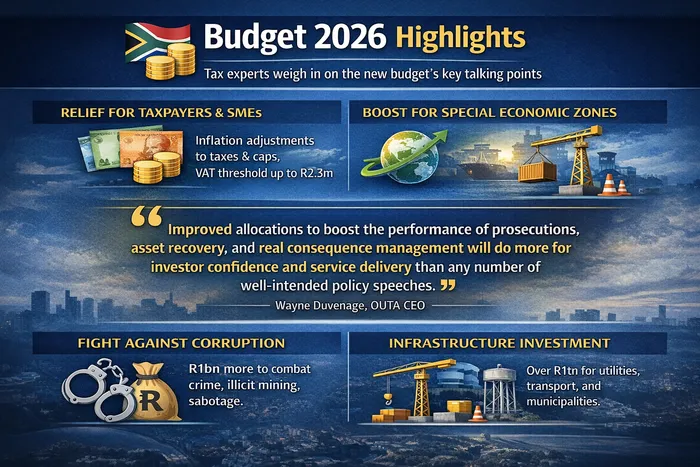
Key National Budget 2026 highlights.
Image: ChatGPT
The Organisation Undoing Tax Abuse (OUTA) welcomed additional funding to tackle organised crime, illicit mining and economic sabotage, but warned it was insufficient.
Funding for the judiciary will increase by R687 million over three years, alongside an additional R1 billion allocation to fight organised criminal activity.
“Improved allocations to boost the performance of prosecutions, asset recovery, and real consequence management will do more for investor confidence and service delivery than any number of well-intended policy speeches,” said Wayne Duvenage, OUTA CEO. “Corruption is not only a moral issue. It is a direct economic risk.”
OUTA also raised concerns about debt. “Every rand lost to corruption leads to increased pressure on borrowing, which impacts negatively on debt service, translating into fewer services,” said Duvenage.
Tax Justice SA leader Yusuf Abramjee added that ‘llicit trade is draining around R100 billion a year from the fiscus. “That’s R250 million every single day going to criminals instead of schools, hospitals and policing. South Africans don’t need more speeches. They need arrests, prosecutions and recovered revenue,” Abramjee said.

Finance Minister Finance Minister Enoch Godongwana aims to cut down on illegal trade.
Image: ChatGPT
Yael Geffen, chief executive of Lew Geffen Sotheby’s International Realty, said reforms targeting metro trading services could have far-reaching positive implications for the property sector.
“It’s a stark warning to badly run councils because the Minister pointed to Johannesburg as a case study of failure.”
Under the new system, revenue collected for services must be reinvested into those same services. “Let’s be blunt: one of the biggest reasons for the flood of semigration to the Western Cape is simple – the municipalities there work.”
Yet, Momentum Group Foundation’s Nkosinathi Mahlangu said the budget lacked concrete new interventions for youth unemployment.
“While this year’s Budget is broadly consumer-friendly and fiscally responsible, it does not present tangible new action to address youth unemployment at the scale the crisis demands.”
As new institutions such as the University of Ekurhuleni take shape, there should be a deliberate focus on faculties aligned to scarce and economically relevant skills, rather than duplicating programmes that already exist, said Mahlangu.
IOL Business