


Independent delivery contractors could soon be granted protection under proposed changes to labour laws.
Image: ChatGPT
The delivery driver bringing you dinner. The ride-hailing operator weaving through traffic to get you home. The courier dropping off your late-night online splurge.
Under proposed changes to South Africa’s labour laws, they may soon be treated as employees and not “independent contractors”.
Cabinet recently approved the publication of the Labour Laws Amendment Bill, 2025 and the Labour Relations Amendment Bill, 2025 for public comment.
The proposals are not yet law, with public comment open until the end of March, but they signal the biggest shake-up of labour relations in decades.
At the centre of the shift is a strengthened presumption of employment. If implemented, the law would extend labour protection to anyone whose employment is controlled by a platform or company.
People who are integrated into a business or depend on a company for an income also become employees, regardless of what your contract says.
While not a legal definition of a “gig worker,” the draft amendments redraw the line around who counts as an employee.
That could pull app-based drivers, food delivery riders, freelance platform workers, hospitality shift staff and even certain film and television freelancers into the full protection of labour law.
If classified as employees, they would be entitled to join trade unions, bargain collectively and take part in protected strike action.
Companies would have to issue written contracts to shift and “on-call” workers, setting out guaranteed hours, maximum hours and notice periods. Cancel a shift without proper warning, and the worker must be paid.
For workers long treated as flexible, disposable labour, it is a fundamental shift.
But the reforms are not one-sided.
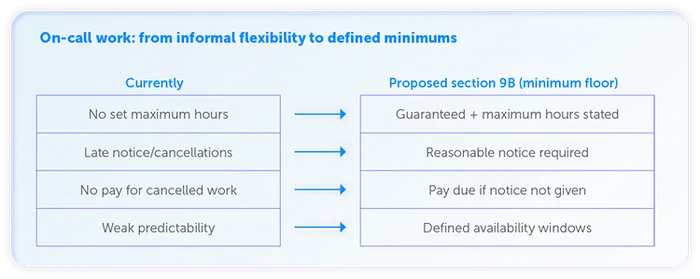
Proposed changes to labour law will increase protection for gig workers.
Image: Cliffe Dekker Hofmeyr
Severance pay in retrenchments would double from one week to two weeks’ remuneration for every completed year of service.
At the same time, it would become easier to dismiss staff.
Under the draft amendments, employees could be dismissed without a hearing in the first three months of employment, or during probation, whichever comes first.
Disciplinary procedures are streamlined and align with the revised Code of Good Practice on Dismissal issued in 2025, which lowers procedural hurdles in cases of incapacity or misconduct.
However, high earners will see their compensation for unfair dismissal capped at R1.8 million.
New small businesses would also be exempt from bargaining council agreements for their first two years – a move designed to ease regulatory pressure on start-ups.
Cabinet said the Bills aim to modernise labour law, strengthen enforcement and extend protections to vulnerable and previously excluded workers, while balancing employers’ operational requirements.
“Proposed amendments aim to strike an appropriate balance between increased flexibility for employers and enhanced protections for workers,” the Cabinet statement said.
IOL BUSINESS