

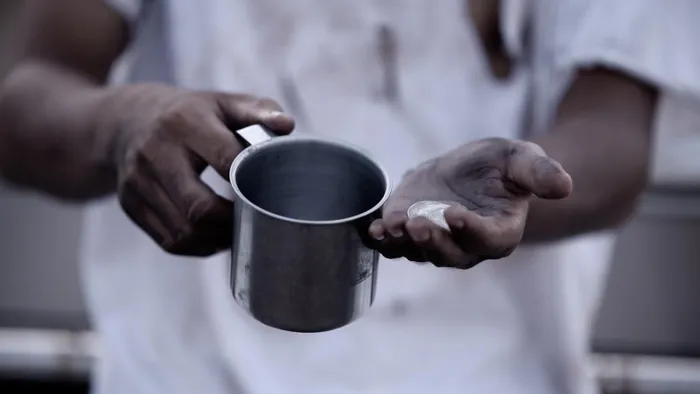
Poverty cannot be understood purely in terms of income, as perceptions of wellbeing are influenced by broader economic and social pressures.
Image: Freepik
Fewer South Africans now describe themselves as poor than they did eight years ago, but many still say their income does not cover the cost of everyday living.
This is one of the key findings from Statistics South Africa’s report Subjective Poverty in South Africa: Findings from the Income & Expenditure Survey, 2022/2023. And it notably found that “individuals’ reported levels of happiness are consistently associated with how they evaluate their financial circumstances”.
The study examines what economists call subjective poverty – how individuals perceive their own financial well-being and whether they believe they can meet what they consider to be a basic, acceptable standard of living.
Unlike traditional poverty measures based purely on income, subjective poverty reflects how households experience financial pressure, including the rising cost of living and the responsibility of supporting extended family members.
Financial strain
“Even households that do not perceive themselves as “poor” may still feel financially strained and uncertain. And those perceptions matter – they influence how households make decisions, plan for the future, and navigate the challenges of everyday life,” said Statistics South Africa.
Two of the three measures used to assess subjective poverty improved between 2015 and 2023. Using the self-perceived wealth indicator, the share of individuals who considered themselves poor declined from 34.4% in 2015 to 25.7% in 2023.
The minimum income indicator, which compares what households say they need to make ends meet with what they actually earn, also improved. The proportion of individuals who reported falling below their perceived minimum income declined from 50.6% in 2015 to 41.3% in 2023.
Insufficient income
However, a third measure showed the opposite trend. The income evaluation indicator, which asks individuals whether their income is sufficient to meet their needs, increased from 49.7% in 2015 to 51.4% in 2023.
“This means that a slightly larger share of individuals now regard their income falls short, even though fewer individuals classified themselves as poor overall,” said Statistics South Africa.
A similar pattern appears at household level.
The proportion of households that classified themselves as poor using the self-perceived wealth indicator declined from 33.8% in 2015 to 25.3% in 2023. The minimum income indicator also improved, falling from 53.0% to 44.5%.
At the same time, the share of households reporting that their income is insufficient increased from 48.8% to 51%.
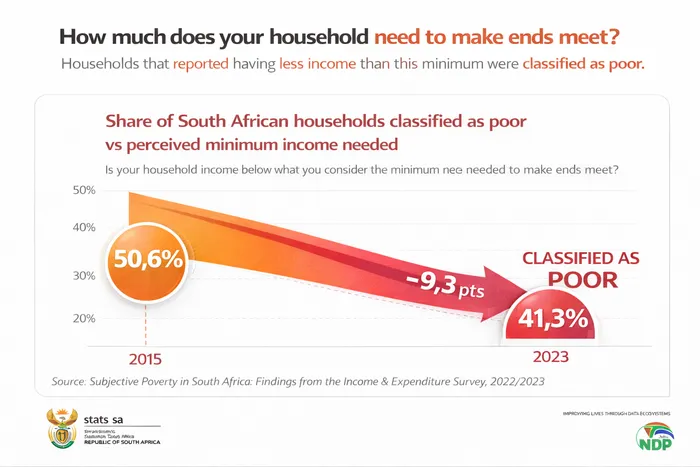
Residents in South Africa are increasingly less likely to label themselves as poor, yet many still perceive themselves to be financially stretched and unable to meet the rising cost of living.
Image: Statistics South Africa
Happiness and poverty
The report also highlights differences between subjective and traditional poverty measures.
While objective measures often show women facing higher poverty risks, the subjective indicators suggest men are slightly more likely to perceive themselves as poor.
The survey also found a strong link between happiness and poverty.
Using the Lower-Bound Poverty Line – the income required to cover basic food and essential non-food items – 40.6% of individuals who described themselves as less happy were classified as poor in 2023. Among those who described themselves as happier, the poverty rate was 16.8%.
The gap becomes even larger when subjective measures are used. According to the self-perceived wealth indicator, 54% of individuals who described themselves as less happy also regarded themselves as poor, compared with 14.7% among those who reported being happier.
Statistics South Africa said the findings show that poverty cannot be understood purely in terms of income, as perceptions of wellbeing are influenced by broader economic and social pressures.
IOL BUSINESS