

The war in the Middle East will have global ramifications on the economy.
Image: ChatGPT
A widening conflict in the Middle East has raised concerns among economists that the global economy could face another energy-driven shock, potentially pushing up inflation and slowing growth.
But analysts say the economic consequences will depend largely on one factor: how long the conflict lasts.
Military strikes by the US and Israel on Iran, followed by retaliatory attacks targeting US bases, Israel and Gulf states, have pushed the region into what economists describe as a new period of uncertainty for global markets.
The biggest economic risk lies in energy markets. The Middle East remains central to global oil and gas supply, and disruptions to production or shipping routes could push prices higher.
Economists say the clearest way the conflict could affect the global economy is through energy prices.
Analysts at Capital Economics said the overall impact will depend largely on how far oil prices rise.
“If oil stays near $70 to $80 per barrel, developing market (DM) inflation will be only about 0.2 to 0.3 percentage points above our baseline forecast and the broader economic fallout should remain limited,” the firm said.
Capital Economics added that “if prices climb to $90 to $100, DM inflation could rise up to 0.7 percentage points, and we would probably shave a few tenths from 2026 gross domestic product growth forecasts”.
Developed markets, often shortened to “DM,” refers to advanced economies such as the United States, Europe and Japan.
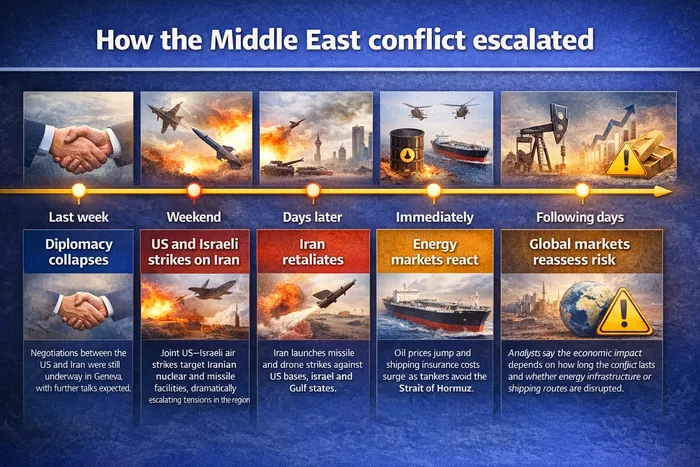
How the Middle East conflict escalated.
Image: ChatGPT
The duration of the conflict is emerging as the key variable economists are watching.
Analysis from Allianz notes that the economic consequences could remain limited if the conflict ends quickly.
“The US-Israeli strikes on Iran will have implications for energy markets, shipping costs, inflation risks and financial conditions – but everything hinges on how long the conflict lasts,” Allianz said.
The firm said it still expects a relatively short escalation.
“While a prolonged war could bring back a 2022-style inflation shock, we continue to expect a relatively short-lived escalation, with oil prices expected at $70 per barrel.”
This, Allianz said, is more than 15% up from previous estimates; peak expected at $85 and contains implications for global gross domestic product and inflation.
However, Allianz warned that the risks rise if fighting drags on.
“A conflict extending beyond a four- to six-week window would have greater macro and market implications.”
Allianz said it views three months as the turning point towards a switching regime risk and a recessionary scenario. “But the US administration has an incentive to end the conflict soon as higher oil prices worsening the affordability crisis could mean less support in the November midterm elections,” it said.
Economists at Investec outlined several potential paths for the conflict. Each carries very different implications for global markets.
“Trump has stated that Operation Epic Fury would last about four weeks.”
In this scenario, the US could declare the mission complete once key military targets have been hit. Investec noted that a short conflict may already be reflected in financial markets.
“A short conflict such as this may be what markets are pricing in given the relatively contained market moves this morning.”
Investec said regime change appears unlikely.
“Such a scenario is seemingly what the White House would like to achieve, but broad consensus is that this is unlikely, especially with air power alone and with American ‘boots on the ground’ looking to be a definitive red line for Trump.”
The bank said that, even if Iran’s leadership were removed, the current political system would likely endure.
“Reported US intelligence assessments ahead of the strikes were that such an outturn was unlikely in the near-term even if [cleric and former supreme leader of Iran] Khamenei was killed, they concluded that he would likely be replaced by hardliners.”
Investec said the risk remains that events could draw the US into a longer military campaign.
“Whilst the White House may have a plan for how long the conflict lasts, developments can always change the dynamics and it is possible that events on the ground change and the US is drawn into a far longer operation than had been anticipated, as was the case with Iraq and Afghanistan.”
Investec added that, for the global economy and markets, such a scenario would pose even greater question marks over energy supplies.
The most serious risk would be a wider regional war. “To quote an old military maxim, ‘no plan lasts first contact,’ which in this context could be analogous to unforeseen consequences and the situation spiralling out of control.”
Investec warned that such an outcome could create lasting instability in the region. “This for the Middle East would also represent a lasting and chaotic threat to regional stability.”
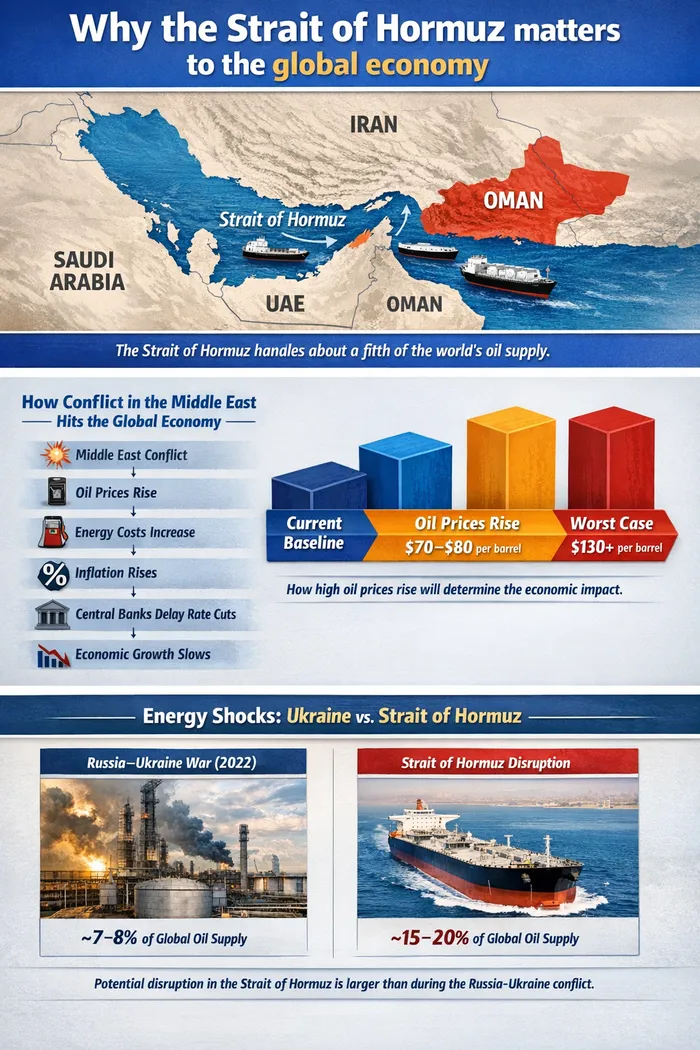
Here's why the closed shipping route matters to the rest of the world.
Image: ChatGPT
Energy supply concerns extend beyond oil production. Annabel Bishop, chief economist at Investec, said shipping disruptions are already affecting global energy markets.
“Supply constraints for oil shipping (exports) are currently key drivers of higher oil prices given the heavily constrained transport routes and increased price of shipping now… The cost of shipping has gone up, more than quadrupling for some tanker spot prices.”
Bishop added that the conflict has affected a range of countries in the region. “The number of countries hit by Iranian missiles exceeds eight now, including the UAE, Saudi Arabia, Jordan, Israel, Oman, Qatar, Kuwait, Iraq and Bahrain.”
Shipping routes are already adjusting in response. “Shipping has rerouted from the strait of Hormuz, and increasingly the Red Sea, to around the Cape of Good Hope," said Bishop.
Economists say rising energy prices would quickly feed into inflation across many economies.
Investec said even relatively modest price increases could lift consumer inflation.
In the UK, illustratively, the current level of the oil price would, if maintained, add about 0.2 percentage points to headline inflation via higher petrol prices, it said. A sustained 40% shift up in natural gas price futures would boost this by a further 0.7% percentage points or so through higher household utility bills.
The economists noted that these figures capture only the direct effect on households. In reality, businesses facing higher energy costs often pass those increases through to customers.
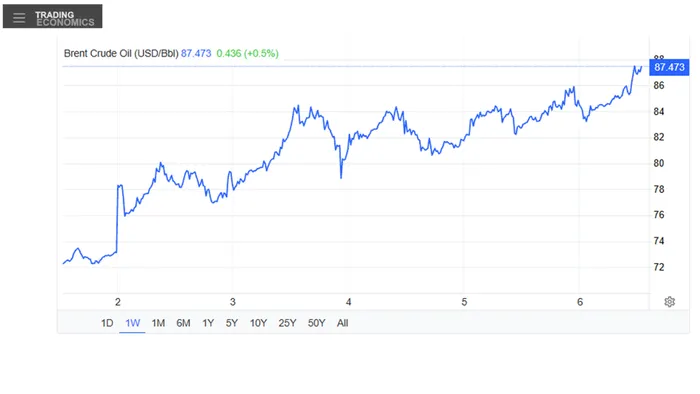
Spiking oil will hit economies hard.
Image: ChatGPT
Economists frequently compare the potential impact of the Middle East conflict with the energy shock triggered by Russia’s invasion of Ukraine in 2022.
Pierre-Olivier Gourinchas, economic counsellor at the International Monetary Fund, said wars spread through the global economy in multiple ways. “The effects of the war will propagate far and wide, adding to price pressures and exacerbating significant policy challenges.”
Gourinchas added that the 2022 invasion resulted in global economic prospects being been severely set back, largely because of Russia’s invasion of Ukraine.
War acts as a supply shock that spreads through commodity markets, trade and financial systems, said Gourinchas.
The IMF said Russia’s role as a major exporter of oil, gas and metals meant the Ukraine conflict pushed commodity prices higher and slowed global economic growth.
Despite the geopolitical escalation, economists say financial markets have so far reacted cautiously.
Energy prices have risen, while investors have moved into traditional safe-haven assets such as government bonds and gold. However, broader market moves remain relatively contained.
Much now depends on whether the conflict disrupts energy infrastructure or key shipping routes.
For now, economists say the range of possible outcomes remains wide – and the duration of the conflict will ultimately determine how far its economic effects spread.
IOL BUSINESS