

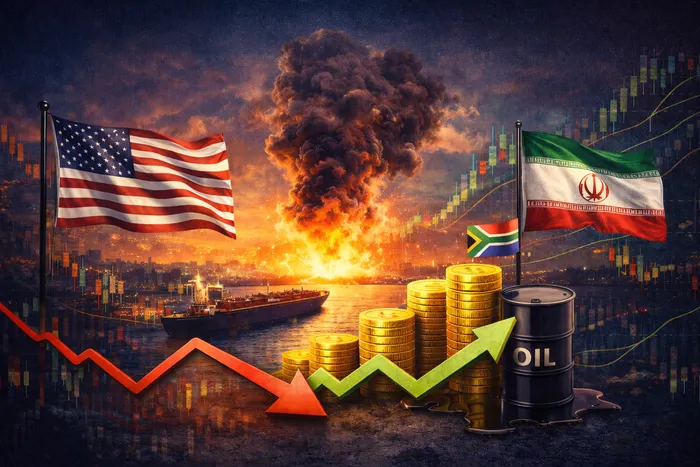
The sustainability of the ceasefire now becomes critical, as any breakdown in negotiations can send markets back into a risk-off environment.
Image: ChatGPT
A two-week ceasefire between the US and Iran has sparked a sharp market rebound, even as both sides claim victory, with Donald Trump saying the US achieved a “total and complete victory”.
The rand surged and oil slumped, but the relief rally may be short-lived if the fragile truce unravels, with Iran warning the pause is “not the end of the war”.
Oil prices plunged and global stocks rallied after the US and Iran agreed to a two-week ceasefire that will see Tehran temporarily reopen the Strait of Hormuz, AFP reported.
Global equities surged on hopes the conflict that has disrupted the world economy could ease, with major markets across Asia and Europe posting strong gains following the announcement, AFP reported.
The ceasefire, announced just before Trump’s deadline for Iran to reopen the waterway or face escalation, will allow safe passage through the Strait of Hormuz, through which a significant share of global oil and gas flows.
Crude prices dropped by over 15% on the ceasefire announcement after surging 63.3% in March, with prices still expected to remain above pre-war levels, Nolan Wapenaar, co-chief investment officer and head of fixed income at Anchor Capital, said.
“However, the relief is expected to be fragile, and a sustained return to pre-Iran-war levels of circa $70 a barrel would require a lasting peace agreement, not just a two-week pause,” said Wapenaar.
Wapenaar explained that, while the oil price is likely to decline from its peak, it is expected to remain materially above pre-war levels. This could see April’s fuel price increase delayed in its severity rather than reversed.
Investec chief economist, Annabel Bishop, however made the point that infrastructure has been damaged in the Middle East, and supplies have been disrupted. “Oil prices are not expected to drop straight back to pre-war levels and instead are likely to still see some elevation over the second quarter,” she added.
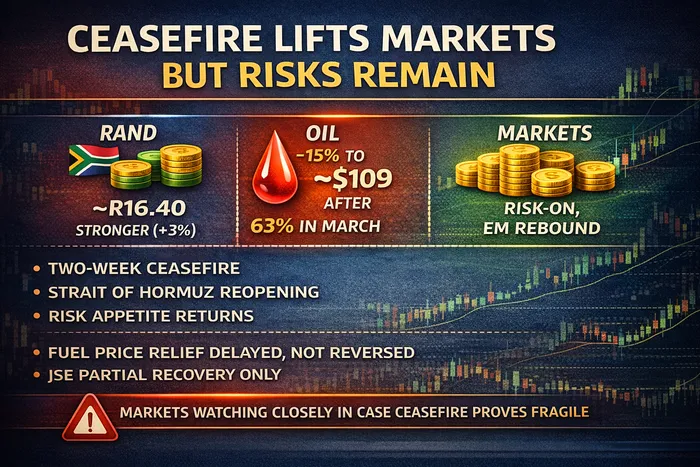
Although markets and commodities are trending positively after the ceasefire, risks remain.
Image: ChatGPT
Andre Cilliers, currency strategist at TreasuryONE, added that investors are rotating back into emerging market currencies on the back of easing geopolitical tension and lower oil prices. This, he said, has buoyed the local currency. “The rand is one of the clearest beneficiaries of the risk-on mood,” he said.
According to Trading Economics, the local currency was at R16.43 just after mid-morning, having come off its recent highs of just more than R17 to the dollar.
Wapenaar said the rand is “already 3% firmer” from its late-March levels, adding that the local unit remains “a barometer” of global sentiment toward emerging market investments.
“The ceasefire should provide a meaningful tailwind as global risk appetite returns and emerging market currencies, including the rand, will typically recover quickly in these situations,” said Wapenaar.
However, Wapenaar said that “the rand is also held hostage by two other variables – the broader emerging markets risk environment and South Africa’s fiscal credibility. Any signs of the ceasefire not holding are likely to result in a weakening of the local unit.”
The jubilation over news of the ceasefire was also felt in the markets, with Botes saying the market “celebrated the news”.
Wapenaar added that while the ceasefire is “modestly positive” for the JSE, the market is unlikely to fully recover March’s losses during the two-week period. “The JSE delivered its worst monthly performance in circa 18 years in March, with the FTSE JSE All Share Index plummeting 11.2% month-on-month,” he said.
The best performers last month were those companies that either produced what suddenly became more expensive, such as energy in the form of Sasol, or which sold essential items, such as food retailers, said Wapenaar.
“Global markets will also likely be watching closely whether the Strait of Hormuz’s reopening runs smoothly,” Wapenaar said.
Bishop said inflation is expected to reach 4% this year, with the potential for a 25 basis point interest rate hike around mid-year.
“The sustainability of the ceasefire now becomes critical, as any breakdown in negotiations can send markets back into a risk-off environment,” said Botes.
IOL BUSINESS