

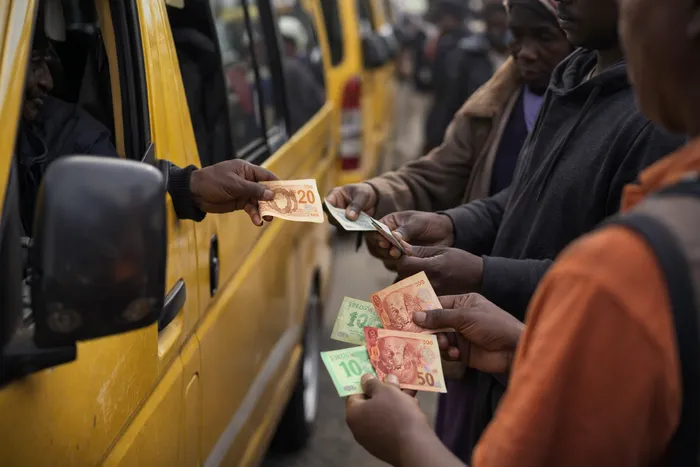
Low income earners are worst affected when fuel increases.
Image: ChatGPT
South Africa’s latest fuel price increase is rippling unevenly through the economy, with lower-income households taking the hardest hit as transport costs rise faster than wages.
Petrol prices rose by about R3 a litre in April, while diesel surged by roughly R7 a litre – a jump of close to 40%. While the increase has lifted costs for all motorists, its impact is most acute in the country’s taxi-dependent economy, where millions rely on daily fares to get to work.
Figures from Statistics South Africa show that around 26% of workers rely on taxis as their primary mode of transport to work, while taxis account for the majority of public transport trips.
At the same time, household data shows transport is one of the largest expenses for South Africans, with lower-income households forced to spend a far greater share of their income simply to earn a living.
Economists say the inflation impact could have been worse. Johann Els said that without government intervention, inflation would have reached 4.2% in April but is now expected to come in at about 3.6% following a reduction in the fuel levy.
Frank Blackmore said the fuel price increase will add about 0.6 percentage points to inflation, instead of closer to 1 percentage point, pushing inflation to just above 4%.
However, the relief is uneven. While motorists benefit directly from lower fuel levies, millions of commuters face rising costs indirectly through taxi fares, which are tightly linked to diesel prices.
The National Taxi Alliance said after the April fuel price increase that fares could rise by between R3 and R6 per trip on shorter routes, and between R10 and R30 on longer-distance trips as operators respond to higher diesel costs.
Estimates and commuter case studies suggest monthly taxi costs typically range between R1,000 and R1,500, depending on distance and route – a baseline that is now under pressure.
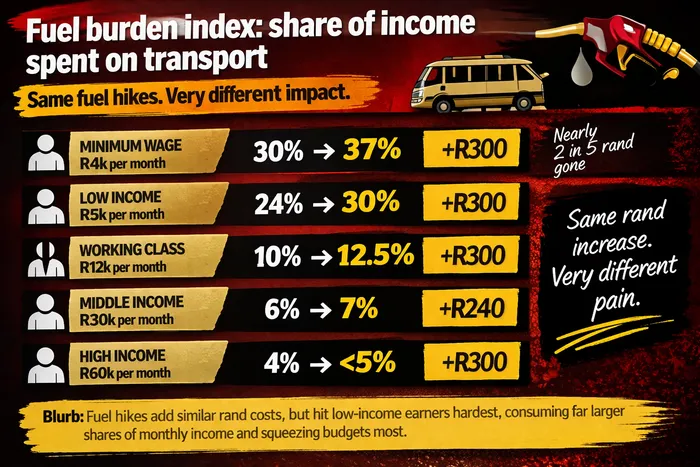
The impact of fuel price hikes across various salary bands.
Image: ChatGPT
Modelling based on desktop research and publicly available data shows the impact of these increases varies sharply by income level.
For a low-income worker earning around R5,000 a month and relying on taxis, transport costs of about R1,200 already consume roughly 24% of income. If fares rise by around R300 a month, that climbs to about R1,500 – or roughly 30% of income – effectively pushing transport costs towards one-third of monthly earnings.
Minimum wage earners will also see a R300 a month increase on transport costs, which takes the percentage of what they spend on fuel up to 37% of what they earn from 30%.
For a worker earning R12,000 a month, taxi costs rise from about R1,200, or 10% of income, to roughly R1,500, or 12.5% - a noticeable squeeze, but far less severe in relative terms.
The Pietermaritzburg Economic Justice and Dignity group pegs the average household food basket at R5,328.53.
By contrast, a middle-income motorist earning R30,000 a month and using around 80 litres of petrol per month would see fuel costs rise from about R1,840 to just over R2,000, increasing their transport burden from roughly 6% to around 7%.
For higher earners, the shift is marginal. A household earning R60,000 a month would see fuel costs rise by roughly R300 a month, nudging transport costs from about 4% of income to below 5%.
While the rand increase in transport costs is broadly similar across income groups, typically between R240 and R300 a month, the real impact is anything but equal. For lower earners, that increase absorbs a meaningful share of income; for higher earners, it is little more than background noise.
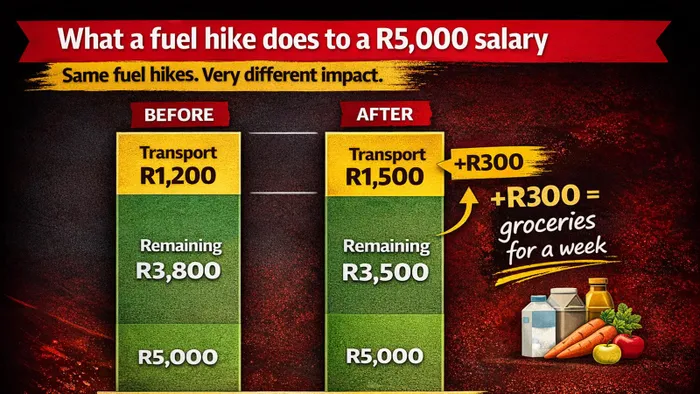
What the recent fuel hike does to someone earning a R5,000 salary.
Image: ChatGPT
The disparity is largely driven by the sharper increase in diesel prices, which underpin the taxi industry.
While petrol prices rose by about 15%, diesel increased by roughly 40%, sharply raising operating costs for taxi operators and putting immediate pressure on fares.
This creates a lag effect in the economy. Operators may delay fare increases to avoid losing passengers, but sustained cost pressures make adjustments inevitable.
The result is a double hit for lower-income households - first through higher prices for goods and services, and then through rising transport costs.
Figures from Statistics South Africa show transport already consumes a disproportionate share of spending among lower-income households, and the latest fuel increases risk pushing that burden even higher.
While government intervention has softened the headline inflation impact, it has not removed the underlying cost pressures facing commuters.
As fuel costs work their way through the transport system, the gap between what different income groups spend just to get to work is widening - turning transport into one of the most visible and immediate pressure points in South Africa’s cost-of-living crisis.
IOL BUSINESS