

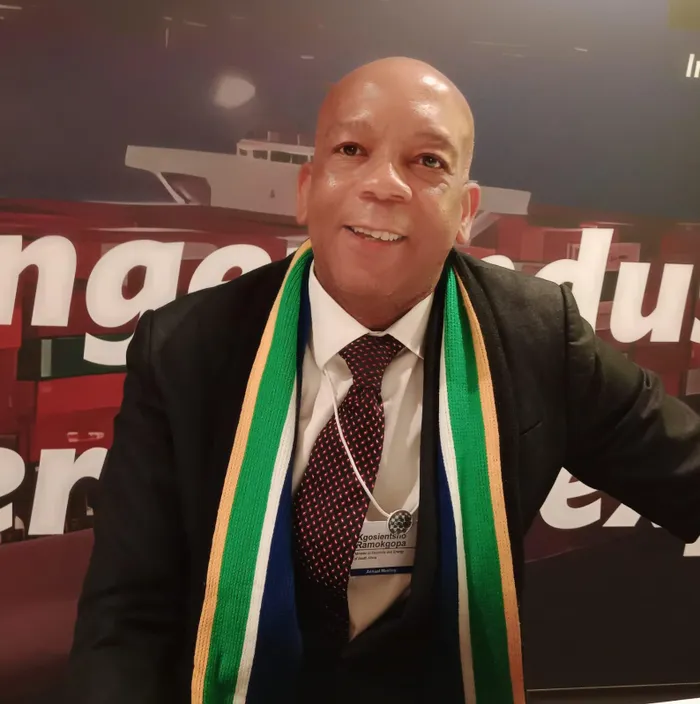
Minister of Electricity and Energy, Kgosientsho Ramokgopa, during an interview on the sidelines of the World Economic Forum (WEF) Annual Meeting in Davos on Thursday.
Image: Siphelele Dludla /Independent Newspapers
Despite progress in stabilising South Africa’s electricity supply, Minister of Electricity and Energy, Kgosientsho Ramokgopa, has stated that the nation is not yet ready to declare an end to load shedding.
Speaking on the sidelines of the World Economic Forum (WEF) Annual Meeting in Davos, Ramokgopa made it clear that any official declaration of victory over the electricity crisis must be tempered with the understanding that economic growth must accompany an improvement in energy generation.
South Africa has experienced over 250 consecutive days without load shedding, but Ramokgopa cautioned against premature celebrations. He noted that declaring the electricity crisis over would be misleading unless stable energy supplies visibly fuel economic expansion — a goal that has yet to be reached.
“The first goal is to reach a point where people don’t even notice how many days we’ve gone without load shedding,” he explained. This target reflects a psychological transition in the public’s perception of electricity stability, yet he acknowledged that “we’re not quite there yet.”
The current state of South Africa’s electricity system shows notable enhancements in both capacity and reliability; there is now an average of 4,000MW to 5,000MW of excess energy available daily. However, technical issues, like a fire on transmission lines, can still cause temporary disruptions, demonstrating the delicate balance of the system's resilience.
Ramokgopa addressed the economic repercussions of load shedding, acknowledging that many energy-intensive companies have shuttered operations due to escalating energy costs. He cited companies like Samancor, Merafe, and Vedanta — if these smelters were to resume operations simultaneously, South Africa would face an additional 7,000MW in electricity demand, creating a potential shortage of 2,000MW.
But, as the Minister stressed, the end of load shedding cannot merely be gauged by technical metrics. It is pivotal that economic growth aligns with energy stability. “My measure of load shedding being over is the following: If the economy tomorrow were to grow by 3% and you still have one or two failures - because it’s the nature of the system - and the lights don’t go off, I don’t have to call the press conference, then load shedding is over,” he declared.
Presently, the economic climate is sluggish, with growth hovering around only 0.8%. Ramokgopa pointed out that while electricity generation has increased, it remains below the peak levels of 2007 and 2008.
Accepting current conditions as the end of load shedding would only signify acceptance of slow economic growth, an outcome he is not prepared to endorse. “There’s a new target that’s coming,” he reiterated, indicating that further ambitions lie ahead.
Moreover, Ramokgopa highlighted the role of the private sector in South Africa’s energy strategy. He mentioned that some publicly procured private generators are not yet operational, affecting overall capacity.
He remarked, “We need to plan for contingencies”, pointing to the importance of alternative energy sources such as gas supply to bolster reliability as the country moves toward stabilising its electricity supply.
As South Africa strides toward a more reliable energy future, Minister Ramokgopa’s cautious optimism underscores the intricate link between a robust electricity supply and economic sustainability. Until these elements are firmly aligned, the spectre of load shedding will remain a critical part of the national conversation.