

Treasury highlighted several credibility milestones: South Africa’s removal from the Financial Action Task Force grey list, a recent credit rating upgrade, and lower borrowing costs.
Image: Supplied
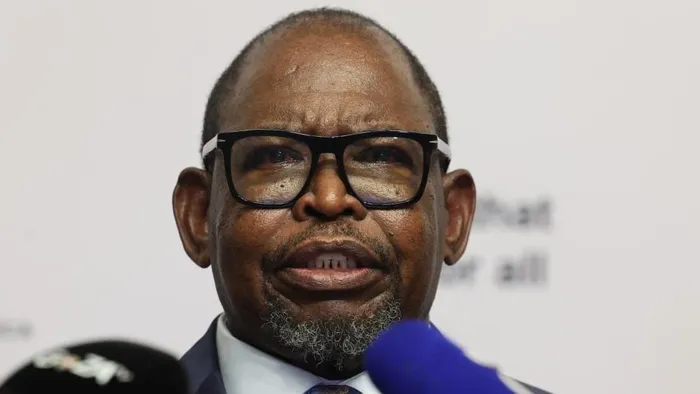
Finance Minister Enoch Godongwana struck a more optimistic tone for South Africa’s economy during this afternoon’s National Budget speech.
Godongwana also pointed to firmer growth projections and what he described as a decisive shift in the country’s fiscal trajectory.
Treasury now expects real economic growth of 1.6% in 2026, an improvement on the 1.4% estimated for 2025.
The upgrade reflects strengthening activity from the second half of 2025, signalling what government believes is a gradual rebuilding of economic momentum.
Over the medium term, growth is forecast to average 1.8%, reaching 2% by 2028.
Yet Godongwana warned that the recovery remains fragile.
Persistent logistics bottlenecks, underperforming public infrastructure, and the recent outbreak of foot-and-mouth disease continue to weigh on economic activity and cloud the outlook.
Against this backdrop, Godongwana said faster, inclusive growth remains South Africa’s only sustainable path forward.
Government’s strategy continues to hinge on four priorities: safeguarding macroeconomic stability, accelerating structural reforms, expanding investment in growth-enhancing infrastructure, and strengthening state capacity.
“These pillars are the foundation upon which inclusivity is built, and how we ensure that growth is faster,” the minister said.
The domestic outlook unfolds within a global economy projected to grow by 3.3% in 2026.
Advanced economies are expected to expand at a moderate pace, while emerging markets are forecast to remain the engine of global growth.
India and Sub-Saharan Africa are tipped to outperform, supported by resilient domestic demand.
Treasury said geopolitical tensions and shifting trade policies are reshaping global supply chains, forcing countries to rethink trade strategies.
South Africa, government said, must diversify export markets, broaden trading partnerships, and reduce vulnerability to external shocks.
Godongwana also used the National Budget to underline what he called a “turning point” in the management of public finances. He contrasted the current outlook with the stark realities of recent years.
Five years ago, South Africa faced deep institutional damage from State Capture, multiple credit rating downgrades, and the economic devastation of the coronavirus pandemic.
In 2020, the country fell to sub-investment grade with the final downgrade by a major ratings agency.
In 2023, the Financial Action Task Force grey-listed South Africa, intensifying pressure on the financial system and investor confidence.
“The warning lights were flashing. Public finances were under severe strain and growth had stalled.
"Faced with this crisis, we chose not to be defined by it. Instead, we turned it into a catalyst for change,” Godongwana said.
Government responded with a fiscal strategy centred on stabilising debt, investing in infrastructure, and improving spending efficiency.
Treasury said that approach is now beginning to pay off.
For the first time in 17 years, government debt is projected to stabilise, with the debt-to-GDP ratio expected to decline over the coming years.
The budget deficit has narrowed significantly, while debt-service costs – long one of the fastest-growing expenditure items – are easing.
Treasury highlighted several credibility milestones: South Africa’s removal from the Financial Action Task Force grey list, a recent credit rating upgrade, and lower borrowing costs.
“These are signals of restored credibility. Of renewed resilience. And of a nation regaining its footing,” Godongwana said.
IOL BUSINESS