

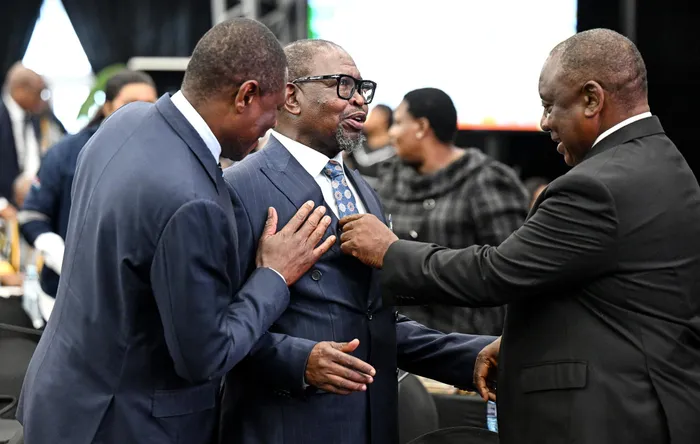
Finance Minister Enoch Godongwana has the final checks to his suit done by President Cyril Ramaphosa and Deputy President, Paul Mashatile ahead of tabling his 2026 Budget.
Image: Phando Jikelo / GCIS
Honourable Members, we have reached an important turning point in the management of our public finances.
Five years ago, the outlook was stark.
State Capture had hollowed out critical institutions and weakened state owned entities. South Africa had been downgraded to junk status by the last of the three major credit rating agencies in 2020. The devastation of the coronavirus pandemic, coupled with the Russia Ukraine conflict, dealt a blow to global growth. In 2023, the Financial Action Task Force placed South Africa on its grey list.
The warning lights were flashing. Public finances were under severe strain and growth had stalled.
Faced with this crisis, we chose not to be defined by it. We turned it into a catalyst for change.
We committed to a clear reform agenda and a disciplined fiscal strategy built on three principles. Stabilise debt. Invest in infrastructure. Spend better.
Today, that commitment has delivered tangible results.
For the first time in 17 years, debt will stabilise and continue to fall in the coming years. The budget deficit has narrowed significantly, and debt service costs are declining.
The world has taken notice.
South Africa has been removed from the FATF grey list. We secured our first credit rating upgrade in 16 years. Borrowing costs have eased, creating space for growth and development.
These are signals of restored credibility, renewed resilience, and a nation regaining its footing.
The lesson is clear. Steady structural reform and responsible public finances are the foundation of a more inclusive and prosperous South Africa.
Honourable Members, allow me to turn to the global and domestic economic outlook.
Global growth is projected at 3.3 per cent in 2026, broadly in line with last year. Advanced economies are expected to grow moderately, while emerging markets continue to anchor global momentum.
These developments are unfolding amid persistent geopolitical tensions and shifting trade policies that are reshaping supply chains. We must diversify our trade, secure new markets, and reduce vulnerability to external shocks.
Domestically, real economic growth is projected at 1.6 per cent in 2026, up from 1.4 per cent in 2025. Over the medium term, growth is expected to average 1.8 per cent, reaching 2 per cent by 2028.
Logistics bottlenecks, weak infrastructure and the outbreak of foot and mouth disease continue to weigh on activity. Rapid and inclusive growth remains our only durable path forward.
Our growth strategy rests on four pillars.
Maintain macroeconomic stability. Implement structural reforms. Invest in growth enhancing infrastructure. Build state capacity.
A key element of macroeconomic stability is prudent fiscal management that advances social and economic objectives.
The consolidated budget deficit narrows to 4.5 per cent of GDP in 2025/26, improves to 4 per cent in 2026/27 and falls to 3.1 per cent thereafter.
Gross debt stabilises at 78.9 per cent of GDP in 2025/26 and declines to 76.5 per cent by 2028/29.
The main budget primary surplus reaches 0.9 per cent of GDP in 2025/26 and rises to 2.3 per cent by 2028/29.
Government will continue engagements on a principle based fiscal anchor to entrench fiscal credibility.
Energy reforms are stabilising electricity supply and unlocking private investment.
Logistics reforms are removing bottlenecks in rail and ports, lowering costs and improving export performance.
Local government reforms focus on performance linked utility models to strengthen accountability and sustainability.
Housing and spatial reforms aim to locate people closer to economic opportunity.
Gross tax revenue for 2025/26 has been revised up by R21.3 billion. Government has withdrawn the R20 billion in proposed tax increases.
Personal income tax brackets and rebates are fully adjusted for inflation.
To encourage saving, the tax free annual investment limit increases from R36,000 to R46,000. Retirement fund deduction limits rise from R350,000 to R430,000.
The VAT registration threshold for small businesses increases from R1 million to R2.3 million.
Excise duties on tobacco and alcohol increase in line with inflation.
A pack of cigarettes increases from R22.81 to R23.58. Beer increases by 8 cents per 340 millilitre can. Wine increases by 15 cents per 750 millilitre bottle. Spirits increase by R3.20 per bottle.
Fuel levies increase modestly in line with inflation.
Over R88 billion in unclaimed financial assets will be managed through a central administrator.
Crypto assets will be included in the capital flow management framework.
Investment in data infrastructure is prioritised to support growth.
Government has identified R12 billion in savings over the medium term.
Enhanced social grant verification has already resulted in the termination of nearly 35,000 incorrect or fraudulent grants.
Total government spending for 2026/27 amounts to R2.67 trillion.
The social wage accounts for more than 60 per cent of non interest spending.
Old age, disability and care dependency grants increase to R2,400. War veterans grant increases to R2,420. Child support grant increases to R580.
Spending on peace and security increases to R291.2 billion by 2028/29.
Additional funding supports defence operations, policing and border management.
Public sector infrastructure spending will exceed R1 trillion over the medium term.
Investment focuses on transport, water and energy, supported by expanded public private partnerships.
This budget advances inclusive growth and sustainable public finances.
It strengthens economic sovereignty and supports dignity and prosperity for all South Africans.
Thank you.
IOL News