

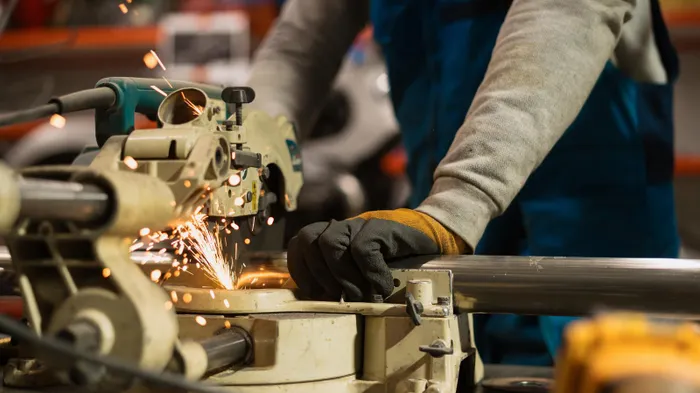
Manufacturing, already in the doldrums, could drag South Africa's economy down.
Image: Freepik
With South Africa’s already moribund industrial base is set to come under further pressure because of the war in the Middle East, the economy could see growth slow even further.
Manufacturing is a key push side driver of the economy and ideally should be a bigger growth driver than it is. Currently, almost two thirds of gross domestic product (GDP) is consumption based through consumer spending.
Industrial output creates a virtuous cycle in that it manufacturing provides structural, sustainable growth by driving high-quality employment, generating technological progress, and improving a nation’s trade balance.
Consumer spending, conversely, primarily drives the service sector, which often relies on rising debt and can result in high consumer debt levels, which are unsustainable in the long term.
As an indicator of manufacturing’s importance, it contributes about 12% to 13% of GDP and employs more than 1.6 million people – accounting for 9.4% of South Africa’s working population. However, its share of the economy has declined from over 20% in the early 1980s, pointing to a long-term structural weakening.
And, it remains in the doldrums. Manufacturing production fell by 2.8% year-on-year in February, according to Statistics South Africa. Quarter-on-quarter to end-February, output was down 2.0% compared with the previous three-month period, with most divisions recording negative growth.
Investec chief economist, Annabel Bishop, cautions that the economic impact of the war in the Middle East will be reflected in the second quarter of the year. She says that, while Investec revised South Africa’s 2026’s GDP forecast down 0.1% to 1.4% based on a short Middle East war, a continuation over April and into May risks seeing another 0.1% shaved off.
Even mining, which has recently provided some support, is showing signs of strain.
Mining production increased by 9.7% year-on-year in February, driven by gains in platinum group metals, gold and manganese, according to Statistics South Africa.
However, over the three months to February, seasonally adjusted mining output declined by 1.7%, suggesting underlying momentum is weakening.
The sector accounted for 6% of gross domestic product, contributing R451 billion to the economy in 2024, and employed 484 837 people in 2025, down 0.9% from the previous year.
Bishop points out that manufacturing, mining and electricity production for the first two months of the year fell a combined 1.2% year-on-year.
“Neither January nor February’s figures were affected by the war in the Middle East, as it began at the very end of February. But the Absa Purchasing Manufacturing (PMI) data shows that, while new sales orders were unchanged in February, they fell in March,” says Bishop.
At the same time export demand also deteriorated, with respondents to the PMI warning that earlier demand may have been brought forward and could fall back in the coming months.
At the same time, rising costs are adding pressure. The purchasing price index surged saw the largest increase since September 1999 driven by a weaker rand and higher global oil prices, particularly for oil-derived inputs, Bishop said.
While logistics data showed a temporary increase in activity, with container volumes rising and international freight volumes reaching nearly 70 million metric tonnes in the first quarter, this is expected to unwind as shipping disruptions linked to the conflict begin to take effect.
IOL BUSINESS