

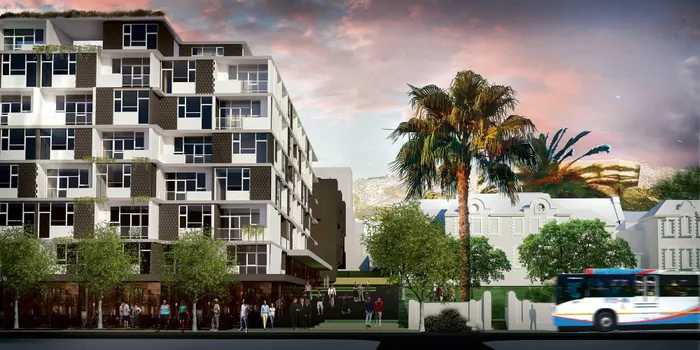
Urban designer Azraa Rawoot’s impression of the proposed mixed-use and social housing development on the Tafelberg site.
Image: FILE
While mixed-use developments have been on the rise for several years globally, automatic success is not guaranteed.
An understanding (and implementation of) core design principles is essential, says Marike Louw, candidate architect at BPAS Architects.
According to Atterbury, a real estate development, investment and management company, South African cities are embracing mixed-use precincts as a cornerstone of urban living and property development.
By integrating commercial, residential, leisure and retail spaces within single developments, property development companies in South Africa offer residents and businesses unmatched convenience, infrastructure and modern amenities.
Shift reasons
“The global (and local) shift towards mixed-use is largely due to lifestyle preferences, the shift in traditional workspaces, risk diversification, land scarcity and efficiency, sustainability and place-making,” says Louw.
“There’s a shift towards experimental environments rather than merely functional ones. People are looking for authenticity, social interaction and community, with convenience and urban living. Workplace shifts have increased the demand for flexibility and spaces that can accommodate different functions.
"Mixed-use developments create a more vibrant urban fabric and thus support sustainability: less commuting, more walkability and diverse uses to create better-connected neighbourhoods.”
However, she says, one of the biggest misconceptions about mixed-use developments is that combining residential, retail and commercial elements in a single building will automatically generate vibrancy, community and sustainability.
“In reality, poorly designed spaces can easily become empty, unsafe and disjointed. Mixed-use developments are not just made by stacking apartments on top of retail and commercial spaces and opening the ground floor to the public.
"It’s important to ensure that the combination of functions within mixed-use developments is strategic and not overcomplex and that the development matches its surrounding context.”
Clear understanding of site navigation
Beyond blending functions, Louw says, successful mixed-use design requires a clear understanding of how different users move through and experience a site; when spaces are active; and where boundaries between public and private life should be drawn.
Key considerations include:
Designing with time in mind: anticipating when each part of the development will be used to avoid overcrowding or periods of inactivity.
Separating where necessary and integrating where beneficial: balancing privacy for residents with activity in public spaces: separate the private and public spaces and create spaces that can act as buffers where needed.
Creating a strong ground-floor interface: shaping the street edge as the “social interface” that makes or breaks the development’s connection to its neighbourhood.
When these elements come together, mixed-use developments can strengthen community life, improve walkability, support sustainability and increase long-term property value.
Context-led mixed-use in practice
BPAS points to two of its designs – The Radley in Bellville, Cape Town, and a (as yet unbuilt) Rosebank development in Gauteng – as examples of mixed-use principles applied with care.
The architecture firm says the Radley responds to the growing demand for urban housing while still fostering a sense of community. Its elevated courtyard creates a shared social space that reconnects residents with the city beyond the building’s walls.
By shaping this courtyard as the heart of the development, BPAS has ensured that communal life is not an afterthought but a defining feature of the resident experience.
The Rosebank development is envisioned as a mixed-use high-rise in one of Johannesburg’s most popular suburbs. Given its dense, pedestrian-orientated setting, Louw explains, the building is designed to sit on a dynamic plinth of aluminium slats that conceals structured parking and enriches the streetscape.
“This solution strengthens the public interface and supports the vibrant urban character of the precinct, while internal programming offers residents and visitors a blend of amenities without compromising clarity or circulation,” she says.
People-shaped cities
BPAS is committed to people-centred design and argues that as urban areas densify, South Africa needs a more strategic approach to mixed-use.
“Without careful planning and a nuanced understanding of context, mixed-use developments risk becoming overcomplicated, underutilised or disconnected from the communities they aim to serve,” says Louw.
“Mixed-use is about creating places where people genuinely want to live, work and spend time. That requires design that understands people.”
Independent Media Property