

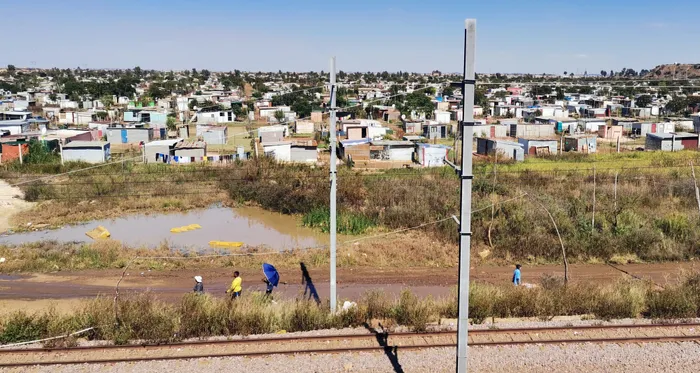
Collaboration with communities, provincial and national government, and other stakeholders key to to develop sustainable, inclusive, and financially viable housing solutions
Image: Oupa Mokoena African News Agency (ANA)
The City of Tshwane requires R32.5 billion to either upgrade or relocate all of its existing informal settlements.
This figure far exceeds the city’s current budget and available resources, says Ald Aaron Maluleka, MMC for Human Settlements at the City of Tshwane.
He says the City of Tshwane is embarking on a significant step towards managing the rapid proliferation of informal settlements across the municipality.
“This comes after the City of Tshwane Council approved the Informal Settlements Management Policy during its ordinary February Council sitting,” Maluleka says.
The approval follows an extensive investigation conducted by the City with the support of the Cities Support Programme (CSP) from the National Treasury Department, says Maluleka.
Tshwane, like other metropolitan municipalities in South Africa, has experienced an influx of residents over the past decades, with growth accelerating during the Covid-19 pandemic.
The City says it has identified 502 informal settlements, reflecting a demand for low-income housing and rental accommodation.
Of these, 194 informal settlements (comprising 355,945 structures) are categorised as able to be upgraded in situ, and 308 (comprising 151,707 structures) are categorised to be relocated. The work in this regard is said to be currently underway.
The unplanned expansion of informal settlements has pushed the urban edge outward, contributing to spatial inefficiencies, environmental pressures, and socio-economic marginalisation, says Maluleka.
He adds that in several instances, settlements have developed in rural areas with limited access to basic infrastructure and municipal services.
The Informal Settlements Management Policy provides a structured and strategic framework to guide the regulation, prevention, upgrading, and, where necessary, relocation of informal settlements within available fiscal constraints.
The policy aligns with the city’s strategic priorities to:
The Department of Human Settlements, mandated to regulate and guide human settlements development, identified critical gaps in statistical data relating to the number of informal settlements and households within them, as well as shortcomings in existing management frameworks.
The newly approved policy seeks to improve planning coordination and ensure evidence-based decision-making, the MMC says.
The City of Tshwane remains committed to working collaboratively with communities, provincial and national government, and other stakeholders to develop sustainable, inclusive, and financially viable housing solutions, Maluleka adds.
The MMC for Human Settlements, Ald. Aaron Maluleka has also officially launched a R4 million Water Reticulation, Sewer Reticulation, Platforms, Roads and Stormwater Infrastructure Project in Ga-Rankuwa Ext 10.
This project is said to be a step towards fast-tracking integrated human settlements development by ensuring that essential bulk and internal services are in place ahead of housing construction.
This critical infrastructure will service 204 walk-up housing units that are scheduled to be built by the Gauteng Department of Human Settlements.
The infrastructure phase is expected to be implemented over a period of approximately 20 months. Upon completion, the Gauteng Department of Human Settlements will proceed with the construction of the housing units, which will be allocated to qualifying beneficiaries.
Speaking at the launch, MMC Maluleka emphasised that the investment ensures that when houses are built, they are supported by reliable bulk services which include water, sanitation, roads and stormwater systems.
“This reflects our commitment to restoring dignity and improving living conditions for our residents, ensuring that no community is left behind,” he said.
Reacting to Finance Minister Enoch Godongwana's 2026 Budget Speech delivered on Wednesday, February 25, Hayley Ivins-Downes, managing executive at Real Estate at Lightstone, says the decision to withdraw the provisionally proposed R21.3 billion in tax increases provided relief to the taxpayer.
She adds that the adjustment of personal income tax brackets and rebates fully in line with inflation would also help protect household disposable income from bracket creep.
“From a property market perspective, putting money back into the pockets of potential buyers was a vital demand-side stimulus. However, increased household affordability must be met with available housing stock.
For the affordable housing sector, the structural supply deficit was a significant hurdle,” Ivins-Downes says.
Lightstone data revealed the scale of the shortage at the lower end of the market, where the ratio of households-to-property was highest at 7.2 for properties valued at R160 000. (If an assumed backlog in registration of 1m properties were added, the ratio drops to 3.6).
Properties within the R160 000 to R330 000 band reflected a household-to-property ratio of 4.5. At higher price band properties, the ratios were lower.
The ratio is close to 1 property for 1 qualifying household above R330 000 valued properties, other than for the above R2m properties, where there are theoretically 1.85 households for every property.
Ivins-Downs cautioned that there were complicating factors in making household-to-property stock assumptions, including:
The managing executive says that while fiscal relief was a positive step, it was only half of the equation.
"Our data confirms that even when affordability improves, the lack of formal stock priced under R500 000 acts as a hard barrier to entry. We are not just facing a credit challenge; we are facing a supply-side crisis,” Ivins-Downes said.
In his speech, Godongwana reiterated the government’s commitment to spatial and housing reforms to restructure cities to ensure people had access to affordable housing located close to centres of economic activity.
Ivins-Downes says translating policy goals into development was critical. “Accelerating the release of publicly owned land and unblocking municipal infrastructure delays would be essential to matching renewed buyer demand with adequate supply,” she says.
Independent Media Property