

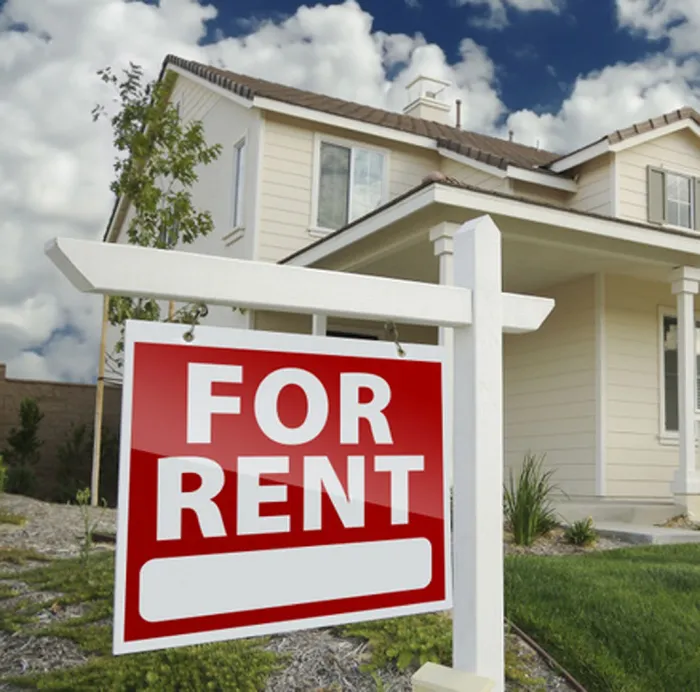
For Rent Real Estate Sign in Front of House Foreign property owners are also entitled to deduct costs incurred in acquiring, improving and disposing of the property.
Image: Andy Dean Photography
The adjusting of the tax thresholds for inflation in the 2026 Budget will influence how much income tax is payable on rental income generated from the South African property.
For international investors rental received for a holiday home or other property in the local market, is regarded as South African-sourced income and therefore taxed by the South African Revenue Service (SARS), says Foreign Buyer Property Solutions.
Foreign nationals owning property in South Africa, or who are considering buying or selling local real estate, should take note of several key announcements in the 2026 National Budget that will directly affect their tax obligations.
Delivering the 2026 Budget in February, Finance Minister Enoch Godongwana proposed additional tax measures to ease the financial burden on households and businesses, by adjusting personal income tax brackets and rebates fully in line with inflation.
In this budget, the compulsory VAT registration threshold increases from R1 million to R2.3 million.
National Treasury also raised the capital gains tax exemption for the sale of a small business for older persons from R1.8 million to R2.7 million.
This applies to small businesses worth R15 million instead of the R10 million previously. It will enable small business owners to receive more tax relief when they sell their businesses, the Godongwana said then.
The provider of integrated tax, immigration and cross-border advisory services for international property investors in South Africa, says for the year ending February next year, the Budget provides relief through increased tax thresholds for individuals under 65, from R95 750 to R99 000.
“This means total income below R99 000 per annum, are exempt from personal income tax,” says the firm specialises in navigating South Africa’s complex regulatory environment, ensuring foreign buyers and sellers remain compliant while protecting capital, residency status and long-term investment outcomes.
Where property is co-owned with a spouse, Foreign Buyer Property Solutions says rental income is split equally between the parties, unlike many other jurisdictions where joint fillings are required, effectively allowing a combined tax-free threshold of R198 000 per annum before personal income tax becomes payable.
“Property owners are taxed on rental profit-not turnover. Deductions such as bond interest, municipal charges, levies, insurance and maintenance, to name a few, must be carefully considered to ensure only the correct net profit is declared and taxed.”
Foreign property owners should ensure they are taxed only on South African-sourced income. Holding a non-resident bank account and registering with SARS as a non-resident taxpayer is important, as incorrect classification could expose non-residents to unintended worldwide tax obligations, the firm says.
When foreigners sell property in South Africa, capital gains tax (CGT) always applies to any profit made on the sale.
However, the firm says South African law allows for an annual capital gains exclusion, exempting the first portion of the capital gain from tax. In the 2026 Budget, this exclusion has increased from R40 000 to R50 000.
In practice this means a seller can realise a profit of R297 500 on disposal without having to pay tax on that, provided they have no other taxable income in South Africa, it says.
“Where spouses co-own the property, the gain is split between them, effectively doubling the available tax-free threshold, i.e. R297 500 each.
“Importantly, foreign property owners are also entitled to deduct costs incurred in acquiring, improving and disposing of the property. These include agent commission, legal fees and qualifying building improvements, to name a few.”
The primary residence capital gains exclusion has also been increased in the 2026 Budget, rising from R2 million to R3 million.
The firm says here two points are important: Under certain circumstances and in limited instances a non-resident foreign national can make use of this CGT exemption. However, caution must be exercised when applying as it requires expert planning.
As the term overlaps with residence principles, incorrectly claiming the exemption may invite broader questions regarding the foreigner’s overall tax status. The increased exclusion is beneficial, but it must be applied carefully and with proper consideration of the wider tax position and factual requirements to consider the property as the applicant’s ordinary residence.
Note that although both spouses are entitled to the tax-free profit of R297 500 on disposal, the total R3 million CGT exemption is shared between the two spouses, the company says.
Another significant development is the increase in the VAT registration threshold from R1 million to R2.3 million, says Foreign Buyer Property Solutions.
It says those who previously operated close to the R1 million threshold and now fall below R2.3 million may, from April 1, 2026, no longer be obligated to register for VAT. This reduces administrative complexity, compliance costs, and ongoing filing requirements.
“While the higher threshold reduces compliance pressure, it may create disadvantages in certain investment scenarios. A foreign investor who is not VAT-registered cannot claim input VAT on property acquisitions, renovations, or ongoing operating expenses. This is particularly relevant in commercial property transactions where VAT is charged on acquisition. In such cases, non-registration can result in irrecoverable VAT costs, directly reducing the overall return on investment.”
The firm says one of the most common compliance errors made by foreign property owners is assuming that if no tax is payable, no filing is required.
It says that even where rental profit as the only South African income falls below R99 000, or capital gain falls within the annual exclusion, a foreign property owner may still be required to register as a taxpayer and submit annual income tax returns.
Rental income does not constitute remuneration from a registered employer, the business says. “As a result, property owners are generally classified as provisional taxpayers. An exception applies where rental from the letting of fixed property does not exceed R30 000 for the tax year.”
If that threshold is exceeded for the 2026/27 period, the taxpayer must submit two provisional tax returns: the first provisional return before the last business day of August 2026 and the second provisional return before the last business day of February 2027-followed by submission of an annual income tax return which standardly opens for submission in July 2027.
Failure to submit returns can result in penalties and interest, even where the final assessed tax liability is minimal or nil.
The 2026 Budget provides genuine relief for foreign property investors, says Foreign Buyer Property Solutions.
However, it says this relief applies to liability and not to compliance.
For foreign nationals investing in the local property market, the firm says the greatest risk often lies in failing to structure, register and report correctly.
“An annual review of your South African tax registration status, provisional tax requirements, capital gains exposure, residence classification and VAT position is essential to maintaining a compliant and defensible cross-border investment strategy.”
Meanwhile, last week, the South African Reserve Bank (SARB) said it published various Exchange Control draft circulars for public comment, following the 2026 Budget announcements by National Treasury.
It says these circulars primarily address increased new limits for cross-border payments and investments by individuals in South Africa, as well as the streamlining of certain administrative processes.
The draft circulars can be accessed at the following link: https://www.resbank.co.za/en/home/publications/publication-detail-pages/circulars/exchange-control-circulars/2026/excon-circ-3-2026
The closing date for comments is March 17.