

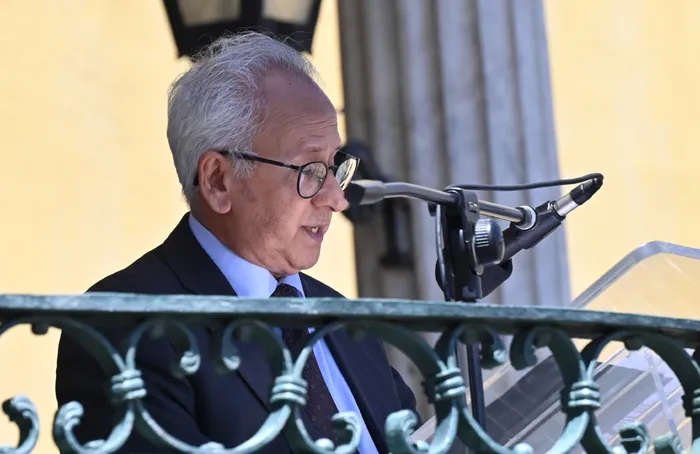
Acting Minister of Police Firoz Cachalia addressing officers of law enforcement agencies ahead of their deployment for the 2026 State of the Nation Address.
Image: Ayanda Ndamane / Independent Newspapers
Firoz Cachalia has conceded that the South African Police Service (SAPS) is not yet in a position to defeat organised crime in the Western Cape, as police finalise a revised stabilisation plan to address persistent gang violence in the province.
The admission comes as Cyril Ramaphosa prepares to deliver the State of the Nation Address (SONA) in Cape Town on Thursday evening, with crime and policing expected to feature prominently.
Speaking earlier this week during a crime-focused engagement in Nelson Mandela Bay, Cachalia acknowledged the scale of the crisis.
“I do not believe we are currently in a position to defeat this crime,” he said. “They are on a killing spree in the Western Cape, with a similar pattern emerging in the Eastern Cape.”
He cautioned that establishing anti-gang units on an intermittent basis amounted to an ad hoc response and said he was awaiting a comprehensive strategy from SAPS leadership.
SAPS confirmed that a stabilisation plan developed in September last year following consultations with provincial stakeholders “requires more time to take effect as well as some adjustments”. A revised plan is now being finalised, with emphasis on enhanced deployment of specialised units — in addition to the existing Anti-Gang Unit — to gang-affected areas. The approach aims to strengthen intelligence-driven policing, increase visibility and improve operational capacity in identified hotspots.
As part of his Western Cape programme, Cachalia has met civil society and religious organisations including the Muslim Judicial Council and the Cape Crime Crisis Coalition (C4). He is also scheduled to meet Western Cape Premier Alan Winde and stakeholders in Kayamandi and Cloetesville in the coming weeks.
Meanwhile, Winde on Wednesday chaired a meeting of the Provincial Safety Council to drive stronger coordination between provincial government and key safety stakeholders in response to persistently high crime levels.
Opening the meeting, the Premier said: “Safety is everyone’s responsibility. But as a provincial government, this priority is paramount because of the devastating impact crime has on our communities and our economy.”
He added: “This council will work harder than ever to bring all stakeholders — government departments, municipalities, academics and law enforcement agencies — closer together to align our strategies and defeat lawlessness.”
Representatives from SAPS and the City of Cape Town’s law enforcement briefed the council on strengthened joint operations targeting violent crime and gangsterism, with improved coordination and intelligence-sharing central to the approach.
However, Winde stressed that enforcement alone would not resolve the crisis.
“While bolstering day-to-day policing is critical, we must also tackle crime at its roots. That means accelerating economic growth and creating more jobs,” he said.
In the days leading up to the council meeting, Winde conducted oversight visits to several police stations across the province.
At Bonnievale police station, Station Commander Captain Konrad Mathysen raised concerns about turnaround times for servicing patrol vehicles, saying visibility and response capacity depended on operational readiness. The Premier also met with members of the Bonnievale Community Police Forum (CPF), which was named first-place CPF of the Year in the 2024/25 Western Cape Community Police Board Excellence Awards.
More than 150 CCTV cameras have been deployed across Bonnievale and are monitored through a local security company, a partnership CPF members say is yielding results.
In neighbouring Robertson, neighbourhood watch members and officers raised concerns about unlicensed vehicles, illegal taxis and unlawful liquor sales, which they said undermine safety and fuel criminal activity.
Winde also visited Khayelitsha police station, where severe under-resourcing was highlighted. The station has 73 detectives, but only 25 have access to laptops and workstations. Each detective is responsible for an average of 333 case dockets.
“SAPS officers cannot win the fight against crime without the tools they need,” Winde said, adding that the province would continue advocating for fair and adequate resource allocation to the Western Cape.
The City of Cape Town has meanwhile renewed its call for devolved policing powers. Mayor Geordin Hill-Lewis said municipal officers were ready to assist with investigations and build prosecution-ready case dockets but remained limited by the absence of investigative authority.
“There is so much preventable suffering in our gang-impacted communities due to extremely low conviction rates for illegal firearm, drug and gang-related cases,” Hill-Lewis said.
With SONA set to be delivered at 7pm on Thursday, the spotlight now turns to whether the President will outline concrete changes in policing strategy, resource allocation or legislative reform affecting the Western Cape — where leaders across spheres of government agree that the scale of violent crime demands urgent, coordinated intervention.
Cape Argus