Informal settlements at high risk
Walter Loening, Maurice Kibel and Louis Reynolds
The OUTBREAK of an epidemic of severe enteritis in Germany should make us sit up and take note and action.
This particular epidemic was most unusual in that the cause was a highly toxic and virulent EHEH variant of the common E coli bacterium. E coli bacteria are fairly harmless inhabitants of the human gut. It is of note that this outbreak occurred and spread fairly widely in a country known for its high standard of sanitation and hygiene.
The consequences of an epidemic of this nature possibly occurring in the informal settlements are too horrendous to contemplate.
Recently our attention has been drawn repeatedly to the plight of our fellow citizens in informal settlements and Khayelitsha in particular: on World Toilet Day, March 20 last year, about 600 people stood in a queue outside the public toilet on the Sea Point promenade.
They did this to draw attention to the many thousands living in circumstances where functioning toilets in easy access are a rarity.
On Freedom Day, Anglican Archbishop Thabo Makgoba led a protest march from St George’s Cathedral to the mayor’s office demanding improved sanitation. Then, in City Press on June 5, there was an open letter, addressed to our newly elected mayor, Patricia de Lille, and signed by Axolile Notywala, general secretary of the Social Justice Coalition based in Khayelitsha.
During the weeks before the local government elections, mortality data for this informal settlement and other regions of the metropolis were reflected and debated in your columns.
A visit to this informal settlement is an informative exercise. As you take Mew Way off the N2 you are almost immediately confronted by a large battery of mobile “chemical” toilets. They face the houses with their backs to the road.
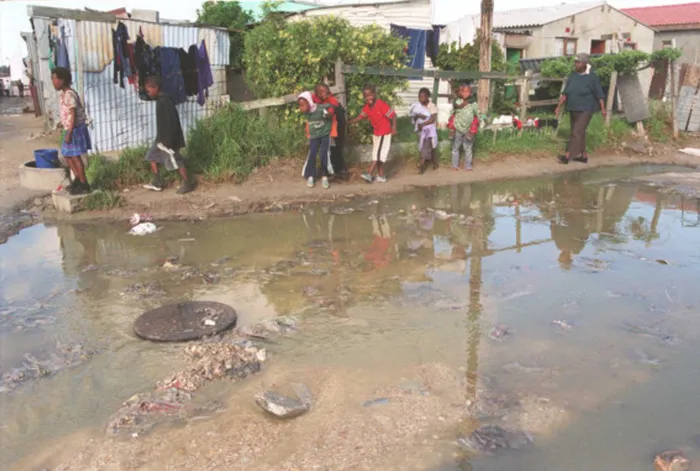
The first turn to the left leads into Landsdowne Road with Khayelitsha’s Section RR, possibly the most underserved community in the area, on the right. Many of the dwellings are not visible as they lie below the level of the road. When you get a view of them you can see a little stream running down the valley, apparently emanating from an immense battery of toilets on the next street corner.
Whenever an opportunity arises to look down some of the tiny lanes or the occasional track winding its way between these densely packed shacks one is struck by the absence of refuse and dirt. Here and there one can see some clean washing hung out to dry. But there are no toilets to be seen.
What does Mrs M do if her child needs to relieve herself during the day? Does she drop everything, lock the house and wander off to the distant toilet? Or does she send the little five-year-old to fend for herself, praying that she will not encounter any of the many potential hazards?
To do this in the dark means facing the risk of assault or even rape. It may be easier to relieve oneself in any little open space. To add insult to injury the toilet allocated to your household may be out of order or possibly locked by someone else.
In the light of these unpleasant circumstances it is not surprising that out of all infrastructural inadequacies it is lack of access to safe and clean toilets that the community has highlighted as its top priority.
The City of Cape Town acknowledges that there are at least a quarter of a million people who do not have a minimum standard of basic services. Some claim that this figure is closer to 500 000. The city’s Informal Settlements Sanitation Master Plan (2009) aims at one toilet to five households, each serving five people. At the same time it acknowledges that perhaps between 100 and 150 people use one toilet.
The infant mortality rate and under-5 mortality rate are globally regarded as among the best indicators of the health of a community.
In Khayelitsha about 60 children among every 1 000 born alive die of diarrhoea-related illness before their fifth birthday – 10 times more than in our southern suburbs.
That under the prevailing conditions this number is not appreciably higher could be ascribed to households doing their utmost to maintain as high a standard of hygiene as possible.
This is remarkable considering the additional factor of difficult access to safe water. To have a water stand pipe within 10 metres of your home in Section RR would be considered a luxury. Moreover, the so-called “grey water” surrounding the base of the stand pipes is known to be badly contaminated with dangerous E coli organisms.
Faced by these almost insurmountable challenges, what could be achieved in the short and medium term?
This is where the Social Justice Coalition has done some essential footwork. Based in Khayelitsha with no fewer than 1 000 members in the area and city-wide, the organisation has achieved invaluable collaboration with the community. It has been shown in cities around the world that sustainable upgrading of communities can be achieved only with the full and active participation of its members.
What then, apart from the community itself, are the resources available to the city?
l Ward councillors
l District health clinics with well-qualified professional nurses and medical officers.
l Environmental health officers.
l The Philani Nutrition Centre, a non-governmental organisation with a highly skilled outreach team that has been working effectively in Khayelitsha for several decades.
l The churches and other faith-based organisations with Makgoba and Dean Michael Weeder already part of intervention endeavours.
l All schools and early childhood education centres.
l The Social Justice Coalition and other community organisations with evident goodwill.
l The integrated management of the childhood illness strategy, with its community component.
The implementation of key family practices of the childhood illness strategy can offer the child protection against E Coli infections and their potentially disastrous consequences.
This calls for outreach teams, such as Philani or other community health workers, empowering parents and the community to provide low-cost nutrition and state-sponsored supplementation. Furthermore, home-based implementation of primary health care measures would prevent immediate and long-term complications of diarrhoea.
With these resources to hand it now requires a fully well-orchestrated collaborative intersectoral effort to lift the Khayelitsha community out of this unacceptable, polluted quagmire. It is absolutely essential to mobilise true bottom-up community participation and to remove the matter from the political football field.
There is an urgent need, with full community participation and intersectoral action, to:
l Make sure every toilet is functioning, adequately monitored and routinely maintained.
l Provide effective management of waste water at public stand pipes.
l Consider and select the best options for the provision of additional toilets.
l Consider and select the best options for the provision of additional stand pipes.
l Deploy every suitable resource to ensure there are toilets and hand-washing facilities at all educational facilities so that hygiene can be practised and taught effectively.
l Develop an action plan for promotive and preventive strategies to deal with the problem of gastroenteritis in children.
In conclusion it must be emphasised that the effects of diarrhoeal illness are manifold: the illness almost always causes some interference with the child’s nutrition. Should this occur in a child who is nutritionally compromised, the risk of death is appreciably higher. If diarrhoea persists malnutrition gets worse and the child’s chances of recovery are reduced.
Any child with diarrhoea needs to remain at home to prevent the infection of other children.
It stands to reason that HIV-infected children are far more susceptible to gastroenteritis and its serious consequences.
l Loening is emeritus professor of maternal and child health, Kibel is emeritus professor of child health, and Reynolds is professor of paediatrics and child health, and is a member of the People’s Health Movement. All are with UCT .