

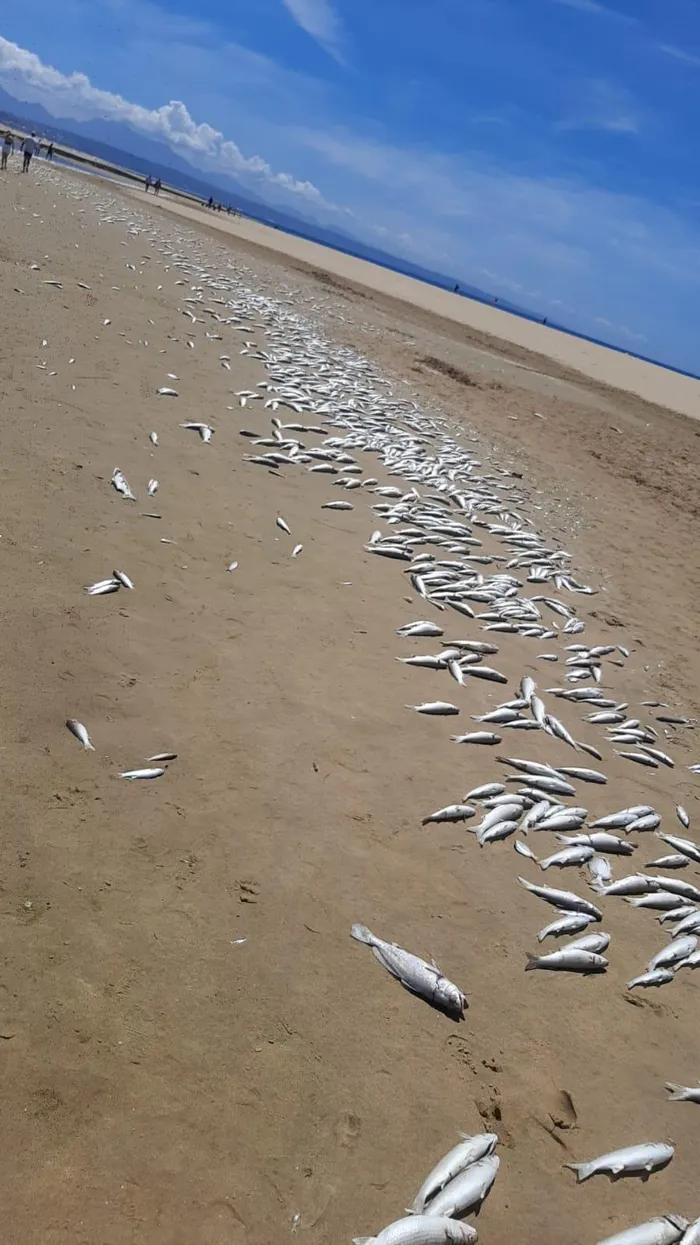
The Mossel Bay municipality says the fish kill resulted from severe oxygen depletion within the estuary.
Image: Mossel Bay municipality
The Department of Forestry, Fisheries and the Environment (DFFE) says the mass mortality of fish in the Hartenbos Estuary in Mossel Bay is not due to a red-tide, but is the result of sewerage discharge and resultant eutrophication and ammonia toxicity.
This comes after the Mossel Bay municipality said recent water samples for the Hartenbos Estuary were compliant with applicable standards.
DFFE on Sunday confirmed that the large numbers of dead white mussel, whelks and other shellfish that washed out at St Helena Bay and Elandsbaai on the West Coast was confined to these areas.
Observations by Fisheries Control Officers (FCOs) and satellite imagery indicate visible red-tides from Elandsbaai 100 km northward, to above the Olifants Estuary on the West Coast.
“There have been no mortalities of fish or shellfish reported associated with these visible new red-tides. However, there remains a high risk of toxicity and it is still advised that all shellfish, irrespective of being washed out or collected from shore or subtidal, should not be eaten,” DFFE said.
Satellite imagery and reports by members of the public and FCOs, also confirmed a visible red-tide in Walker Bay, Hermanus. This red tide is bioluminescent, the phytoplankton producing spectacular flashes of colour at night.
There have been no reported fish or shellfish mortalities reported with this red-tide but a cautionary approach remains that no shellfish be collected and eaten.
“Further eastwards, there has been a mass mortality of fish in the Hartenbos Estuary in Mossel Bay. This mass mortality is not due to a red-tide, but is the result of sewerage discharge and resultant eutrophication and ammonia toxicity,” DFFE said.
Mossel Bay municipality on Saturday said the emergency mechanical breaching of the Hartenbos Estuary confirmed the cause of fish mortalities.
“Critically low dissolved oxygen levels were recorded in the system, triggering an intervention in accordance with the provisions of the Approved Estuary Mouth Management Plan, which allows for emergency breaching when ecological functioning is threatened.”
A contractor was deployed onsite and clean-up operations continued.
“Scientific observations have confirmed that the fish kill resulted from severe oxygen depletion within the estuary. The oxygen deficit was caused by an algal bloom, exacerbated by a combination of low water levels, elevated temperatures, and nutrient‑rich conditions - all factors known to accelerate oxygen consumption and create hypoxic conditions.
“The Garden Route District Municipality, through its regular recreational water quality sampling programme, has verified that all recent water samples for the Hartenbos Estuary were compliant with applicable standards.”
DFFE said it would continue to monitor the situation with respect to the extent of the “red tides” and resultant mass mortalities on the West Coast and South Coast.
Cape Times