

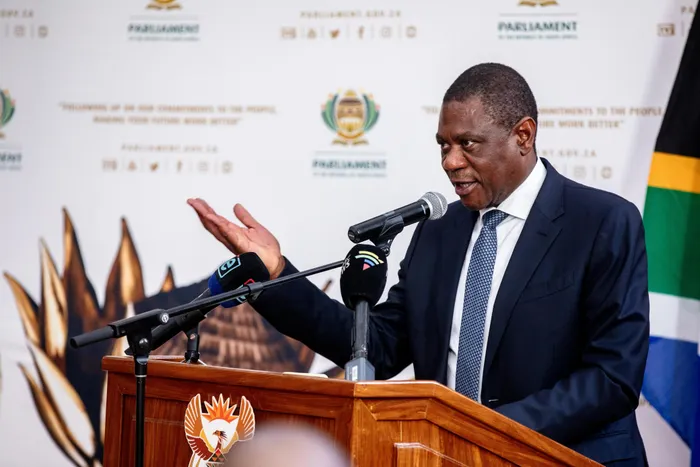
Deputy President Paul Mashatile said abandoning B-BBEE was not an option as doing so would be abandoning transformation.
Image: Parliament RSA
The two-phased review of the empowerment framework, Broad-Based Black Economic Empowerment (B-BBEE), will be led by Trade, Industry and Competition Minister Parks Tau and his department.
Responding to DA Deputy Chief Whip Baxolile Nodada during the question-and-answer session in the National Assembly on Thursday, Mashatile said the first phase of the review will refine and assess subordinate laws, including regulations, codes of good conduct, guidelines, and practice notes that fall within Tau’s legislative authority.
He also said the second phase, which will be the prerogative of Parliament, will involve the review of the Broad-Based Black Empowerment Act for substantive amendments.
“This process will also be supported by the B-BBEE Commission and other oversight bodies to ensure credibility and enforcement. The review will focus on strengthening B-BBEE by shifting from compliance to measurable outcomes.”
Mashatile added that the review would further strengthen the execution of the constitutional imperative of reimagining economic transformation and accelerating the participation of black South Africans in the economy.
He said abandoning B-BBEE was not an option as doing so would be abandoning transformation.
“B-BBEE is a necessary tool for transformation, essential for achieving economic equality, and we're going to proceed to implement it,” Mashatile said.
DA MP Michael Bargraim asked whether the review will take into consideration alternatives like the DA's Economic Inclusion for All Bill and whether the policy that created most jobs and narrowed inequality will be implemented.
In response, Mashatile said there will be public hearings to enable all South Africans to make submissions.
“So, if the DA has some clever ideas, you are allowed to bring them forward. We will look into them,” he said.
“If we think they don't make sense, we will throw them away, but we'll give you a chance to bring them because I think it's only fair that we should hear how you think you are going to help us.”
Mashatile was asked about measures the government will put in place to address the practical challenges faced by black-owned businesses and emerging entrepreneurs in accessing markets, finance, and procurement opportunities.
He stated that the government has taken a decision to shift to more empowerment-oriented approach by looking at the implementation of programmes that really empower black businesses.
“What we are going to look at is to ensure that we look at some of the issues coming from the B-BBEE Commission but not end up focusing too much only on compliance.”
However, UDM MP Nqabayomzi Kwankwa said the discussion was not about whether black economic empowerment was needed.
“It is about whether or not we need it in its current form, which is what you are seeking to address. We need to fund the BEE programme so that our people can begin to control and own the means of production.”
Mashatile agreed that there was a need to fund the agencies and departments that empower the previously disadvantaged, particularly black, people.
“One of the challenges we have to deal with very sharply is a question of fronting.”
He noted that some companies engage in fronting for compliance purposes.
“So, if you go to their books, you will see that they have somebody maybe with an African name, who has got 30% there, but really that is where it ends.”
He said empowerment must mean real involvement in business, where black people in this country must build enterprises and not be happy that they have 10% of a fundamental business.
“We want to see black people building factories, building businesses, and not be happy with some 10% here, 20% here, which in most cases is not even here,” he said.
“That is why one of the things we are doing is to train young people to become entrepreneurs and not go and queue for the 10% of fundamental business and all that.”
Cape Times