

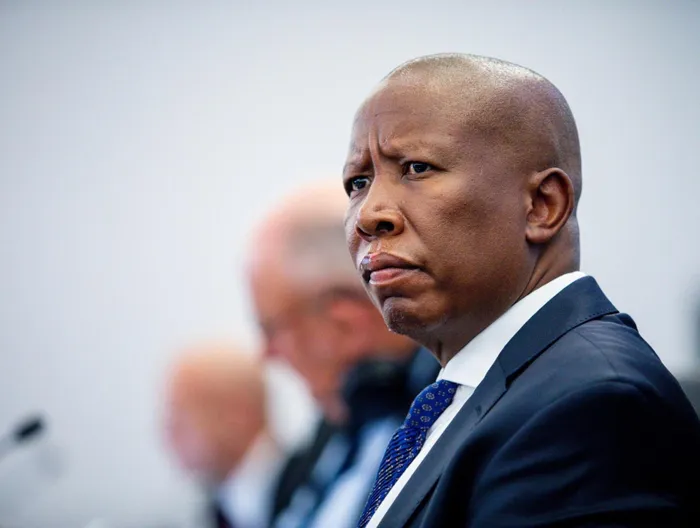
EFF leader Julius Malema.
Image: Abongile Ginya / Isolezwe lesiXhosa
When Julius Malema appeared in the East London Magistrates' Court for sentencing after being found guilty of discharging a firearm at the EFF's fifth anniversary in Mdantsane in 2018, the EFF came out in support of their Commander-in-Chief. East London and the rest of South Africa were on tenterhooks.
Joel Cesar, the state advocate, moved for a stiff jail sentence, arguing that other perpetrators with similar offences received at least eight years' imprisonment. The magistrate, Twanet Olivier, was also cynical about Malema’s remorse or the charitable work feeding children in poor communities as mitigating factors.
Let me provide some background for context and perspective:
Firstly, AfriForum was responsible for laying charges against Malema in August 2018 after he fired several shots in the air at the EFF celebration at the Sisha Dukashe stadium in Mdantsane. Jacques Broodryk, AfriForum’s spokesperson for Community Safety and Justice, believed that Malema should prepare for a lengthy prison sentence.
AfriForum, which now operates as a “civil rights organisation”, believes that if it did not act on behalf of the broader community, Malema would never have faced the law.
The same AfriForum has made a case of white genocide, against white South Africans and particularly the Afrikaner. This dossier pandered to right-wing American lobby groups, which eventually led to the South African government and President Cyril Ramaphosa being ridiculed and hauled over the coals in the White House by the racist, narcissist, Donald Trump.
America opened its doors for white Afrikaners to be resettled as refugees. Despite a handful of opportunists, Afrikaners did not respond en masse.
The second aspect that I want to raise is the role of the Social Worker, Jessie Thompson, who presented a psycho-social report in mitigation of sentencing. Many of us social workers have produced reports based on our investigations of the “offender” and conducted interviews with relevant family members, colleagues, employers, etc., to arrive at a better understanding of what makes the individual tick. Thompson shared with the court that Malema had a poor childhood and lived with his mother and grandmother and never knew his father.
With reference to the case, Thompson recommended that Malema be considered for a non-custodial sentence, noting that he has no previous convictions and, as a public figure and parliamentarian, represents and enjoys widespread support. With regards to comparing the case with other similar charges, she argued that Malema might become the first person to ever be convicted for discharging a firearm for “celebratory purposes”.
Professor Tumi Senokoane (Unisa), in his article in the Cape Times (25 January 2026), was sceptical about Olivier, who argued whether it would be OK if “anyone who is having a birthday today may walk down Oxford Street, shoot a firearm, and say it is their birthday and they are celebrating…?” He argued that the magistrate was either sarcastic or ignorant. He further argued that anyone would know that the use of weapons during celebrations is not a new phenomenon.
He cited the 21-gun salute, a popular example linked to naval tradition, as well as several reasons for its existence. The first would be for the making of noise to do honour to the guest, and the second was the emptying of guns by firing as a gesture. This was considered a friendly gesture. It was a sign that s/he was trusted and considered an ally or a sign of friendship; naval ships firing their cannons signalled that they had no hostile intent, that they were disarmed and harmless; it was used as a gesture of respect and honour.
Senokoane also noted that in many parts of the world, the new year is celebrated by firing cannons, firearms, and firecrackers, highlighting the occasion's celebratory nature.
He cited an article in The Citizen newspaper (29 March 2025), titled “UFC Middleweight Champion Fires the Cannon.” This happened at the Voortrekker Monument in Pretoria. Of course, AfriForum had no issue with the firing of a canon at this celebration. However, whether it was legal or illegal was not the concern; rather, the aim was to show that the use of weaponry plays a role in celebrations across various communities. Senokoane explained that weapons play a significant, multifaceted role in African celebrations, serving as potent symbols of heritage, social status, and spiritual linking rather than merely as devices of violence. They are profoundly implanted in the cultural frame, appearing in ceremonies ranging from weddings and initiations to funerals and royal festivals.
The professor further sketched the militancy associated with some political parties. Some embrace a militant posture to mobilise supporters and influence change. For this reason, some parties have military ranks and structures, and some members receive military training. In the EFF, the leader is the Commander in Chief; other senior members are commissars, and the rank-and-file are freedom fighters.
Dr Bongane Mzinyane, a social work lecturer and researcher at the University of KZN, reminded us of the importance of the social work lens in this case. Under South African law, a pre-sentence inquiry is a formal investigation into the character and circumstances of a convicted person. It moves the court from the question of “What did he do?” to “Who is he, and why did he do it?” This is a trial of proportionality.
Under the Probation Services Act 116 of 1991 (as amended) and the Regulations regarding the registration of a speciality in probation services (Government Notice No. 116 published in Government Gazette No. 36159 of 15 February 2013), a probation officer is a specialised social worker with specialised training. They are not merely “helpers”; they are officers of the court. Their mandate is to conduct a developmental assessment that evaluates the offender’s personal and family circumstances, the nature of the offence, the impact on the victim, and the risk of re-offending.
Mzinyane explained that the Magistrate faces a complex set of options under the Criminal Procedure Act (CPA) 51 of 1977. The court must weigh the prescribed minimum sentence (which, for certain firearm offences, can be up to 15 years) against the mitigating factors presented in the social work report.
Sentencing under Section 276 of the CPA includes:
Thompson recommended a suspended sentence and fine, a ban on obtaining a firearm licence, and a payment to Gun Free SA.
“While the accused maintains his innocence, he acknowledges the inherent risks of discharging a firearm in a public setting and regrets that the perception could be created that it is acceptable to recklessly discharge a firearm,” Thompson said.
Olivier had the tough decision to arrive at a sentence that does not affirm the belief that the courts are lenient to those who are politically connected, as AfriForum argued, should the court accept the recommendations of the social worker who argued strongly for a non-custodial sentence.
Olivier claimed that the decision was hers alone, without any outside influence. The sentencing on the various charges effectively amounted to five years' imprisonment, with an additional two years to run concurrently, plus a further fine for another charge.
The question now is what is at stake for Malema; a sentence of 12 months or more is a political death warrant. He has already indicated that he will appeal the sentence.
Under Section 47(1)(e) of the Constitution of South Africa, any person convicted of an offence and sentenced to more than 12 months’ imprisonment without the option of a fine is disqualified from being a member of the National Assembly. This disqualification persists for five years after the sentence is completed.
In conclusion, as an experienced social worker who served as an officer of the court and presented numerous mitigation reports, I support Thompson, who was brave enough to conduct the investigation and present a professional argument. After all, social workers in years to come, as part of their training, will be looking at this case and asking, “What were the thoughts of other social workers?”
*Allie (PhD) is Director of Western Cape Foundation for Community Work
** The views expressed are not necessarily those of Independent Media