

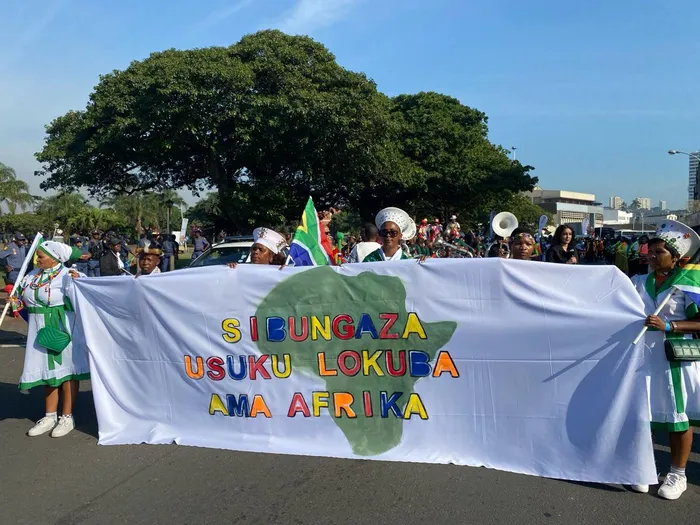
KwaZulu-Natal Premier Thami Ntuli advocates for unity and lawful coexistence during Africa Day celebrations, addressing the challenges posed by undocumented immigration and societal tensions.
Image: Sipho Jack
KwaZulu-Natal Premier Thami Ntuli has called for unity, peaceful coexistence, and respect for immigration laws amid growing concerns over undocumented migrants and rising social tensions in the province.
Ntuli made the remarks during Africa Day celebrations held at the Playhouse in Durban on Monday.
As KwaZulu-Natal grapples with protests and growing public frustration linked to undocumented immigration, Ntuli stressed the importance of embracing a shared African identity while also upholding the rule of law.
“We need to live together without conflicts,” he said. “Breaking the law begins when you move to another country without permission to reside there.”
His comments come amid demonstrations in several parts of South Africa, where communities have raised concerns about the impact of undocumented migrants on jobs, housing, crime, and service delivery.
Ntuli called for constructive dialogue to address the challenges, noting that discussions initiated earlier this year are expected to resume in June in an effort to find lawful and practical solutions.
The Premier also addressed crime and gender-based violence (GBV), urging communities to work together to confront societal challenges.
“As Africans, we are celebrating this day because we must be able to live together,” he said.
Speaking on border security, Ntuli reflected on a recent visit to areas bordering Mozambique and Eswatini, where he observed the complexities facing law enforcement authorities.
He praised government efforts to strengthen border management through technology, including the deployment of drones as part of President Cyril Ramaphosa’s broader security strategy.
Ntuli also argued that local communities play a role in sustaining undocumented immigration by providing accommodation to undocumented individuals.
“We are the ones providing accommodation,” he said, referring to residents who rent out rooms or properties to undocumented migrants.
“Their influx is partly because they know that we will take the little money they have and provide accommodation.”
He urged communities to reconsider such practices and called on leaders to approach protests responsibly, warning that continued unrest could damage KwaZulu-Natal’s reputation as an investment destination.
“We cannot afford to be a province that is constantly seen protesting on the streets,” Ntuli said, adding that stability is critical for economic growth and job creation, especially as unemployment in the province has shown a slight improvement from 32% to 31%.
“It is important to have peace, live together harmoniously, and follow the law in everything we do,” he said.
Meanwhile, Africa Day celebrations in Moruleng in the North West were overshadowed by a boycott from several African ambassadors led by Central African Republic ambassador André Nzapayeke.
The diplomats cited growing fears over the safety of foreign nationals amid increasing anti-immigrant sentiment in South Africa.
“There will be thousands of people attending, and we cannot assure these people that they will be secure,” Nzapayeke said.
President Cyril Ramaphosa has also condemned attacks on foreign nationals, describing them as the actions of “opportunists exploiting legitimate grievances,” while reiterating the need to reject xenophobia, ethnic mobilisation, and intolerance.
DAILY NEWS