

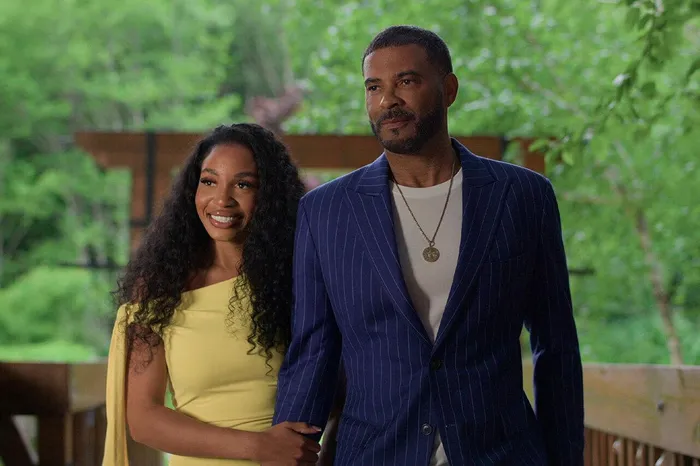
'Age of Attraction' highlights the pressure of modern dating and how quickly things can fall apart. The picture is of Vanelle Fenmou and Jorge Sanchez from the series.
Image: X
I know what you’re thinking: another dating show packed with overfilled lips, glowing tans, and people who say “connection” like it’s a full-time job.
"Age of Attraction" on Netflix walks in looking exactly like that girl.
But give it a second… because this one tries - keyword tries - to be a little deeper and surprisingly, a little more real.
And by “real”, we’re not talking about some fairytale romance with violin music in the background. We’re talking about the kind of real where people are awkward, slightly desperate, and very aware that time and age are not exactly on their side.
The premise? Simple, but chaotic in execution. A group of singles are thrown into a speed dating situation where they connect without knowing each other’s ages.
Hosted by former "Bachelor" star Nick Viall and his wife Natalie Joy, who added a slightly stiff, scripted energy to the whole thing, contestants are expected to form meaningful connections almost immediately.
No pressure, right?
From the jump, it’s giggles, nerves, and that “please let this not be a disaster” energy. And if you hit it off with someone? Off you go to the “Promise Room” - yes, it’s as cheesy as it sounds.
That’s where the big reveal happens: ages are shared, and for some reason, commitment rings are exchanged like we’re already planning the wedding. Whoever signed off on that idea, uhm, yeah, no comment.
Now here’s the thing: the show moves fast. Like, suspiciously fast. You’re telling me people are out here making semi-serious commitments after what feels like two conversations and a shared laugh about favourite snacks?
But apparently, the show leans heavily on the idea that “if you know, you know.” Sure. If you say so.
While viewers might find themselves picking favourite couples (don’t lie, we all do it), it doesn’t take long before things start falling apart. And not in a dramatic, wine-throwing kind of way, more like a slow, awkward realisation that maybe this wasn’t it.
Once couples are flown off, via seaplane, because we’re still pretending this is luxury, to what looks like a mid-budget hotel setup, the real test begins. Cohabitation. And suddenly, the vibe shifts. Fast.
Some couples wasted no time jumping straight into physical intimacy, dressing it up as “deepening their connection,” but let’s call it what it is: urgency mixed with a bit of fantasy. It gave very much “we’re trying to force something meaningful out of a very short timeline.”
And then there’s the elephant in the room: age. The show wants to push this idea that age doesn’t matter. That love transcends numbers. That connection is king. But reality? Reality said, “Let’s not lie to ourselves.”
One of the most talked-about pairings was a 60-year-old man and a 27-year-old woman. And for a moment, it looked like the show might actually prove its own point. There were sparks, emotional conversations, even those “we were meant to meet here” moments. You almost believed it.
But then, just a few days in, which felt like 2 to 3 days, one disagreement was enough to expose the cracks. Suddenly, they weren’t on the same page. Suddenly, life experience, expectations, and yes, age, started to matter. Even if they said it didn't.
Could there have been other reasons? Of course.
And don’t even get me started on some of the younger guys, because wow. The energy was very much giving “I’ve always had a thing for older women, and now I’m living my best life.”
Meanwhile, a few of the older women acted shocked by age, which reveals that, let’s be honest, they weren’t exactly shocking. Ma’am, you knew. And that’s okay. Own it.
What "Age of Attraction" does get right, though, is the discomfort. The silences. The moments where two people are sitting across from each other with absolutely nothing left to say.
No dramatic music can save you there. It’s either painfully quiet, or you can feel the tension through the screen. And those moments? Those feel real.
The kisses, on the other hand, felt … negotiated. Like both parties silently agreed, “we should probably do this now.” There wasn’t that natural, butterflies-in-your-stomach kind of romance. It was more second-hand embarrassment than second date energy.
And maybe that’s the biggest takeaway here. This show doesn’t accidentally reveal something about modern dating; it shouts it.
People are tired. People are searching. And somehow, we’ve landed in a place where finding love on a structured, high-pressure reality show feels like a viable option.
It raises real questions, too. Can you genuinely connect with someone without knowing key parts of their identity? Does age truly not matter, or are we just pretending it doesn’t until things get serious? And how much of attraction is emotional versus physical versus practical?
There’s something a bit sad underneath it all. In a quiet, reflective way. Love feels rare. Connection feels forced. And people are trying, sometimes a little too hard, to make something real out of something clearly manufactured.
As for another season? It’s a no from this side. The concept is interesting, sure. But the execution feels rushed, forced, and at times, unintentionally uncomfortable.
It’s “reality” TV that occasionally hits the mark but mostly reminds you why some things shouldn’t be rushed or televised for a show.
Rating: ** significant flaws but some merit.