

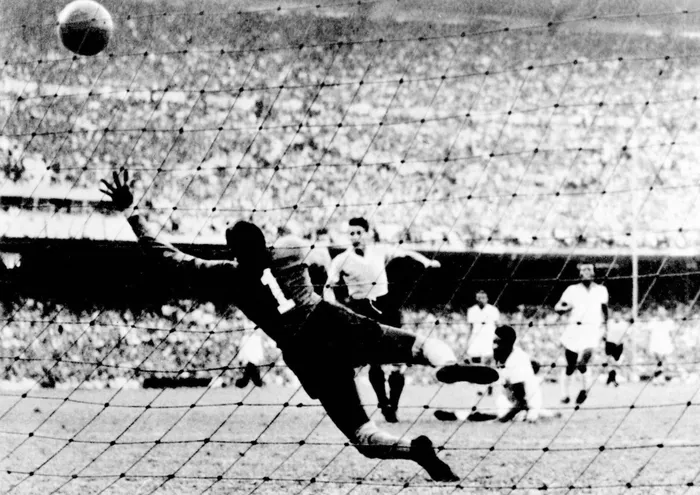
File picture taken on July 16, 1950 at the Maracana stadium in Rio de Janeiro, when Uruguay star Juan Alberto Schiaffino scored against Brazil in the 1950 Fifa World Cup final.
Image: AFP
The world was still healing from the scars of a global conflict when the Fifa World Cup finally returned in 1950, after a 12-year hiatus caused by the Second World War.
Brazil was selected as the host, and the tournament was designed to be a grand celebration of the nation’s footballing obsession — though it ultimately delivered a result that would haunt the country for decades.
While Europe was still in the midst of reconstruction, several nations remained absent. Germany and Japan were banned from participating, while several Eastern Bloc countries withdrew for political reasons.
India also withdrew, citing travel expenses and a lack of practice time — though it was widely rumoured at the time that they declined because they were not permitted to play barefoot.
Scotland also declined their invitation despite qualifying. As a result, only 13 teams took part in the first post-war showpiece.
Brazil used six venues for the tournament, headlined by the colossal Maracanã Stadium in Rio de Janeiro. Built specifically for the event, it remains one of the most iconic cathedrals of football. The stadium was the site of the final-round matches and witnessed the record for the highest attendance in football history — a figure still debated but officially cited at nearly 200,000.
The 1950 tournament was unique as it was the only World Cup in history not to have a single-match final. Instead, the 13 teams were divided into four groups, with the winners of each group progressing to a final round-robin stage.
The team with the most points at the end of this final group would be crowned champions. This format led to a de facto final in the last match between Brazil and Uruguay.
The tournament marked the highly anticipated debut of England. Having long considered themselves the masters of the game, the English had avoided the previous three tournaments.
However, their debut ended in one of the greatest shocks in sporting history. England arrived as heavy favourites but were stunned 1–0 by a United States team composed largely of part-time players and amateurs.
The result was so unbelievable that when the score reached England, many newspapers initially assumed it was a typing error and reported that England had won 10–1.
Brazil and Uruguay were flying, making it comfortably into the second group phase. They would eventually face each other in their final match.
Brazil entered the final match against Uruguay needing only a draw to secure the trophy, while Uruguay required a victory.
What followed is known in footballing lore as the Maracanazo (The Maracana Blow). Brazil took the lead through Friaca, and the massive crowd began celebrating a certain victory. However, Uruguay fought back with goals from Juan Alberto Schiaffino and Alcides Ghiggia to win 2–1. The stadium fell into a deathly silence that allegedly lasted for days.
Uruguay were crowned champions for the second time, and the defeat was felt so deeply in Brazil that the national team famously abandoned their white kit in favour of the now-iconic yellow and blue.
The 1950 World Cup is the reason the Jules Rimet Trophy spent the war years in a shoebox. To prevent the Nazi occupiers from seizing the trophy, Fifa Vice-President Ottorino Barassi hid the gold statuette under his bed in Rome for the duration of the conflict. It survived the war and was safely flown to Brazil to be hoisted by Uruguayan captain Obdulio Varela.