


New research shows youth in African countries lead the world in mental resilience, while wealthier nations struggle with things such as smartphones and processed foods.
Image: Pexels.
A new report has revealed a surprising trend in global mental health: while the world’s youth are facing a growing "mind health crisis", young adults in Sub-Saharan Africa are currently the most mentally resilient on the planet.
The Global Mind Health in 2025 report (previously called the Mental State of the World report), released by Sapien Labs, analysed data from nearly one million people across 84 countries.
Using the Mind Health Quotient (MHQ), a metric that tracks how well we navigate life’s challenges, the study found that while older generations are holding steady, younger people are struggling.
Specifically, 41% of young adults (ages 18-34) now face mental health challenges that substantially impact their ability to function productively in daily life.
In a striking reversal of typical economic trends, wealthier countries are faring the worst. While the global average MHQ score sits at 66/100, the top spots are dominated by African nations.
Ghana ranks 1st globally for youth mind health while Nigeria, Kenya, Zimbabwe and Tanzania round out the top five.
By contrast, countries like the UK, New Zealand and Japan sit at the bottom of the rankings.
In the UK, the average MHQ for young adults is just 20, compared to Ghana’s 69.
While several of its neighbours lead the world, South Africa tells a different story.
The data highlights a massive generational gap within the country. While older South Africans are maintaining relatively strong mental wellbeing, the younger generation is finding the road much tougher.
Adults 55+ hold a solid average MHQ of 98.
Young adults (18-34) score significantly lower at 39.
This puts South African youth at 46 out of 84 countries, performing better than the US and UK, but trailing far behind Ghana or Nigeria.
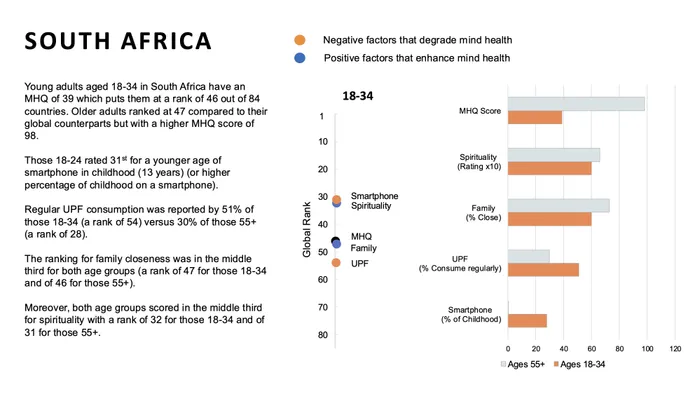
A breakdown of the South Africa's findings.
Image: Supplied.
The report identifies four major levers that are dragging down the mental well-being of Gen Z and millennials.
1. The smartphone era
Gen Z is the first generation to grow up entirely with smartphones. The data shows a direct link: a younger age of first smartphone ownership is associated with increased suicidal thoughts, aggression and other problems in adulthood.
In Finland, the average age for a first phone is 10, while in Tanzania and Uganda, it is 18.
2. Ultra-processed foods (UPF)
What we eat affects how we feel. High UPF consumption is linked to depression and poor emotional control.
"Mind health declines systematically with consumption of these products; after controlling for other factors, they are estimated to contribute 15-30% of the mental health burden," reads the report.
3. Fading family bonds
Strong family ties act as a massive safety net. The report found that "those with poor family relationships are almost four times more likely to have mental health scores in the distressed or struggling ranges".
Currently, these bonds are strongest in Latin American countries like the Dominican Republic and Argentina.
4. The power of spirituality
Spirituality, defined as a connection to a higher power, showed a massive impact on MHQ scores. In the 18-34 age group, those with high spirituality scores typically had MHQ scores 20 points or more higher than those without.
Tanzania currently leads the world in this category.
Dr Tara Thiagarajan, founder and chief scientist of Sapien Labs, warns that simply spending more on therapy isn't enough.
"In the US, spending on mental health research and care has risen dramatically, by billions of dollars... and while important, it’s not moving the needle.
"We need to stop chasing the symptoms and instead begin tackling the broader problems that erode the productivity and well-being of young adults."
The report suggests that by delaying smartphone use, improving diets and fostering social and spiritual connections, countries can begin to reverse this progressive slide and help the next generation find their footing.
David Blanchflower, professor of economics at Dartmouth College, shared that while the report is not the first to connect these influences to mental health challenges, the breadth and depth of the Global Minds data stand out for revealing the scale of the problems they are causing.
"When you see evidence that almost half of all young adults globally, the heart of the workforce, are struggling with an array of mental health challenges, that means we are facing a crisis that can undermine the health of entire economies and societies.
"It’s a clear signal that we need to act to address the root causes."