

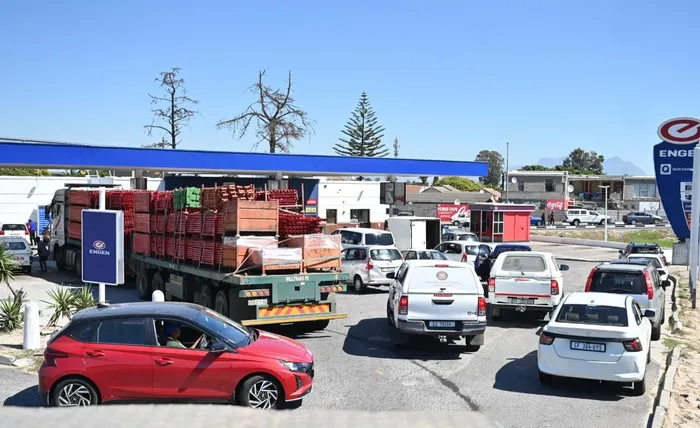
Motorists queue at an Engen petrol station in Kuilsriver as they brace for steep April 2026 fuel hikes, with petrol set to rise by R3.06 per litre and diesel increasing by up to R7.51 per litre, adding fresh pressure on household budgets and transport costs.
Image: Ayanda Ndamande / Independent Newspapers
Based on current local and international factors, the fuel prices for April 2026 will be adjusted significantly, the Department of Mineral and Petroleum Resources has revealed, and in spite of a temporary R3 tax reprieve.
From midnight, motorists will pay the following:
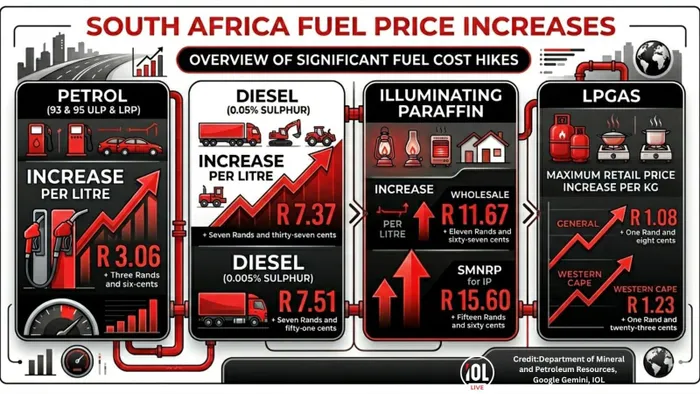
Official fuel price increases from April 1.
Image: IOL
After the price adjustments take effect on Wednesday, April 1, a litre of 95 Unleaded petrol will cost R22.53 at the coast and R23.36 in the inland regions, where 93 Unleaded will cost R23.25. The wholesale price of 50ppm diesel will rise to R25.35 at the coast and R26.11 in Gauteng. Full story here
The maximum Retail Price of LPGas will increase by R1.08per kg, and R1.23 per kg in the Western Cape.
Government is set to slash the fuel levy by as much as R3 per litre in an effort to cushion motorists and businesses from a sharp spike in fuel prices.
The proposed relief measure, announced on Tuesday, is aimed at softening the blow for consumers and limiting the knock-on effects on inflation, particularly in transport and food costs. Treasury said the relief measure, which will cost the government around R6 billion per month, will be re-evaluated on a monthly basis for the following two months.
Month-end unaudited data from the Central Energy Fund (CEF) previously pointed to petrol price increases of between R5.31 for 93 Unleaded and R5.82 for 95 Unleaded. Diesel looked set to increase by between R10.13 in the case of 500ppm and R10.27 for the cleaner 50ppm.
The war in the Middle East has led to a surge in international oil prices, with the cost of Brent Crude surging by around 38% since the previous review period. Brent averaged around $95 per barrel in March, up from $69 the previous month.
While the rand also weakened due to the economic uncertainty caused by the war, oil prices account for the bulk of the aforementioned under-recoveries that will lead to April’s fuel price hikes.
April’s rising fuel costs are expected to ripple through the economy quickly, with transport and logistics sectors feeling the greatest impact. Diesel in particular drives up operating expenses along supply chains, adding pressure on businesses already dealing with sluggish demand.
For everyday shoppers, the effect often manifests in higher prices for essentials like food and household goods, as the cost of moving products increases.
These fuel-driven price pressures also make the inflation picture in South Africa more challenging, potentially limiting the central bank’s room to cut interest rates.
The impact is already filtering through to the agricultural sector, with higher diesel prices, tightening fertiliser supply and increasing strain on export logistics, said BDO South Africa.
“South Africa’s agricultural sector is uniquely exposed to global shocks,” says Sanele Nkosi, Head of Agriculture at BDO South Africa. “Farmers rely heavily on imported inputs such as fertilisers, fuel and machinery, while selling into globally priced markets.”
Since February, instability around key shipping routes near the Strait of Hormuz has pushed up fuel and freight costs, creating a compounding effect across the value chain, BDO noted.
Read more
The South African National Taxi Council (SANTACO) has warned that taxi fare increases may be imminent as operators grapple with fuel shortages, rising diesel costs, and supply constraints across the country.
In a statement, the council said growing uncertainty around projected fuel price increases has already begun to affect daily operations.
Read more
IOL Motoring

April's diesel price increase could hit R10, while petrol hikes will exceed R5.
Image: AI / ChatGPT