

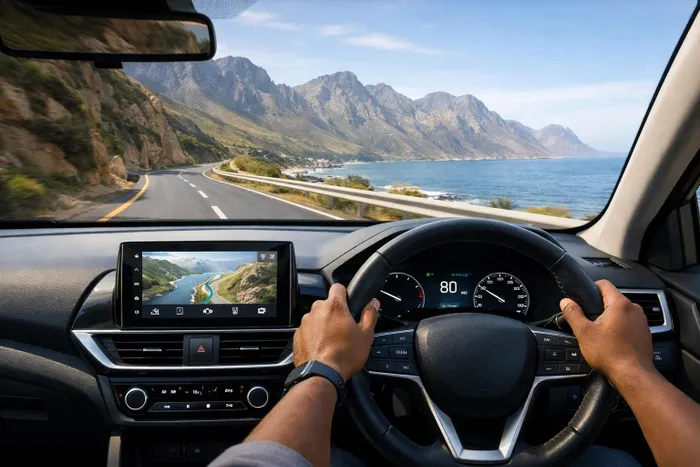
Changing your driving habits can lead to significant fuel savings.
Image: AI / Sora
Following April’s sharp fuel price hikes in South Africa, motorists are once again under pressure as the cost of filling up eats further into household budgets.
With petrol and diesel prices on a continued upward trend, reducing fuel consumption is no longer just a good habit — it’s a financial necessity.
While global oil prices and geopolitical tensions remain beyond motorists’ control, how you drive and maintain your vehicle can make a meaningful difference at the pumps.
“Defensive driving is not just about safety; it’s one of the most effective ways to reduce fuel consumption,” says MasterDrive CEO Eugene Herbert. “Adapting your driving style can cut costs, protect your car and ease the strain on your wallet.”
Here’s how South African drivers can stretch every tank further.
One of the biggest factors influencing fuel consumption is driving behaviour.
Anticipate the road ahead: Looking 10 to 12 seconds ahead allows you to predict traffic flow, avoid unnecessary braking and reduce repeated acceleration.
Keep your speed in check: Speeding doesn’t just increase risk — it significantly raises fuel consumption. Reducing your speed by as little as 20km/h can cut fuel use by up to 20%. On highways, most vehicles are at their most efficient between 100km/h and 120km/h.
Keep it gentle: Studies show that erratic driving can increase fuel consumption by 10% to 40%, while also accelerating wear on brakes and tyres. Smooth, gradual acceleration uses less fuel than hard launches. Rapid acceleration forces the engine to burn more fuel than necessary.
Keep it consistent: Keep gentle but consistent pressure on the throttle when you reach cruising speed, also taking full advantage of your momentum where possible. Constantly varying your throttle — even slightly — increases fuel consumption. Aim for smooth, consistent pedal inputs, especially on long drives.
Change gears efficiently: Smooth and timely gear changes are key. In manual vehicles, keeping revs between 2,500 and 3,000rpm helps maintain optimal efficiency. Many modern automatics already optimise gear shifts, but consistent driving still plays a major role.
Combine trips: Short journeys — especially those under 5km — are fuel-intensive because engines run a richer mixture before reaching optimal temperature. Combining errands into one trip allows your car to run more efficiently for longer.
Avoid traffic where possible: Stop-start driving in heavy congestion can increase fuel consumption by up to 40%. Using navigation apps or carpooling can help reduce time spent idling in traffic.
Reduce excess weight: Carrying unnecessary items in your boot or driving with unused roof racks increases both weight and aerodynamic drag. Even small reductions can add up to noticeable savings over time.
Watch aerodynamics: At higher speeds, open windows and bulky exterior accessories increase drag, forcing the engine to work harder. Keeping windows closed at highway speeds can improve efficiency.
Beyond driving style, your car’s mechanical condition plays a critical role in fuel efficiency.
Check tyre pressures regularly: Under-inflated tyres increase rolling resistance, making the engine work harder and raising fuel consumption. Even a tyre that looks properly inflated may be under pressure, so always use a gauge. Over-inflation, however, can reduce grip and cause uneven wear — stick to manufacturer recommendations.
Keep your engine in top condition: Regular servicing is essential. Worn spark plugs, clogged air filters and dirty fuel injectors can all reduce combustion efficiency and increase fuel use. Sticking to service intervals ensures your engine runs as intended.
Use the correct engine oil: Oil with the wrong viscosity increases internal engine resistance, forcing components to work harder and burn more fuel. Always follow the specifications in your owner’s manual.
Check alignment and balancing: Misaligned or poorly balanced wheels create additional drag and uneven tyre wear, which can marginally increase fuel consumption — especially at highway speeds.
Individually, many of these habits can reduce fuel consumption by 10% to 20%. Combined, they can significantly extend the distance you travel on a tank — potentially meaning fewer trips to the petrol station each month.
As Herbert puts it: “Driving efficiently is not just about saving money. It’s about safer roads, lower emissions and smarter habits that benefit everyone.”
In the face of rising fuel prices, these incremental changes can make a real difference — helping South African motorists stay mobile without breaking the bank.
IOL Motoring