

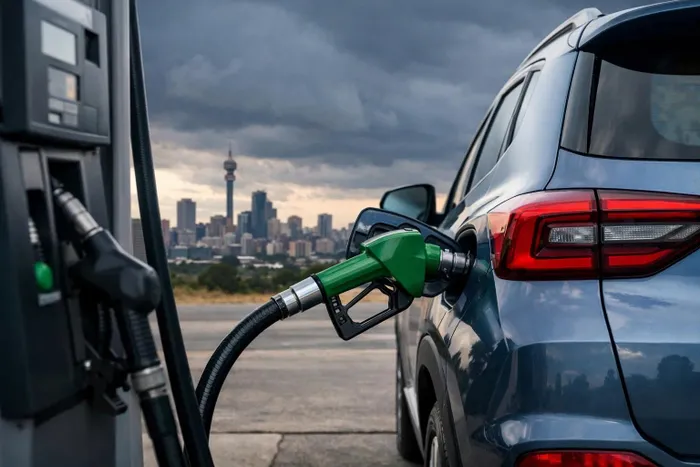
Recent positive developments in the Middle East won't necessarily lead to relief at the pumps in May.
Image: AI / Sora
Following sinister ‘civilisation-ending’ threats made against Iran by US President Donald Trump on Tuesday, the world woke up to a last-minute ceasefire on Wednesday morning, with both sides claiming victory.
Although the two-week truce does not spell a permanent end to the war, at least not yet, with talks set to resume in Pakistan on Friday, international oil prices plunged by as much as 16% on Wednesday morning, trading around the $94 mark as markets digested the news and global stocks rallied in early trade.
It’s a well-known fact that high oil prices have led to a fuel price crisis across the globe, but will this week’s lower Brent Crude costs translate into lower fuel prices in South Africa in early May?
Although it is too early to predict the exact impact on local fuel prices, the current oil price scenario is unlikely to result in significantly lower pump prices next month for a number of reasons.
Firstly, the price of benchmark Brent Crude oil has yet to return to its lows last seen before the beginning of the Middle East war. During the review period that determined South Africa’s March fuel price structure, the last one before April’s record increases, Brent traded at an average of $69, according to the Department of Mineral and Petroleum Resources. As mentioned, it is currently trading around $94, which is nearly identical to its average during the most recent review period that led to April’s price structure. It took time for oil prices to build up to the highs seen during the peak of the war, and not all of that filtered through to April’s fuel prices.
But there is certainly a potential silver lining.
Before the ceasefire, data from South Africa’s Central Energy Fund (CEF) was pointing to a diesel price hike of around R10 in May, and petrol increases of between R2 and R4. Although these early-month oil prices will still filter through to next month’s price adjustment, the under-recoveries are likely to be neutralised to a large degree if oil stays at $94 or lower.
What this means, in plain English, is that we’re likely to see modest rather than significant price adjustments in May, bearing in mind that it’s too early to make any definitive predictions.
The best-case scenario, however, is that oil continues to retreat on positive news from the truce talks, and a little relief could be on the cards, particularly in the case of diesel.
The biggest impact is likely to be felt in June, however, and here it’s a case of everything to play for. If the peace talks are not a success and the war resumes, the critical Strait of Hormuz passage is likely to be blocked once again, sending oil prices surging past $100 and resulting in a continuation of the global fuel price crisis.
The flipside is a permanent end to the war, which would presumably lead to lower oil prices and a reversal of the punishing fuel price increases that have brought the world to its knees.
Yet it remains to be seen whether oil will return to its pre-war lows any time soon.
"Even with a peace deal, Iran may be emboldened to threaten the Strait of Hormuz more frequently in the future, and the market will price in heightened risk to the Strait of Hormuz going forward," MST Marquee analyst Saul Kavonic told Reuters.
Commonwealth Bank analyst Vivek Dhar said there was still scope for a significant geopolitical premium being entrenched for the foreseeable future, based on the details of the comprehensive peace agreement.
"It's a good start and could pave the way to a more permanent reopening - but lots of ifs still to work out," IG analyst Tony Sycamore added.
However, Patrick De Haan, head of petroleum analysis at GasBuddy, said the ceasefire hasn’t really clarified anything when it comes to the Strait of Hormuz.
There's also the not-so-small matter of the South African Treasury's R3 temporary tax reprieve that was announced ahead of April's fuel price hike. Without this, South Africans would have seen a R6.06 per litre petrol price increase this month and a R10.37 to R10.51 diesel price hike.
Although the government has indicated it may be extended by a month, at some point in time, this fiscus-funded reprieve of R3 will have to be worked back into South Africa's fuel price structure, and this could potentially lead to significant fuel price increases if international oil prices have not subsided sufficiently to counteract it.
IOL Motoring