

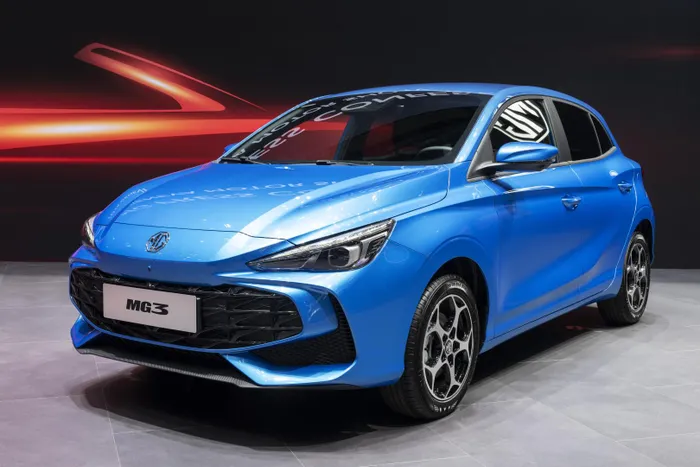
The new MG3 is offered in two variants: a petrol engine with either a five-speed manual gearbox or a continuously variable transmission (CVT) and a Hybrid+.
Image: Supplied
MG Motors dipped its toes into the South African waters again in January this year with the petrol-driven ZS and HS SUVs, complemented by the fully electric, low-slung Cyberster.
MG will officially start reporting monthly sales figures from September, but for now, they say they have sold just under 2,000 units in the past six months and grown their dealer network to 44, with another six scheduled to open before the end of the year.
To widen the net, the company has now added the all-new MG3, marking the local debut of its third-generation best-selling compact hatchback.
Yes, you read it correctly; the MG3 is a fully-fledged hatchback and not another SUV from the Chinese owned brand.
The MG3 is offered in two variants: a petrol engine with either a five speed manual gearbox or a continuously variable transmission (CVT) and a Hybrid+, the first conventional, non-plug-in hybrid system fitted to an MG model.
There are two grade options: Comfort and Luxury, with the Hybrid+ offered only in Luxury guise.
Exterior
MG says it’s a torpedo-inspired silhouette anchored by a striking "sharkline" front profile with Projector LED headlamps (on the Luxury model) and LED DRLs.
They’ve incorporated some of the Cyberster design language, including its “bubble butt” rear profile.
It stands on 16-inch alloys, and in St. Moritz Blue, it’s a fine-looking car while the Hamstead Grey we also had on the launch drive tends to camouflage the lines.
Flare Red, Morning Yellow, York White, Blade Silver and Pearl Black wrap up the rest of the colour palette.
Interior
Inside the MG3, it’s a neat and well thought out cabin with soft-touch finishes on the dashboard and door cards, raised stitching and brushed metal accents providing a quality look and feel.
Behind the square top and bottom multi-function steering wheel, there’s a seven-inch digital driver display, and in the centre of the dash, the 10.25-inch touchscreen infotainment system is wired Apple CarPlay and Android Auto compatible.
During the launch drive, our phones paired seamlessly, and initially we struggled to figure it out but once we had, it was easy enough to operate.
We needed to get to the Advanced Driver Assistance System (ADAS) programmes because they’re unnecessarily sensitive, and the warning signals were becoming irritating.
They do, however, revert to the default settings once the car is switched off.
There’s a lack of physical buttons, so temperature control and everything else are buried in various menus, which proved to be a somewhat frustrating experience.
Boot capacity is 293 litres, which was ample to store two overnight bags and laptop bags, and with the rear seats folded, there is a total of 983 litres.
Standard across the range are follow-me-home headlights, single zone automatic climate control, electric mirrors and windows, tilt-adjustable steering, tyre pressure monitor system and cruise control.
Luxury Grade models receive simulated leather upholstery, a six-speaker sound system (over the Comfort’s four-speaker system), a 60/40 split rear seat, vents for the rear passengers, keyless entry, adaptive cruise control and a 360-degree camera.
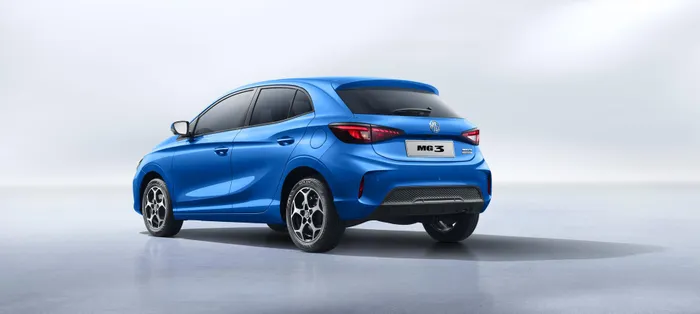
The petrol variant of the MG3 is a naturally aspirated 1.5-litre four-cylinder engine, delivering 81kW and 142Nm.
Image: Supplied
Engines
The two powertrains of the MG3 could not be any more different.
The petrol variant is a naturally aspirated 1.5-litre four-cylinder engine, delivering 81kW and 142Nm.
It’s paired to either a manual five-speed gearbox or a CVT, and during our launch drive in the Western Cape, we clocked consumption figures of 6.0l/100km.
For what it’s worth, MG claims acceleration from 0 to 100km/h for the manual derivative in 10.8 seconds.
The Hybrid+ powertrain with a 1.83kWh battery, 1.5-litre Atkinson-cycle 75kW petrol engine and 100kW electric motor produces a combined power output of 155kW and 425Nm.
It does away with the CVT and is instead fitted with a three speed automatic transmission.
It has automatically selected separate generator motors that switch between various modes dependent on the battery level.
The EV mode allows the vehicle to run purely on electric power for as long as the battery charge lasts.
In Series mode, the engine powers a generator, which in turn drives the electric motor.
Series + Charge mode functions in the same way but, also tops up the battery when the engine is under low load.
In Drive + Charge mode, the engine directly powers the wheels while simultaneously charging the battery through the generator.
Finally, in Parallel mode, both the engine and the electric motor work together to drive the wheels.
According to MG, it will get from 0-100km/h in eight seconds and from 80-120km/h in five seconds.
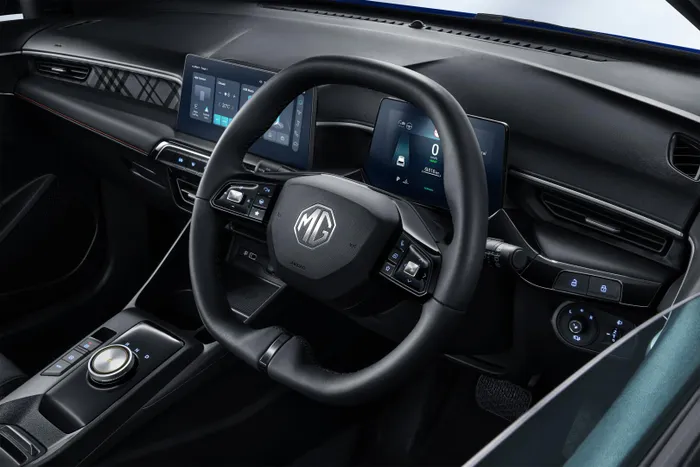
Inside the MG3, it’s a neat and well-thought-out cabin with soft-touch finishes on the dashboard and door cards.
Image: Supplied
Driving
We first drove the Hybrid+ and it proved to be a well balanced and comfortable driving experience.
With its hybrid powertrain, there’s a definite EV quality about it, and playing around with various throttle levels, it seamlessly switched between the different modes, even managing to get it close to 100km/h using only the battery.
It handled the twisty bits of the route with aplomb with the chassis, suspension and steering combining well to provide a decent overall driving experience.
Despite the oddity of a three-speed gearbox, it didn’t hamper the acceleration, and it felt perfectly calibrated, providing a refined drive.
With some spirited driving, consumption stood at 4.5L/100km before we stepped into the CVT Luxury.
It provided a completely different experience, and while the engine is keen to rev, it’s let down by the CVT despite having a step function designed to imitate shifts.
In normal city and highway driving, it’s acceptable, but once you accelerate hard to pass slower traffic, the engine revs higher, and it takes an age for the CVT to respond and increase the car’s speed.
This was even more so when we drove up Franschhoek Pass where we played around with hard braking, cornering and attempting fast exits with acceleration response long after we had exited the corner.
I suspect the entry level manual would be a better option if improved driving dynamics are something you’re after.
In a cluttered B-segment, there’s no harm with MG offering another option, and it will be interesting to see how consumers react, considering the range of alternatives that include Suzuki, Mazda, Chery, VW and Toyota.
It comes with a seven-year/200,000km warranty and a three-year/45,000km service plan.
Pricing: