

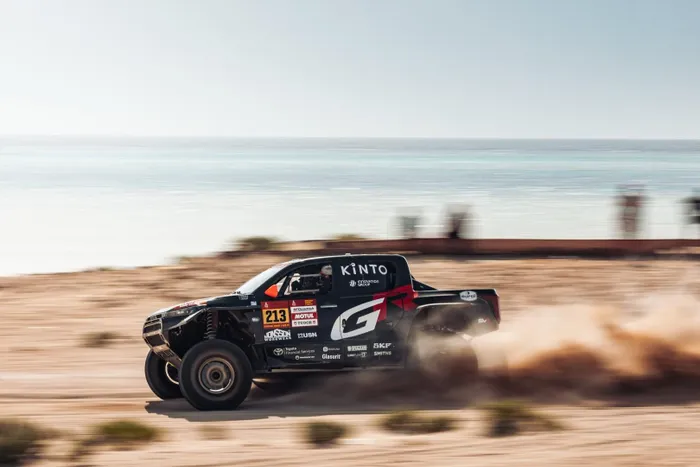
Toyota Gazoo Racing South Africa (TGRSA) arrived back home from the Dakar Rally with a mix of fatigue, relief and reflection.
Image: Supplied
Toyota Gazoo Racing South Africa (TGRSA) arrived back home from the Dakar Rally with a mix of fatigue, relief and reflection. This year’s event was demanding even by the race’s own standards, and while they may not have a winner’s medal, the team's overall performance tells a story.
After more than 7,000 kilometres across Saudi Arabia, this year’s Dakar was one of the toughest. The pace was relentless, the competition fiercer than ever, and the attrition rate underlined just how hard it has become.
“This is an incredibly difficult race to finish,” said Glenn Crompton, Vice-President of Marketing at Toyota South Africa Motors. “When you look beyond the final results and study the performance day by day, waypoint by waypoint, we were consistently at the front of the race.”
Strong pace, costly punctures
TGRSA arrived with a clear strategy to survive the opening stages and position all three cars for the second half of the rally. In terms of speed and reliability, that objective was largely achieved. The GR Hilux IMT EVO ran competitively throughout the event and remained mechanically strong.
What ultimately shaped the team’s Dakar was tyre damage. Across the rally, the team had close to 36 punctures - time losses that were impossible to recover in an event now decided by seconds rather than minutes.
“Unfortunately, punctures were the one element we couldn’t control, and that clouded the overall picture,” Crompton said. “But this was a very strong Dakar for us as a team.”
Faster, harder
The evolution of Dakar into a near flat-out sprint has placed huge demands on both cars and crews. High-speed stages over rocky terrain left little margin for error, yet the Hilux again proved durable.
The fact that all three cars made it to the finish remains significant. It also reinforced the depth of preparation behind the scenes, where reliability is built long before the start.
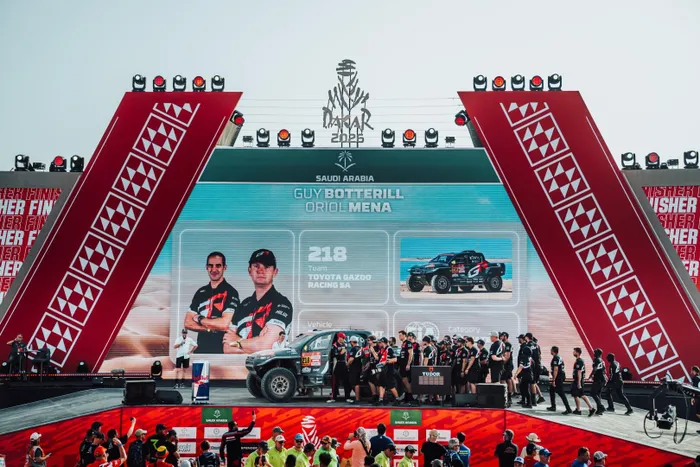
All three Toyota Hilux bakkies finished the race.
Image: Supplied
Stage win
The standout moment came from Saood Variawa and co-driver Francois Cazalet, who claimed a hard-fought Stage 8 victory. Starting deep in the field, they pushed through dust, traffic and changing conditions to take the win by just a few seconds.
Variawa went on to finish as the top-placed South African driver at Dakar 2026, a result that reflected his maturity, consistency and speed across the two weeks.
Resilience
Guy Botterill and navigator Oriol Mena endured a tough time of it. Early issues, including a damaged hydraulic jack and a stage completed without power steering, cost them valuable time, but they continued to push and recover ground where possible.
João Ferreira and Filipe Palmeiro showed flashes of podium-contending pace, particularly on the early dune stages. Tyre damage and time spent nursing the car home ultimately defined their Dakar, but the underlying speed was evident.
Behind the scenes
Dakar 2026 again highlighted the human effort that keeps the TDRSA team running. Mechanics, engineers and support staff worked through the night to ensure all three cars reached the start line each morning.
“For us, it’s about development - not just of cars, but of people,” Crompton explained. “Drivers, navigators, mechanics, engineers - everyone grows through this process. That’s why we do Dakar. The results matter, but how you achieve them matters more.”
Team Principal Shameer Variawa praised the collective effort behind the scenes and the robustness of the GR Hilux across the event, noting that the cars had largely run trouble-free despite the harsh conditions.
“The pace has been good, and we didn’t have many mechanical problems, which shows the work the team put in,” he said.
Pride over podiums
As the team looks ahead to the rest of the 2026 season and the longer road to Dakar 2027, the overriding emotion is pride rather than disappointment.
“There’s a huge amount of sacrifice involved,” Crompton concluded. “When you see what this team puts in - the professionalism, the passion, the resilience - you realise that every single person can take pride in what was achieved. That, more than any trophy, is what this journey is really about.”